

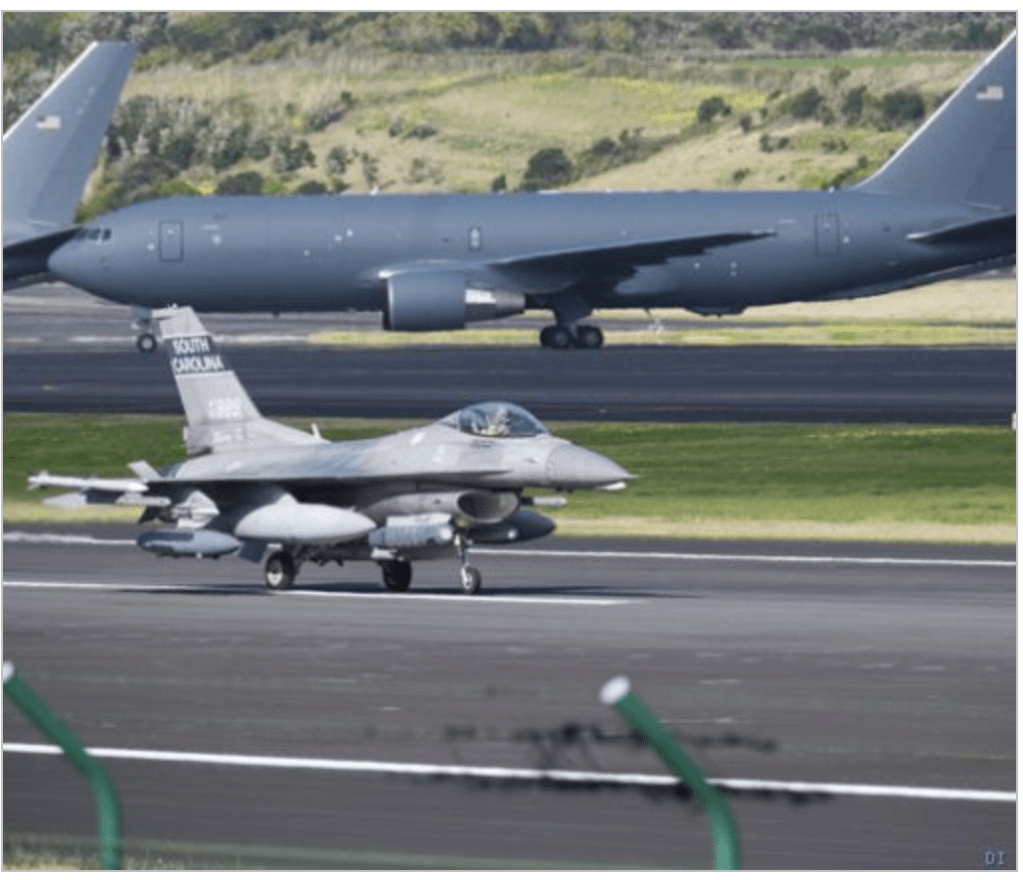
A U.S. military contingent comprising refueling tankers, fighter jets, transport aircraft, and support personnel has been stationed on Terceira Island since early this week, marking a significant uptick in activity at Lajes Air Base in the Azores.
At least 12 KC-46 refueling aircraft are currently positioned at Lajes, departing regularly on missions whose details remain undisclosed. In recent days, observers have also reported the presence of F-16V “Viper” fighter jets—also known as Block 70/72 models, the most advanced variant in the F-16 family—as well as F-35 stealth fighters, among the most sophisticated aircraft in the U.S. arsenal. Publicly available tracking data further indicates movement of military cargo planes through the base.
According to sources consulted by this newspaper, the apparent destination for both the cargo aircraft and fighter jets is the Middle East, possibly with a stopover in Jordan. However, that information has not been officially confirmed.
Command-and-control systems have also reportedly been deployed to Lajes, potentially enabling operational coordination from Terceira Island itself. According to information gathered, these capabilities could include offensive operations, though no official statements have clarified the scope of the deployment.
Logistical support for the operation is being provided by approximately 400 U.S. service members. Some have been housed in local hotels on Terceira. Most of the personnel arrived directly from the United States, while others were reassigned from U.S. European Command headquarters in Germany.
Unconfirmed reports circulating locally suggest that the renewed activation of Lajes may be linked to political difficulties in Spain concerning the use of Spanish bases for U.S. air operations. As of press time, Portugal’s national government had not issued an official statement regarding the presence or use of this American military force on Terceira Island.
What’s at Stake?
The last significant presence of U.S. refueling aircraft at Lajes occurred prior to the June 22, 2025, U.S. strike on Iranian nuclear facilities. In that operation, two B-2 Spirit stealth bombers were reportedly refueled multiple times from the Azores before carrying out their mission.
Portuguese commentators have noted similarities between the current movements in the Azores and those that preceded the June 2025 strike, raising the possibility that another deployment may be underway.
Meanwhile, ongoing negotiations between the United States and Iran over Tehran’s nuclear program appear increasingly strained. Recent statements from the U.S. administration have taken a firmer tone, and allied forces have reportedly reinforced their presence in the Middle East, according to international media accounts.
Underlying this strategic pressure is Israel’s longstanding opposition to Iran developing or acquiring nuclear capabilities—whether for military or civilian purposes. That issue remains at the center of one of today’s most volatile geopolitical flashpoints, where diplomacy and deterrence continue to collide.
In Diário Insular, José Lourenço-director
Translated into English as a community outreach program by the Portuguese Beyond Borders Institute (PBBI) and the Modern and Classical Languages and Literatures Department (MCLL), in collaboration with Bruma Publication and ADMA (Azores-Diaspora Media Alliance) at California State University, Fresno. PBBI thanks Luso Financial for sponsoring NOVIDADES.

 Novidades - The Islands and the Diaspora