

By Rafael Cota
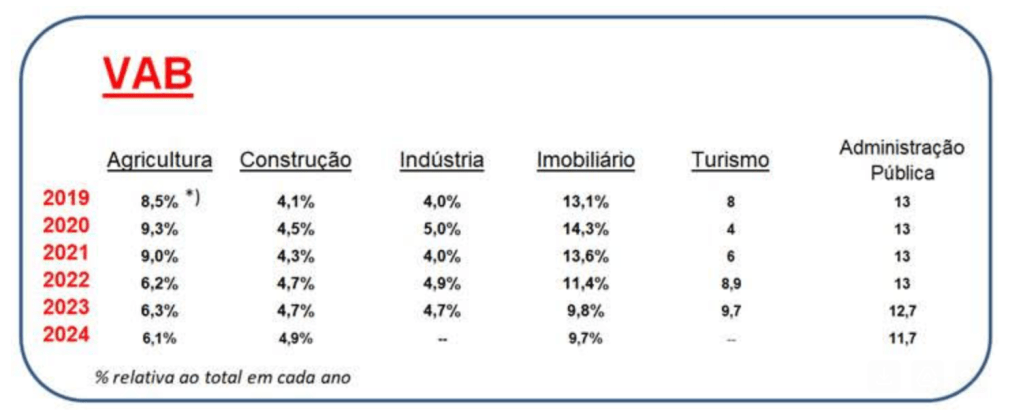
According to newly released data from Instituto Nacional de Estatística (INE), agriculture’s share of the Azorean economy declined again in 2024, accounting for 6.1% of regional GDP—down sharply from 9.3% just four years earlier, in 2020. The numbers point to a structural shift underway in the Atlantic archipelago, where traditional pillars are giving ground to new economic drivers.
Real estate activity has also weakened, while construction and industry remain modest and uneven, rising one year only to retreat the next. The largest share of Gross Value Added (GVA) continues to come from Public Administration—an enduring stabilizer in the regional economy—now joined by a fast-growing tourism sector that is reshaping the economic landscape.
Tourism’s Ascent
Tourism has posted significant gains in guest arrivals and overnight stays, with spillover benefits extending to restaurants, leisure services, and small businesses across the islands. The most recent confirmed figure, for 2023, placed tourism’s contribution to GDP at 9.75%. Regional government projections, cited by the Secretary for the Economy, suggest that figure could reach as high as 20% by 2025.
Such growth, however, is accompanied by caution. Within the business community, concern persists over tourism’s volatility. The sector depends heavily on air connectivity and is vulnerable to global competition from lower-cost destinations. A shift in airline routes, fuel prices, or geopolitical stability can quickly alter demand.
Even so, without the benefit of final 2024 data, it is already clear that tourism is currently one of the most dynamic forces in the Azorean economy—generating jobs and encouraging new entrepreneurial initiatives.
Policymakers are also exploring more decentralized strategies, particularly in air operations, to distribute visitor flows more evenly among the islands. A broader spread of arrivals could reduce pressure on high-traffic destinations while stimulating growth in less-visited communities.
Growth Above the National and European Average
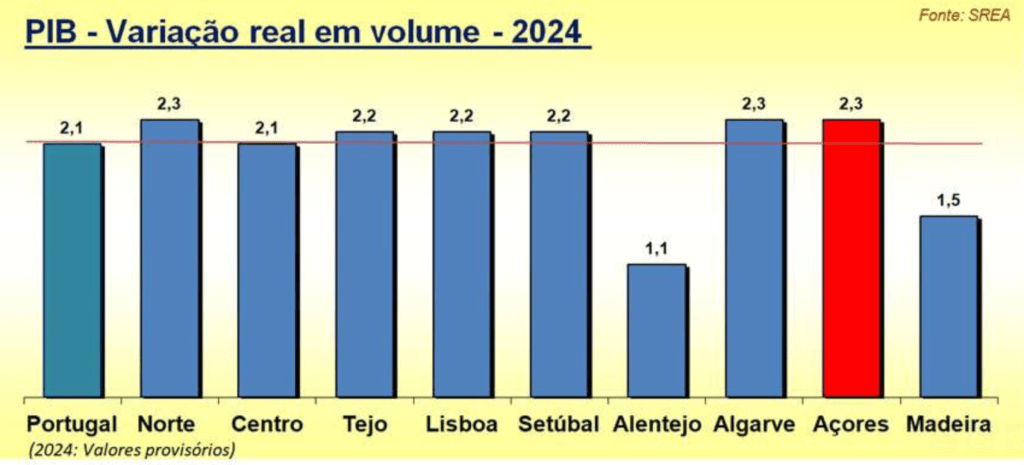
Despite challenges in certain sectors, provisional Regional Accounts indicate that in 2024 the Azorean GDP grew by 2.3% in real terms compared to the previous year—0.2 percentage points higher than Portugal’s national growth rate of 2.1%. The region also outperformed both the Norte and Algarve regions.
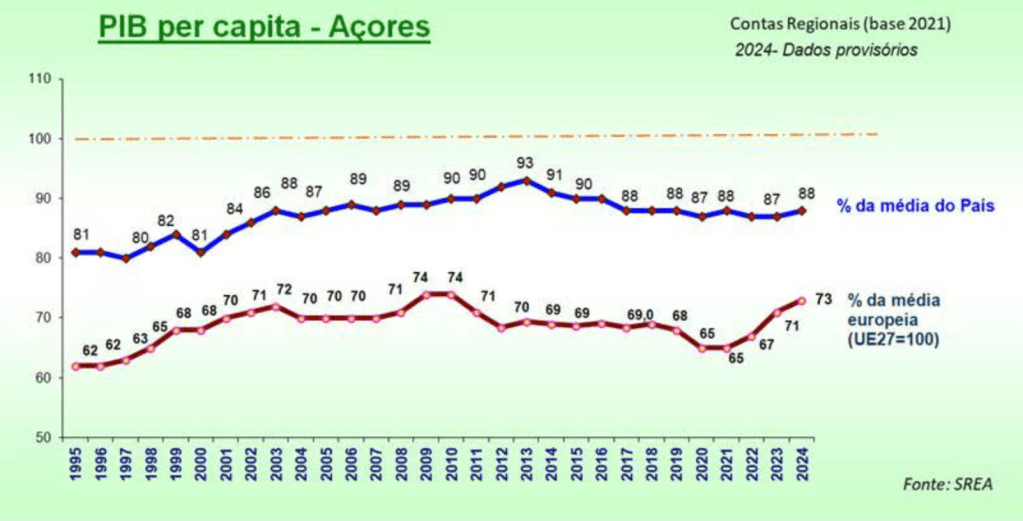
This positive performance has brought the Azores’ GDP closer to the national average, now standing at 88% of Portugal’s benchmark—a level previously reached but now reaffirmed. More strikingly, the region has narrowed the gap with Europe as a whole, reaching 73% of the European Union average.
That relative progress was aided in part by subdued growth across the continent. According to Eurostat, annual projections for 2025 estimate growth of just 1.5% in the eurozone and 1.6% across the EU.
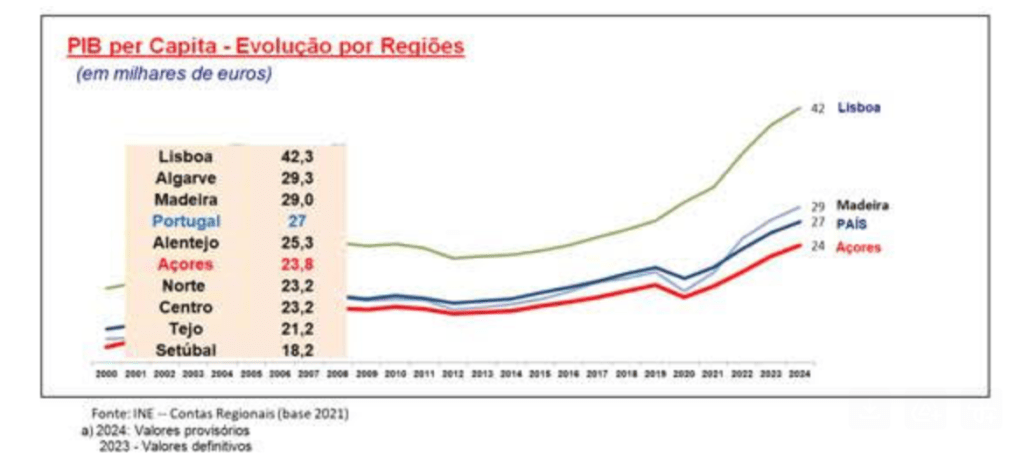
Yet the broader picture remains mixed. Although 2024 delivered favorable GDP growth, the Azores still lag behind the national average in per capita GDP. The region trails Lisbon, the Algarve, Madeira, and Alentejo, though it remains ahead of Norte, Centro, and Tejo and Setúbal.
A Delicate Balance
The data sketch an economy in transition. Agriculture—long a defining feature of Azorean identity and production—no longer commands the weight it once did. Tourism surges forward, dynamic but fragile. Public Administration provides ballast. Construction and industry search for stability.
The Atlantic islands have always balanced tradition with adaptation. Today, the numbers suggest that adaptation is accelerating. The question facing the Azores is not merely how fast the economy is growing, but how resilient—and how diversified—it will prove to be in the years ahead.
Rafael Cota, Jornalista.
Translated into English as a community outreach program by the Portuguese Beyond Borders Institute (PBBI) and the Modern and Classical Languages and Literatures Department (MCLL), in collaboration with Bruma Publication and ADMA (Azores-Diaspora Media Alliance) at California State University, Fresno. PBBI thanks Luso Financial for sponsoring NOVIDADES.

 Novidades - The Islands and the Diaspora