


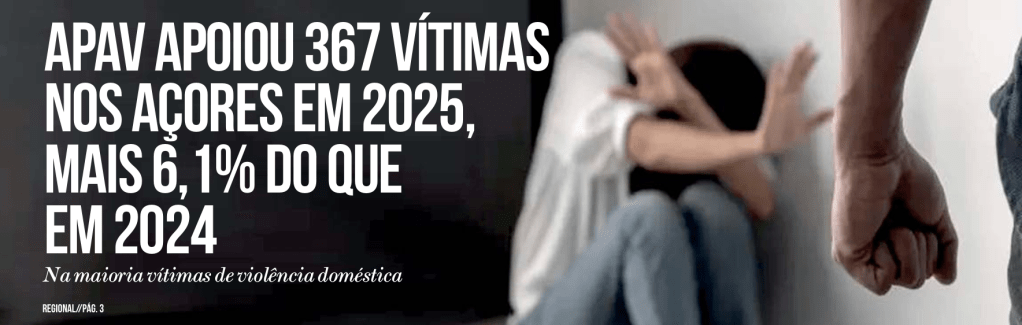
In 2025, the Associação Portuguesa de Apoio à Vítima (APAV) provided direct assistance to 18,549 victims nationwide, handling a total of 111,854 support contacts and registering 35,341 crimes and other forms of violence. Of those victims, 367 were recorded in the Autonomous Region of the Azores—an increase of 6.1% compared to 2024.
The figures were released in observance of the European Day for Victims of Crime, marked annually on February 22. The national statistics reflect support processes carried out in person, by phone, and via email over the course of the past year.
Compared to 2024, the data show an 11.5% increase in the number of victims assisted, a 5.8% rise in total support contacts, and a 13.1% increase in reported crimes. Since 2020, the number of victims supported by APAV has surged by 41.7%, underscoring a troubling upward trend.
On average, APAV assisted 357 victims per week in 2025. Among them were 199 adult women, 39 elderly individuals, 76 children, and 43 adult men. Of the victims supported, 57% formally filed complaints with judicial or law enforcement authorities.
Domestic Violence Dominates
Domestic violence remains, by far, the most prevalent crime. Of the more than 35,300 crimes recorded, 26,124—73.9%—were related to domestic abuse.
Other significant categories included:
- 1,076 cases involving the online sharing of child sexual abuse content
- 889 cases of physical assault
- 864 cases of child sexual abuse
- 856 cases of threats or coercion
- 662 cases of defamation or insult
- 576 cases of discrimination and incitement to hatred or violence
- 539 cases of fraud
- 239 cases of stalking
- 232 cases of rape involving adult victims
The Profile of Victims
The overall profile of victims supported by APAV remains predominantly female (75.5%), with an average age of 37. In most cases, the aggressor had a close relationship with the victim—most frequently a spouse (14.6%) or a parent (13%).
Among elderly victims, 75.7% were women, with an average age of 76. In these cases, the aggressor was most often a son or daughter (35.1%) or a spouse (22.3%). This group sought help primarily for domestic violence (81.2%).
For younger victims, the average age was just 10 years old, and 58.1% were girls. In these cases, the aggressor was typically a parent (42.6%) or a step-parent (7.7%). The majority were victims of domestic violence (60.4%) or child sexual abuse content-related crimes (14.5%).
In 2025, APAV also assisted adult male victims, whose average age was 48. The most common crimes in this group were domestic violence (65.5%) and physical assault (6.9%), with aggressors often being a spouse (12.7%) or a child (9.7%).
Among adult women, the average age was 45. Domestic violence accounted for 85.8% of cases, followed by threats or coercion (2.4%). The aggressor was most frequently a spouse (20%) or former partner (14.2%).
Nearly half of all crimes—49.6%—occurred in the shared residence of victim and aggressor. Another 14.4% took place in the victim’s own home, and 9.6% occurred in public spaces.
A Persistent Reality
The data reveal a stark and sobering pattern: violence remains overwhelmingly intimate, often unfolding within family structures and behind closed doors. While the rise in reported cases may partly reflect increased awareness and willingness to seek help, the persistence of domestic violence—particularly against women, children, and the elderly—remains deeply concerning.
For the Azores, where 367 victims sought assistance in 2025, the numbers represent more than statistics. They reflect lives interrupted, families fractured, and a continued need for vigilance, support systems, and sustained public awareness.
As Portugal marks the European Day for Victims of Crime, the figures from APAV serve as both testimony and warning: support services are expanding, but so too is the demand for them.
From Diário dos Açores-Paulo Viveiros-director
Translated into English as a community outreach program by the Portuguese Beyond Borders Institute (PBBI) and the Modern and Classical Languages and Literatures Department (MCLL), in collaboration with Bruma Publication and ADMA (Azores-Diaspora Media Alliance) at California State University, Fresno. PBBI thanks Luso Financial for sponsoring NOVIDADES.

 Novidades - The Islands and the Diaspora