

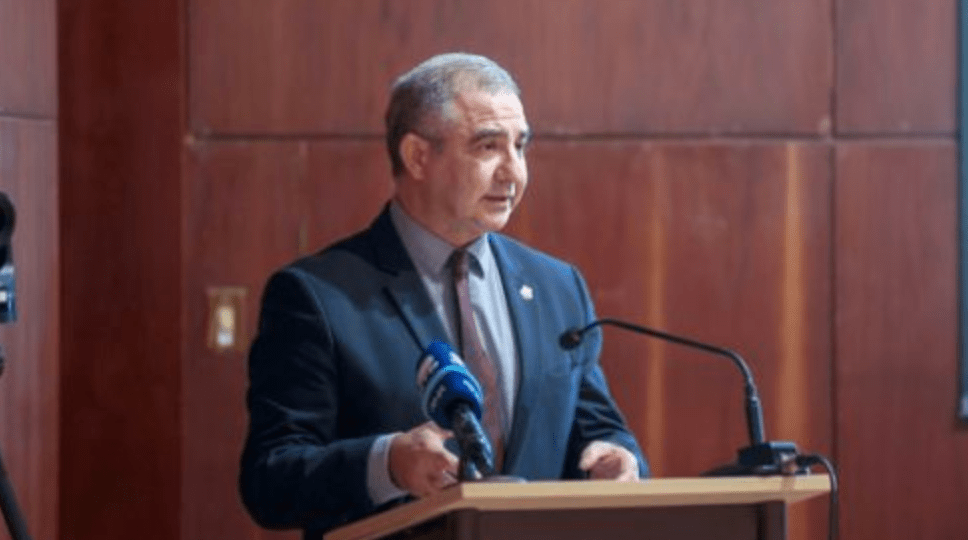
The president of the Azores’ Regional Government, José Manuel Bolieiro, delivered a forceful rebuke of Portugal’s central authorities this week, accusing the state of being “ungrateful” to the autonomous regions and of clinging to a “centralist” and even “colonialist” mindset in its approach to regional finances.
Speaking Thursday night in Ponta Delgada at the closing session of a conference marking “50 Years of Autonomy in the Communities,” Bolieiro framed the debate not as a partisan dispute, but as a structural tension embedded in the country’s political culture.
“We constantly need to fight the centralists,” he said. “And centralists have no party color and no geography. They exist in every political party and in every place.”
His remarks came one day after Portugal’s Parliament voted on proposed changes to the Social Mobility Subsidy (SSM), a program designed to offset the high cost of travel between the islands and mainland Portugal. The proposals passed despite opposition from the Social Democratic Party (PSD) and the CDS-PP at the national level.
Bolieiro argued that the Azores must continue confronting what he described as Lisbon’s instinct for control.
“It must be denounced,” he said. “In a democracy, we have the right — and the duty — to denounce, to affirm our convictions and defend our understanding. Our understanding is democratic, autonomous, and rooted in decentralization.”
A Clash Over the Regional Finance Law
The Azorean leader extended his criticism to the Republic’s interpretation of the Regional Finance Law, which governs fiscal relations between Lisbon and the autonomous regions.
“The country is ungrateful when it debates, in an atavistic, manipulative and coercive way, a financial regime that is meant to collaborate in the development of the entire national territory,” Bolieiro said. “It has never even weighed the tribute it owes to those who provide it with strategic and geopolitical value.”
He took issue with what he described as the prevailing narrative in Lisbon — that mainland Portugal is generously subsidizing the islands.
“The message continues to be: ‘We’re giving you a great deal in solidarity, and you must manage the little we give you,’” he said. “That is not fair. It’s a centralist, colonialist understanding — one that belongs to the last century.”
Bolieiro insisted that the Azores have not fully benefited from their geostrategic importance in the Atlantic and emphasized that it is the Azores and Madeira that give Portugal its “Atlantic projection” — its maritime and geopolitical reach beyond continental Europe.
Social Mobility Subsidy: Satisfaction and Friction
Earlier in the day, speaking to reporters about the parliamentary vote on changes to the Social Mobility Subsidy, Bolieiro expressed satisfaction that a legislative proposal originating with the Azorean government had been approved.
“We took the initiative,” he said. “The Government of the Azores submitted a draft proposal to our Regional Legislative Assembly, which unanimously approved it and forwarded it to the Assembly of the Republic. It passed. I can only be satisfied.”
Among other measures, the changes aim to revoke the requirement that beneficiaries demonstrate up-to-date tax and social security contributions in order to receive the subsidy — a condition critics argued unfairly penalized struggling residents.
Asked about the position of the national PSD parliamentary caucus, Bolieiro acknowledged that it had shown “coherence and solidarity” with the Republic’s government, which it supports. Still, he characterized the outcome as “not appropriate and unjust” with respect to Azorean interests.
The regional president and leader of the PSD/Azores said he had instructed Social Democratic deputies elected by the islands to vote in favor of the Azorean government’s proposal “regardless of any requirement of party discipline.”
When pressed about remarks by Miguel Albuquerque, head of the PSD in Madeira, who suggested that Madeira’s Social Democratic deputies might declare themselves independent after being barred from intervening in the parliamentary debate, Bolieiro struck a more measured tone.
“I deal in facts, not threats,” he said. “I understand my colleague’s statements. I will always, obviously, stand in solidarity in defense of the interests of islanders.”
Bolieiro’s remarks underscore a tension that has shadowed Portuguese democracy since the 1974 Revolution and the subsequent establishment of regional autonomy: how to balance national cohesion with meaningful decentralization. Fifty years after autonomy was enshrined, the debate is no longer about whether the islands should govern themselves — but how much trust, and how many resources, Lisbon is truly prepared to concede.
In Diário Insular — José Lourenço, director.
Translated into English as a community outreach program by the Portuguese Beyond Borders Institute (PBBI) and the Modern and Classical Languages and Literatures Department (MCLL), in collaboration with Bruma Publication and ADMA (Azores-Diaspora Media Alliance) at California State University, Fresno. PBBI thanks Luso Financial for sponsoring NOVIDADES.

 Novidades - The Islands and the Diaspora