

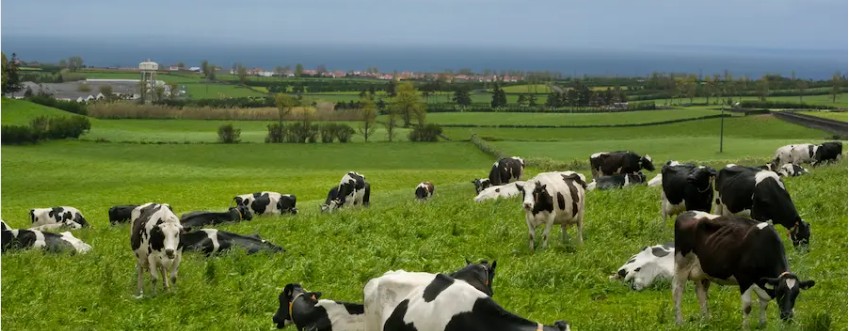
Agriculture continues to power the economy of the Azores, far exceeding local consumption needs and standing as a leading export engine, according to a statement released by the Regional Government.
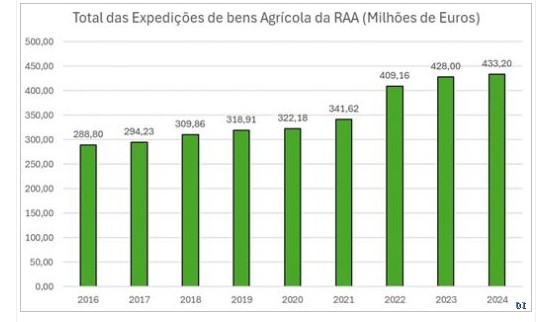
Recent data from the Azores Regional Statistics Service (SREA) show that in 2024 the Region shipped €433.2 million in agricultural goods, with the dairy sector overwhelmingly dominant, accounting for €381.4 million of that total.
The impact extends well beyond raw export figures. When factoring in Gross Value Added (GVA) from processing and trade, agriculture represents 5.79 percent of the Region’s total GVA. The dairy industry alone recorded €533 million in revenue in 2024 — roughly a quarter of Portugal’s entire national dairy industry output.
That performance, according to the statement attributed to Regional Secretary António Ventura, is the result of sustained modernization efforts. Between 1995 and 2024, €969 million was invested in upgrading agricultural operations across the archipelago.
Sovereignty and Social Cohesion
Beyond the numbers, the government argues, agriculture serves as a cornerstone of territorial occupation and social stability.
In an archipelago where 60 percent of the landmass is dedicated to farming, agriculture provides the primary source of income for 14,713 Azoreans. On the smaller islands in particular — where alternatives outside public employment are limited — farming acts as a bulwark against depopulation and a guarantor of community sustainability.
“On the smaller islands, where job opportunities beyond the public sector are scarce, the land is what prevents population decline and ensures the survival of local communities,” Ventura said.
Despite global trends toward service-sector expansion, the Azores continue to view their primary sector as a strategic reserve of food sovereignty. Producing locally is not merely a matter of cultural tradition, the statement notes; it is a safeguard of autonomy and security in the face of volatile international markets.
Still, significant challenges remain. Farmers’ incomes are constrained by the archipelago’s ultraperipheral status, high logistics costs, and demanding soil and climate conditions. Looking ahead, the preservation of this economic pillar will depend on ensuring the financial viability of those who work the land — maintaining a careful balance between technological modernization and the Azores’ deeply rooted agricultural heritage.
For the Regional Government, the message is clear: agriculture is not simply an economic sector. It is a strategic asset — one that underpins exports, sustains communities, and anchors the islands’ long-term resilience.
In Diário Insular, José Lourenço-director.
Translated into English as a community outreach program by the Portuguese Beyond Borders Institute (PBBI) and the Modern and Classical Languages and Literatures Department (MCLL), in collaboration with Bruma Publication and ADMA (Azores-Diaspora Media Alliance) at California State University, Fresno. PBBI thanks Luso Financial for sponsoring NOVIDADES.

 Novidades - The Islands and the Diaspora