

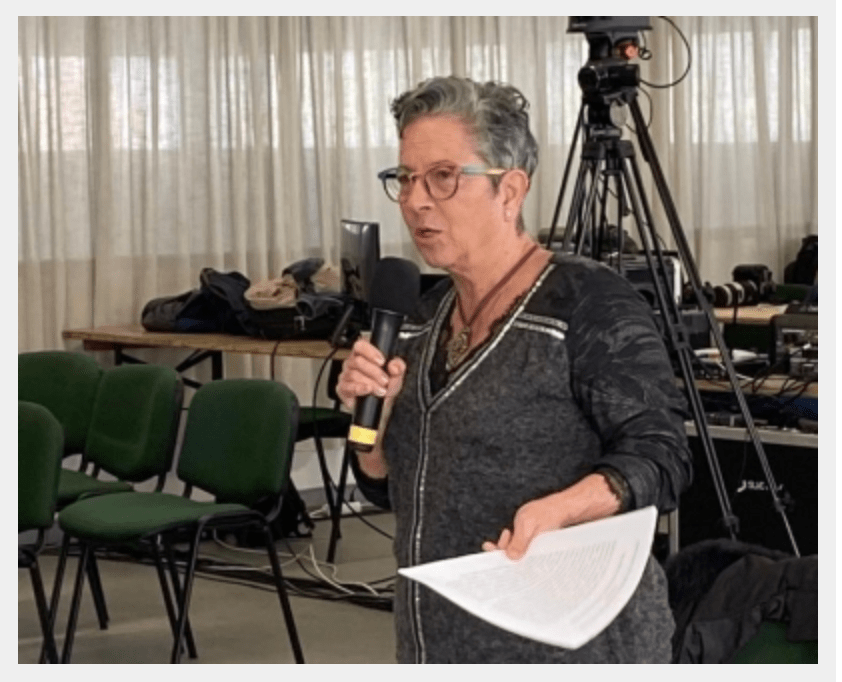
The Coordinating Committee of the Left Bloc (Bloco de Esquerda) in Ponta Delgada is calling for the expansion of the city’s “Housing First” program — first introduced following a recommendation from the party — and is challenging the mayor to take immediate steps toward opening a supervised drug consumption site aimed at removing drug use from public streets.
Avelina Ferreira, coordinator of the Left Bloc in Ponta Delgada, spoke during the public comment period at today’s Municipal Assembly meeting, highlighting what she described as the proven success of the Housing First initiative. The program, launched during the previous municipal term after a proposal from the Left Bloc, provides immediate housing to people experiencing homelessness without requiring prior treatment or sobriety.
“Despite the fears expressed by some,” Ferreira said, Housing First “has proven to be an excellent strategy in responding to homelessness.” She argued that the project should now be expanded to reach more people living without shelter in the municipality.
Pointing to Housing First as an example of how a shift in policy approach can yield tangible results, the party is now pressing for the urgent creation of a supervised consumption room in Ponta Delgada.
According to Ferreira, the city sees the highest concentration of public drug use in the Azores, creating public health concerns and safety risks for individuals struggling with addiction — including overdoses — while also contributing to discomfort among residents and visitors.
“It is in Ponta Delgada that most public consumption takes place, which raises serious public health concerns, endangers people who use drugs — who can and have experienced overdoses — and leaves residents and visitors feeling deeply uneasy,” she said.
Ferreira also expressed surprise at the mayor’s reported preference for a decentralized response rather than establishing a dedicated supervised facility in the city.
“The municipality’s position should be clear: move forward now, in partnership with the Regional Government, to implement this pilot project,” she said. “Creating a supervised consumption room in Ponta Delgada is an urgent and necessary response that requires courage and the will to change what we are witnessing on several streets in our municipality.”
In her remarks, Ferreira also raised concerns about the use of herbicides in municipal parks and gardens, specifically in the parish of São Sebastião, where she serves on the local parish assembly.
She cited warnings from Portugal’s Environmental Agency about the toxicity risks associated with plant protection products. While such chemicals continue to be used in large-scale agriculture, Ferreira argued they were never intended for use in public parks and gardens where children and pets play.
“These products kill insects essential to pollination,” she said, noting that their use — included in the delegation agreement between the municipality and the parish — runs counter to a biodiversity and pollinator protection recommendation previously approved by the Municipal Assembly at the initiative of the Left Bloc.
From Press Release
Translated into English as a community outreach program by the Portuguese Beyond Borders Institute (PBBI) and the Modern and Classical Languages and Literatures Department (MCLL), in collaboration with Bruma Publication and ADMA (Azores-Diaspora Media Alliance) at California State University, Fresno. PBBI thanks Luso Financial for sponsoring NOVIDADES.
 Novidades - The Islands and the Diaspora