

How do you interpret the recent statements by the Minister of Foreign Affairs regarding the use of Lajes Air Base by the U.S. Air Force?
I find the statements difficult to interpret. They come after both the President of the Republic and the Minister of National Defense made very ambiguous remarks on the subject. It seems there is some interest on the part of the authorities in maintaining a degree of confusion among the Portuguese public about how the use of Lajes Air Base actually works.
What the Foreign Minister is now saying appears intended to dispel that ambiguity, but he does so in a rather strange way, because what he says does not seem to align with what is written in the 1995 Defense Cooperation Agreement, particularly the Technical Agreement, which governs the use of the base by U.S. forces.
The minister refers to “tacit authorizations,” which is an ambiguous expression that allows for the interpretation that Portugal does not need to be consulted. Under that reading, Portugal would be implicitly and automatically granting authorization, without asking questions about the purpose of the use of the facilities and without even considering the possibility of refusal.
That posture seems to me to run counter to the spirit of the Agreement and to treat Portuguese sovereignty over the base with excessive lightness — something that should be a priority for any government. It also raises questions about Portugal’s autonomy in foreign policy.
Let’s conduct a thought experiment under what we might call the “Rangel Doctrine”: if the United States were to invade Greenland — as President Trump threatened only a few weeks ago — would U.S. forces have “tacit authorization” to use the base for operations supporting that invasion, for example to control Atlantic maritime and airspace routes in order to block European reinforcements? Could the U.S. use Lajes to support an invasion of territory belonging to a European Union member state and NATO ally? According to what the minister now tells us, they would not even need to request authorization.
Specifically, what does the Lajes Agreement say? Must the United States request authorization to use the base, and under what circumstances?
Yes, they must request authorization. The Technical Agreement is explicit on this point. Article I outlines three scenarios for the use of Lajes Air Base facilities (and others), including aircraft transit through the base or Azorean airspace:
- For military operations within the NATO framework — provided Portugal has not objected to the relevant NATO decisions — only prior notification to Portuguese authorities is required.
- For military operations resulting from decisions of other international organizations in which both Portugal and the United States participate, authorization is not required, provided Portugal has supported those decisions.
- For any other military operations not covered by (1) or (2), the use “shall be subject to prior authorization.”
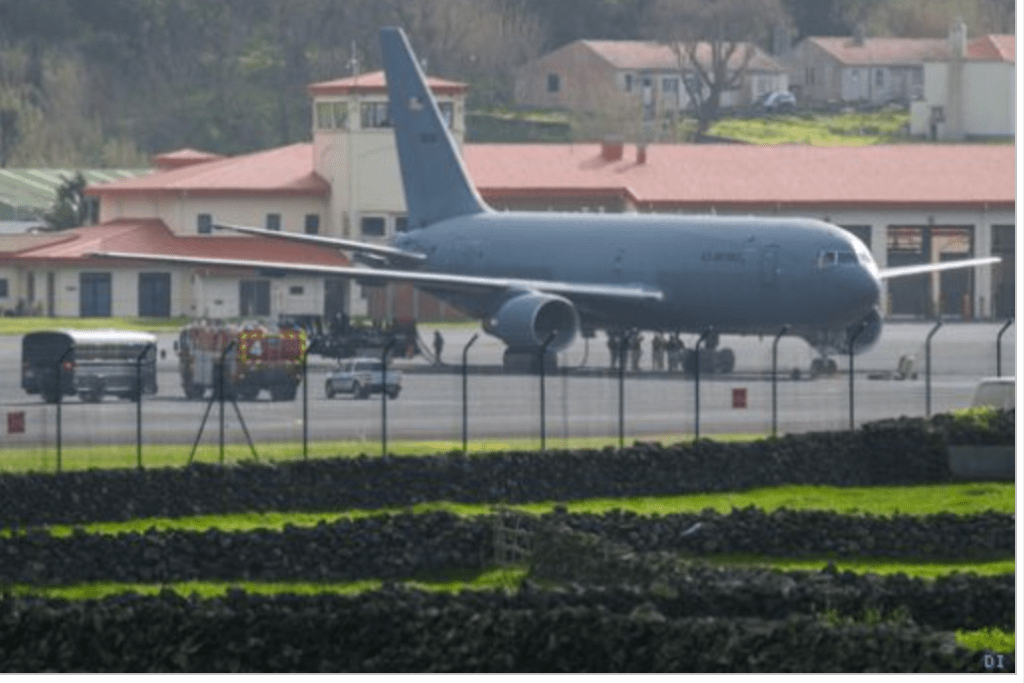
The case of Operation “Midnight Hammer,” the bombing of Iran last June, appears to me to fall under category (3), even if we do not know with certainty whether one of the refueling aircraft that passed through Lajes actually refueled one of the bombers that struck Iranian facilities. The same applies to the broader military posture currently deployed in the Middle East to pressure Iran into negotiations or, potentially, to carry out further strikes. “Military operation” is a broad concept; it is not limited to a direct attack on a state. It also includes non-combat operations.
British media have reported that the United Kingdom denied the use of its military bases for possible attacks on Iran, arguing that such operations could violate international law. In your view, should Portugal adopt a similar position?
I do not have a clear answer. Portugal is in a difficult position — as is all of Europe — after decades of dependence on the United States for defense and for other crucial aspects of our societies.
The United Kingdom’s position is interesting because it faces a similar dilemma, one that has been intensified by Brexit. It sets an example that puts pressure on Portugal to consider doing something similar.
An attack on Iran would, in my view, constitute a clear violation of the norms of just war, though I am not a legal expert and acknowledge that there may be arguments related to the “responsibility to protect” the Iranian population. The justification of self-defense, however, does not seem convincing to me, because there is no ongoing or imminent Iranian attack; Iran’s threats are consistently framed as retaliation for an initial U.S. strike.
The key issue, for me, is this: if Portugal truly has autonomy in its foreign policy, it makes little sense to avoid making decisions about how the country’s most important strategic infrastructure is used. A different matter would be Portugal granting authorization because it agrees with the operations underway in the Middle East. That would be a choice debated in the country — but it would still be a choice.
Does the recent surge in aircraft traffic once again demonstrate the geostrategic importance of Lajes Air Base?
Yes. The strategic relevance of the Azores fluctuates in the short- and medium-term, but remains constant in the long term. We are seeing a role return that had largely faded since the Cold War: maritime surveillance and anti-submarine warfare. In addition, there is the logistical function of supporting the projection of military power across the Atlantic.
In the coming years, if President Trump continues to rely on air power to secure quick foreign policy victories, as he has so far, we can expect more situations like this.
Which brings me to what I call the “irony of Lajes.” We become deeply concerned when the base appears to lose relevance to the United States, as happened with the downsizing announced in 2012. But now that it has clearly regained relevance, that is partly due to a United States pursuing foreign policy objectives that diverge from Europe’s.
So where does Portugal stand? And the Azores? That is a debate we will have to confront. Pretending it has nothing to do with us does not help.
In Diário Insular, José Lourenço-director
Translated into English as a community outreach program by the Portuguese Beyond Borders Institute (PBBI) and the Modern and Classical Languages and Literatures Department (MCLL), in collaboration with Bruma Publication and ADMA (Azores-Diaspora Media Alliance) at California State University, Fresno. PBBI thanks Luso Financial for sponsoring NOVIDADES.

 Novidades - The Islands and the Diaspora