

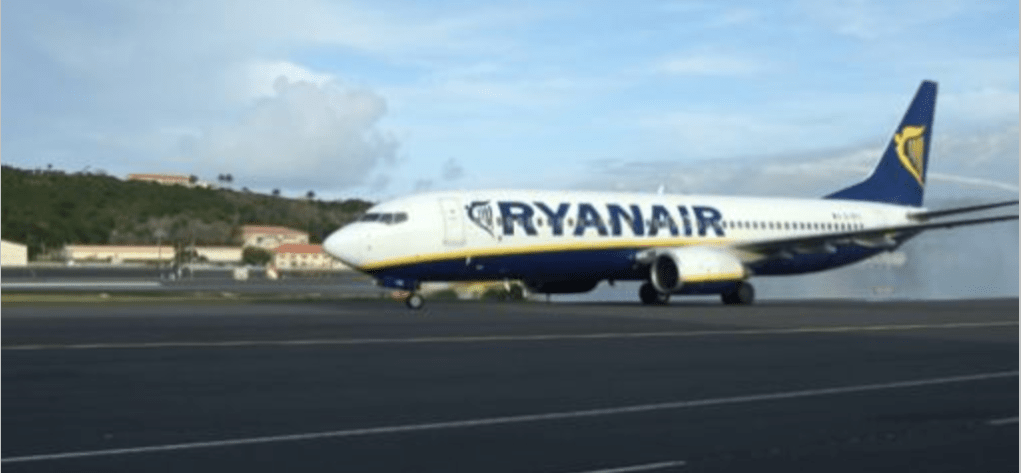
The departure of Ryanair from the Azores could deliver an economic blow estimated between €144 million and €166 million annually, according to a new study by the Câmara de Comércio e Indústria de Ponta Delgada (CCIPD).
In a statement, the business association warns that the airline’s exit may result in the loss of 339,000 to 391,000 overnight stays per year, translating into a direct economic impact of €106.6 million to €122.8 million. When indirect and induced effects are factored in, the total impact rises to between €143.9 million and €165.8 million.
Ryanair, Europe’s largest low-cost carrier, announced it will cease flights to the Azores on March 29, citing airport fees and European environmental taxes as key reasons for its withdrawal.
A Sharp Drop in Visitors
The CCIPD’s research office examined seat capacity and actual passenger traffic on Ryanair routes to São Miguel and Terceira between 2023 and 2025. Using conservative assumptions about the share of tourists on both domestic and international flights, analysts developed two scenarios: one assuming 60% of passengers were visitors, the other 70%.
Under those projections, Ryanair is estimated to transport between 102,886 and 118,561 tourists annually to the Azores.
The projected losses are based on an average stay of 3.3 nights and an average tourist expenditure of €1,036 per visitor, adjusted to 2025 prices. The study also incorporates economic multipliers from an EY-Parthenon macroeconomic analysis of tourism’s impact in the region.
A Blow to Growth
Tourism accounts for roughly 20% of the Azorean GDP, and Ryanair is believed to represent between 7.5% and 8.7% of total overnight stays.
Based on those figures, the CCIPD estimates a decline in Gross Value Added (GVA) between €79.9 million and €92.1 million, and a reduction in regional GDP of €90.1 million to €104.5 million per year. That would translate into a 1.5% to 1.7% contraction in the GDP forecast for 2026.
The timing, business leaders caution, makes the impact especially severe.
“Assuming projected regional GDP growth of around 2% in 2026 — equivalent to roughly €120 million in additional output — Ryanair’s departure could absorb between two-thirds and three-quarters of that growth,” the association warned. “This would substantially undermine the economic momentum outlined in the 2026 regional budget and development plan.”
More Than an Airline
For the CCIPD, Ryanair’s presence in the Azores has gone beyond simply adding seats to the market. The airline introduced effective competition, pressured fares downward, strengthened direct international connectivity, and generated additional tourism traffic.
“Its departure does not represent merely the loss of an airline,” the association emphasized, “but the reduction of a key engine of economic dynamism, with direct and indirect effects on the region’s productive structure.”
Business leaders argue that the potential economic damage far outweighs any public financial effort that might be required to maintain and diversify air connectivity.
They are now calling for the urgent definition of an integrated air access strategy, describing it as “a critical factor for the sustainability of tourism, the competitiveness of businesses, and the protection of regional economic growth.”
In the Atlantic, distance is destiny. When routes disappear, the consequences ripple far beyond the runway.
In Diário Insular-José Lourenço, director.
Translated into English as a community outreach program by the Portuguese Beyond Borders Institute (PBBI) and the Modern and Classical Languages and Literatures Department (MCLL), in collaboration with Bruma Publication and ADMA (Azores-Diaspora Media Alliance) at California State University, Fresno. PBBI thanks Luso Financial for sponsoring NOVIDADES.

 Novidades - The Islands and the Diaspora