

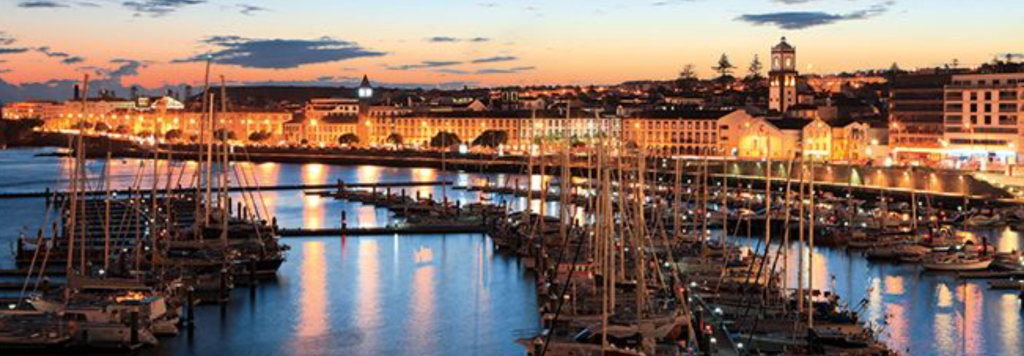
For the fifth consecutive month, overnight stays in the Azores have declined year over year, signaling a sustained cooling of the region’s tourism sector. In January, the archipelago recorded 121,200 overnight stays—down 9.9% from the same month in 2025—according to data released by the Serviço Regional de Estatística dos Açores (SREA).
The downturn affects all categories of tourist accommodations—hotels, local lodging, and rural tourism. Since September, overnight stays have consistently trailed prior-year levels, with declines of 1.2% in September, 2% in October, 6.8% in November, 5.1% in December, and now nearly 10% in January.
In the first month of the year, the Azores welcomed 44,300 guests, a drop of 9.8%, with an average stay of 2.73 nights—virtually unchanged from a year earlier. Notably, the regional decline runs counter to national trends: across Portugal, overnight stays rose 2% in January.
Foreign Markets Feel the Sharpest Drop
Of the 121,200 overnight stays recorded in January, 55% (66,600) were by domestic travelers, while 45% (54,600) came from international visitors. Both segments declined, but the contraction was far steeper among foreign tourists, down 15.7%, compared to a 4.5% drop in the domestic market.
Germany remained the top international source market, accounting for 10,500 overnight stays (19.3% of foreign stays), though still down 12.2% year over year. The United States followed with 7,400 stays (13.5%), but posted a sharp 28.9% decline. Canada ranked third with 6,100 stays (11.3%), slipping 1.1%.
Among growth markets, Poland (+14.9%), Austria (+8.1%), and Switzerland (+5.9%) stood out. Meanwhile, Slovakia (-49%), Israel (-35.5%), and Spain (-30.2%) recorded the steepest contractions.
Hotels Hold Steadier Than Local Lodging
Hotels accounted for 77,900 overnight stays, or 64.3% of the total, followed by local lodging with 39,400 (32.5%) and rural tourism with 3,800 (3.2%).
Hotels also experienced the mildest year-over-year decline (-3.8%), compared to sharper drops in local lodging (-18.9%) and rural tourism (-20.5%).
Hotel bed occupancy reached 20.8% in January, down 1.7 percentage points, though total revenues edged up 1.3% to €5 million. Rural tourism saw occupancy at 13.6% (down 0.2 points) and revenues fall 9.1% to €441,400. In local lodging, gross occupancy stood at 16.8%, down two percentage points. Notably, 70.4% of active local lodging establishments reported no guest activity in January—an increase of 5.3 percentage points from a year earlier.
Six Islands in Decline

Looking only at hotels and local lodging—which together account for 96.8% of overnight stays—just three of the nine islands posted year-over-year growth: São Jorge (+19.2%), Santa Maria (+18.2%), and Graciosa (+12.3%).
Pico suffered the sharpest decline (-16.6%), followed by São Miguel (-11.2%), Corvo (-9.9%), Terceira (-6.5%), Flores (-5.5%), and Faial (-3.1%).
São Miguel, the archipelago’s largest island, concentrated 70.8% of all hotel and local lodging stays (83,100 nights). Terceira followed with 20,100 stays (17.1%), Faial with 6,200 (5.3%), and Pico with 3,400 (2.9%).
With the exception of São Miguel, domestic travelers represented the majority of overnight stays on every island—particularly in Santa Maria (87.4%), Graciosa (85.7%), and Terceira (76.1%).
Among foreign markets, Germany had the largest share in São Miguel (10.5%), Flores (7.7%), and Pico (7.4%), while Spain stood out in Corvo (9.6%). U.S. visitors led among foreign markets in Graciosa (8.4%), Faial (5.4%), and Santa Maria (3.2%); Canadians were most prominent in São Jorge (5.4%); and the British market was strongest in Terceira (4.3%).
As winter tightens its grip on the Atlantic islands, the numbers suggest more than seasonal fluctuation. With five straight months of contraction—despite national growth—the Azores face a pressing question: is this a temporary cooling, or the start of a broader recalibration in the region’s tourism cycle?
In Diário Insular-José Lourenço-director
Translated into English as a community outreach program by the Portuguese Beyond Borders Institute (PBBI) and the Modern and Classical Languages and Literatures Department (MCLL), in collaboration with Bruma Publication and ADMA (Azores-Diaspora Media Alliance) at California State University, Fresno. PBBI thanks Luso Financial for sponsoring NOVIDADES.

 Novidades - The Islands and the Diaspora