

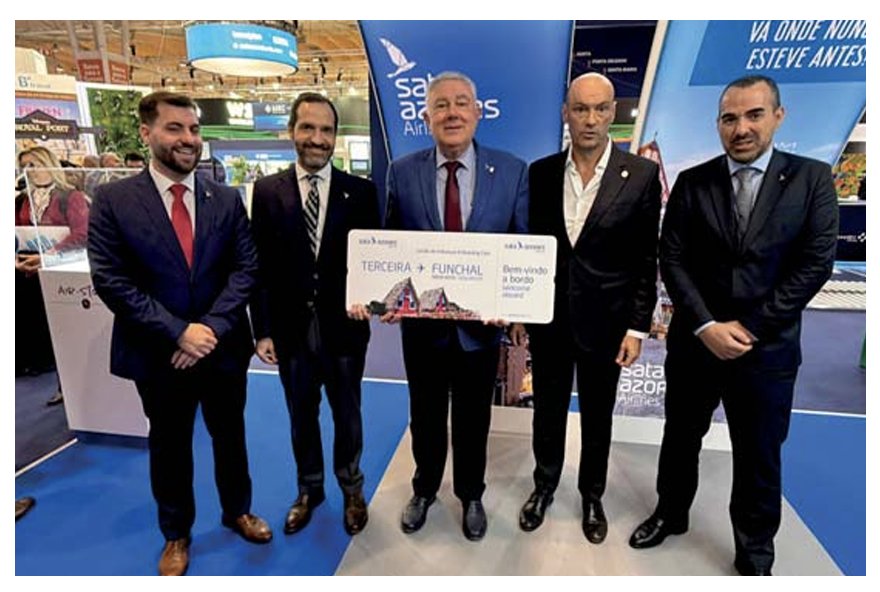
The Vice-President of the Azores Regional Government, Artur Lima, on Tuesday forcefully defended the political affirmation of the Autonomous Regions of the Azores and Madeira against what he described as the “stale, musty, and unacceptable centralism” of Portugal’s central government.
Speaking in Lisbon, Lima argued that relations between the Government of the Republic and the governments of the Autonomous Regions “cannot always be a difficult birth—by suction cup and forceps—and sometimes ending in a cesarean.” He was referring specifically to ongoing tensions surrounding the Social Mobility Subsidy, a program designed to offset travel costs for island residents. “In these cases,” he said, “it’s better to perform a cesarean and put an end to the matter. That is what the governments of the Azores and Madeira must do.”
“No Favors” from Lisbon
Lima stressed that the Republic is “not doing the Azores any favors” through Public Service Obligations (OSP) on air routes. “The Region must be democratically respected,” he insisted, adding that respect “has not been present in matters such as the Social Mobility Subsidy and the OSP.”
He expressed frustration that what he considers rights guaranteed to the Autonomous Regions have had to be “pulled out with iron,” singling out the current PSD and CDS-PP national government. “They are not doing us any favor,” he said. “That saddens me and angers me.”
The Vice-President maintained that the Azores must become “truly more autonomous and less dependent on the will and moods of Terreiro do Paço”—a metonym for Portugal’s central government headquartered in Lisbon’s Terreiro do Paço.
Unity from Santa Maria to Corvo
For Lima, strengthening autonomy begins internally. “We do this by strengthening ourselves and uniting from Santa Maria to Corvo,” he declared, invoking the geographic span of the archipelago. “Azoreanness is lived in the diaspora, but it must also be lived within the Azores.”
He further argued that reducing dependence on Lisbon and on Public Service Obligations requires resilience and bold thinking. While acknowledging that the liberalization of the Azorean airspace a decade ago benefited tourism, he suggested it may now be time to consider “the liberalization of the entire Azorean airspace.”
Lima also called for financial compensation from the Republic for what he described as the archipelago’s strategic contributions. He pointed to Portugal’s NATO membership, the Santa Maria Flight Information Region (FIR), and the country’s vast Exclusive Economic Zone—arguing that these advantages come “at the expense of the Azores and Madeira” and warrant proper recognition.
New Terceira–Funchal Route Announced
Lima’s remarks came during the launch session of a new direct air route linking Terceira Island and Funchal, presented at the Better Tourism Lisbon Travel Market. He praised SATA Air Açores for what he described as “a major contribution and an example of decentralization” in strengthening ties between the two Autonomous Regions.
The new Terceira–Funchal route will operate from May through October 2026, with one weekly flight on Thursdays, increasing to two weekly frequencies between June and September.
According to Lima, the new operation “adds value to the Azores” and reinforces both internal cohesion within the archipelago and cooperation between the Autonomous Regions—an objective he considers essential in the ongoing debate over autonomy and centralization in Portugal.
In Diário dos Açores-Paulo Viveiros-director
Translated into English as a community outreach program by the Portuguese Beyond Borders Institute (PBBI) and the Modern and Classical Languages and Literatures Department (MCLL), in collaboration with Bruma Publication and ADMA (Azores-Diaspora Media Alliance) at California State University, Fresno. PBBI thanks Luso Financial for sponsoring NOVIDADES.

 Novidades - The Islands and the Diaspora