

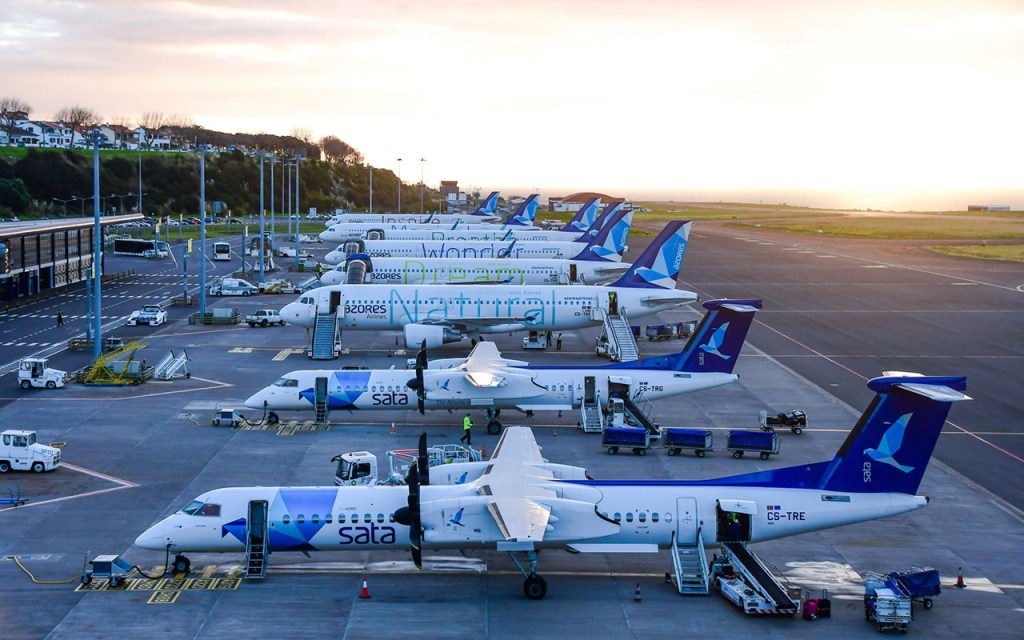
The Atlantic Connect Group has announced it will challenge in court the board of SATA Air Açores’ decision to reject its bid to acquire Azores Airlines, accusing the state-owned company of “disregard for the privatization process.” The consortium says it is prepared to pursue the matter “to the highest national and international courts,” setting the stage for what could become a protracted legal and political battle over the future of the Azorean carrier.
The decision was finalized at a SATA board meeting held on Friday, just days after the public tender jury—led by economist Augusto Mateus—submitted its final report. The panel reaffirmed its earlier recommendation to reject the sole bid, concluding that the proposal “does not meet the requirements established in the procedure, fails to respect previously defined conditions and obligations, and does not safeguard the patrimonial interests of SATA Holding and, consequently, of the Autonomous Region of the Azores.”
The Atlantic Connect Group, whose members include entrepreneurs Tiago Raiano, Paulo Pereira, and Nuno Pereira, had proposed acquiring 85 percent of Azores Airlines for €17 million. The offer was structured as a phased payment plan contingent upon the airline’s future performance. That contingency proved decisive. SATA’s board deemed the model unacceptable, arguing that the purchase price would depend on post-privatization developments and therefore could not be considered “a guaranteed or fixed amount.”
In remarks to Antena 1 Açores, SATA board president Tiago Santos said the payment to SATA Holding would hinge on “a set of future developments at Azores Airlines after privatization,” making it neither certain nor fully defined. The consortium, however, disputes both the substance and the process. It contends that Santos publicly aligned himself with the jury’s position before the formal hearing phase for interested parties had concluded—effectively undermining the bidder’s right of reply.
In a sharply worded statement, the Atlantic Connect Group described the board meeting as little more than a procedural formality designed “to ratify a pre-announced outcome,” and accused the administration of pushing the privatization into a “legal quagmire.”
With the impasse deepening, the Government of the Azores is preparing an alternative path: a direct sale of the airline, to be completed by year’s end—the deadline agreed upon with the European Commission as part of the broader restructuring of the SATA Group. According to Tiago Santos, the framework for that direct sale is “in the final stages of definition.”
What began as a long-anticipated step toward stabilizing the Azores’ air links has now entered a new phase—one marked by legal maneuvering, political scrutiny, and growing uncertainty. In an archipelago where aviation is not a luxury but a lifeline, the stakes extend far beyond balance sheets. They reach into the very question of who will steer the islands’ connection to the world.
In Diário dos Açores-Paulo Viveiros, director

 Novidades - The Islands and the Diaspora