

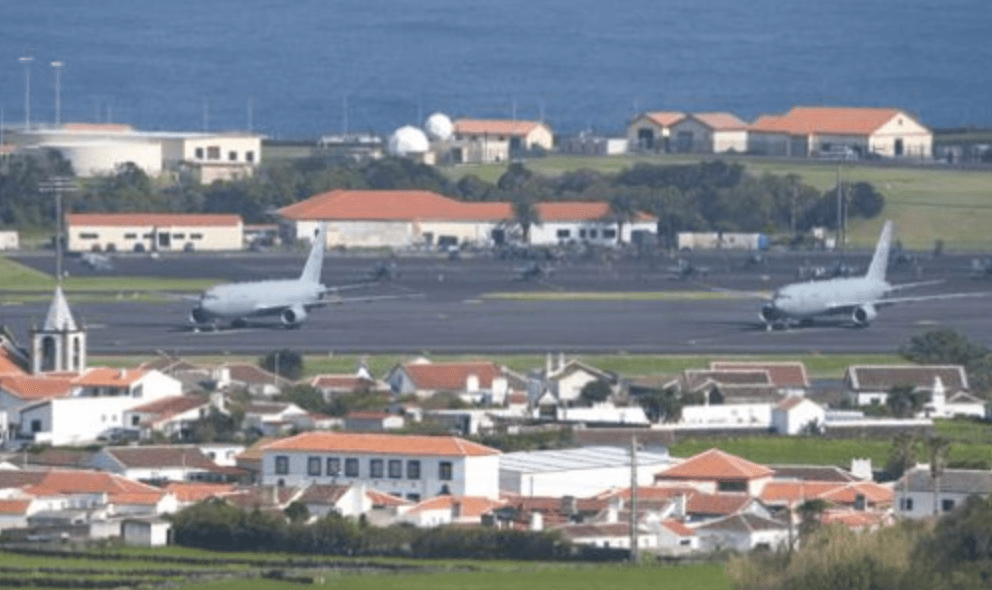
As military movements intensify at the U.S.-used air base at Lajes, a charged quiet has settled over both Lisbon and Ponta Delgada. That silence drew sharp criticism yesterday from Socialist Party lawmaker Vasco Cordeiro, who accused both the Regional and Republic governments of failing to address what he described as a shifting and unstable geopolitical moment—one that affects the Azores, even if indirectly.
The debate unfolded in the Azorean Parliament over a request for urgent consideration of a proposal by the Liberal Initiative (IL), calling for a renewed embrace of the Azores’ strategic centrality within the transatlantic and European defense architecture. Cordeiro argued that the issue at hand goes far beyond procedure. It is about defining the Azores’ political positioning amid global volatility. By opposing urgency and sending the proposal to the committee, he said, the Socialist Party sought not to stifle debate but to break what he called a “mantle of silence” that has shrouded both the Republic and the Region—particularly regarding the recent use of Lajes. “We refuse to allow haste to conceal the Region’s political stance on this matter,” Cordeiro said, framing the vote as a symbolic act against opacity.
The urgency motion was ultimately rejected by a majority of parliamentary benches, which acknowledged the importance of the issue but deemed it too complex for accelerated debate. It will now proceed through the appropriate committee channels. IL lawmaker Pedro Ferreira had urged lawmakers to act swiftly, noting that President-elect António José Seguro has already announced that his first post-inauguration Council of State meeting in March will focus on Security and Defense. With the President of the Azorean Government holding a seat on that council, Ferreira argued, the Region should present a unified position. But João Bruto da Costa, parliamentary leader of the Social Democratic Party (PSD), countered that the matter’s “density” demands deeper committee work—a stance echoed by most parties, with IL standing alone in opposition.
Security concerns extended beyond foreign policy. The Legislative Assembly also approved a resolution from the People’s Monarchist Party (PPM) establishing a working group to review and propose improvements to internal security arrangements in the Region. PPM lawmaker João Mendonça framed the issue bluntly: “Internal security is an essential function of the State. In the Azores, that function operates across nine islands, 19 municipalities, permanent geographic discontinuity, and logistical constraints that do not exist on the mainland.”
Mendonça challenged lawmakers to rethink not just resources, but structure. “We’ve never had the courage to ask the essential question: what if the problem isn’t only means—but the model?” he said. He pointed to stark numbers. The National Republican Guard (GNR) is responsible for roughly 94 percent of the national territory, while the Public Security Police (PSP) covers just 6 percent. Yet the Azores account for 2.5 percent of Portugal’s total land area—meaning that about 42 percent of the territory under PSP responsibility lies in the islands. “Forty-two percent of the country’s PSP territorial responsibility is here in the Azores—and we have 972 officers. This isn’t ideology. It’s math.”
Portugal consistently ranks among the safest countries in the world, Mendonça acknowledged, crediting a mainland model built on strong coordination between the GNR and PSP. But in the Azores, he argued, that complementarity is weakened by geography. There is no rapid land redeployment, no economies of scale, no flexible concentration of operational reserves. The resolution creating the working group passed with broad support—from PSD, PS, Chega, CDS-PP, PPM, BE, and PAN—while IL cast the lone dissenting vote.
Regional Secretary for Parliamentary Affairs and Communities Paulo Estêvão pledged full cooperation with lawmakers in examining the current security model and identifying areas for improvement, particularly in light of mainland realities.
The week’s legislative agenda also included approval of a resolution urging the Republic to consider the demands of Azorean municipalities in revising the Local Finance Law—another reminder that for the islands, questions of defense and security are inseparable from fiscal equity and structural autonomy.
In the Azores, strategy is never abstract. It is measured in runways and coastlines, in troop movements and patrol routes, in the distance between islands and the reach of the State. And in that space between silence and scrutiny, the Atlantic continues to stir.
In Diário Insular-José Lourenço, director
Translated into English as a community outreach program by the Portuguese Beyond Borders Institute (PBBI) and the Modern and Classical Languages and Literatures Department (MCLL), in collaboration with Bruma Publication and ADMA (Azores-Diaspora Media Alliance) at California State University, Fresno. PBBI thanks Luso Financial for sponsoring NOVIDADES.

 Novidades - The Islands and the Diaspora