

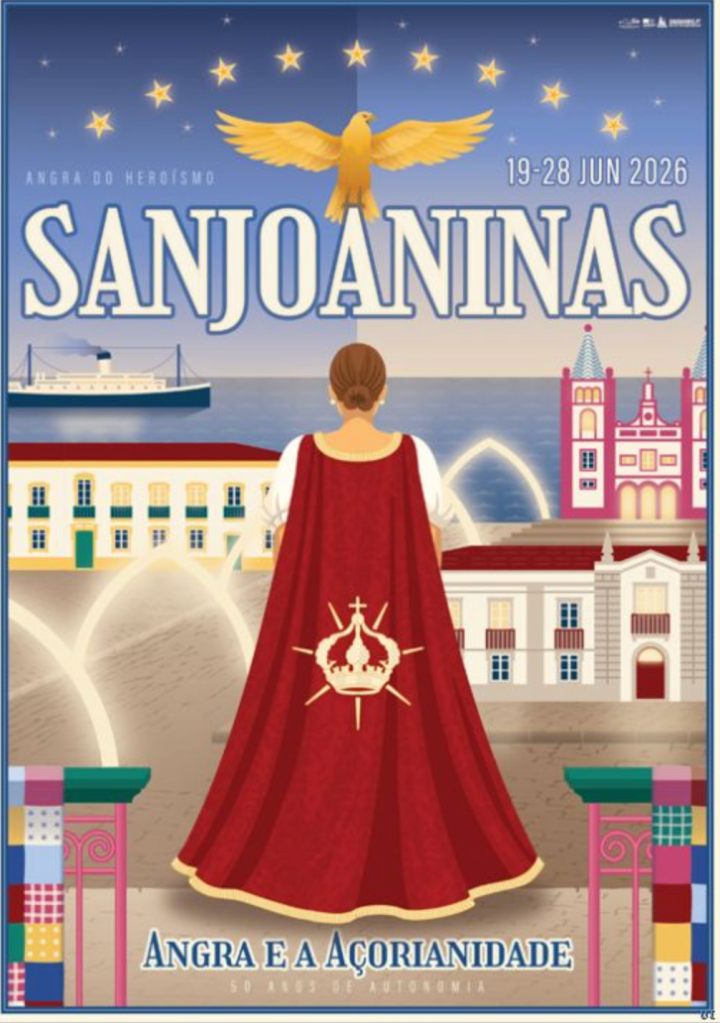
The Sanjoaninas 2026, scheduled for June 19–28 in Angra do Heroísmo, will unfold under the theme “Angra and Azoreanity,” linking the city’s most iconic festivities to the broader commemorations marking the 50th anniversary of Azorean Autonomy.
According to international relations scholar Tomé Ribeiro Gomes, invited by the municipality to reflect on this year’s theme, autonomy deserves to be celebrated not only in ceremonial terms but also as a living celebration—a festa. “In the Azores, and especially on Terceira Island, without celebration there is no people, and without the people, autonomy would have nothing within it,” he said.
“It was the people of these islands who lived through the turbulent process that gave birth to democracy between 1974 and 1976,” Gomes wrote in a text prepared for the festivities. “During those years they debated their future among many possible paths. The outcome was a political-administrative arrangement unprecedented in Portuguese law: regional autonomy. The nine islands became a single political entity—though one composed of distinct communities. It is the sea that isolates them, that separates them from one another and from the rest of the world.”
For Gomes, the very essence of autonomy lies in the collective conversation it demands. The autonomy pact, he said, calls on the community “to engage in an ongoing dialogue about the archipelago’s shared destiny.”
“This debate about our common future is the core of autonomy,” he said. “If we want to know where we are going, we must first understand where we came from—who we are. That answer cannot be found in abstraction, but in the daily practice of Azoreanity. It is hidden somewhere in the fog, in the food, in the accents, in the folk songs, in the anxiety of earthquakes, in the devotion to the Holy Spirit, and in so many other things that may seem ordinary but make us unique.”
Gomes also highlighted the Azoreans’ well-known culture of hospitality.
“During these festivities, the people of Angra open the city’s doors to the other islands, to mainland Portugal, and to the diaspora, inviting them to experience the richness of their culture,” he said. “For these few days Angra becomes the meeting point of the archipelago—a place where, with ease, joy, and generosity, it is proven that the Azoreans are truly a people. And that is something not everyone can claim.”
Presenting the theme and the official poster, Guido Teles, vice-president of the Municipality of Angra do Heroísmo, said the Sanjoaninas represent far more than a popular celebration.
“These festivities are a cultural symbol of Azorean identity,” Teles said. “The Sanjoaninas are a vivid postcard of who we are and also an important contribution to the economic vitality of the municipality.”
The poster’s creator, artist Rúben Quadros Ramos, explained that the centerpiece of the design is a female figure representing Autonomy itself.
“At the center of the composition appears a feminine figure who personifies Autonomy, in a symbolic moment where past, present, and future meet,” he said.
Looking back, Ramos noted, the institutional history of the Azores has deep roots in Angra do Heroísmo. The city’s historic centrality—shaped in large part by its strategic bay—is represented through landmarks such as the Cathedral of Angra, the Palace of the Captains-General, and the former headquarters of the Junta Geral.
“It is fair to say that Autonomy stands firmly grounded here,” he said.
In the artwork, the female figure gazes toward the horizon, symbolizing a future in which emigration is no longer the only path and where the sea—once a barrier—has become the islands’ most valuable resource.
At the top of the poster, the golden hawk and the nine stars appear, evoking the Azorean flag.
“In the present moment—amid the foam of uncertain, sometimes violent and anxious times—both Autonomy and the Azorean people must place their trust in the mantle of the Holy Spirit,” Ramos said. “On the fiftieth anniversary of the Autonomous Region of the Azores, we celebrate the road traveled and renew our responsibility to keep building the future. Because autonomy is not merely a form of government; it is an affirmation of identity, dignity, and confidence in our own destiny.”
Translated into English as a community outreach program by the Portuguese Beyond Borders Institute (PBBI) and the Modern and Classical Languages and Literatures Department (MCLL), in collaboration with Bruma Publication and ADMA (Azores-Diaspora Media Alliance) at California State University, Fresno. PBBI thanks Luso Financial for sponsoring NOVIDADES.

 Novidades - The Islands and the Diaspora