

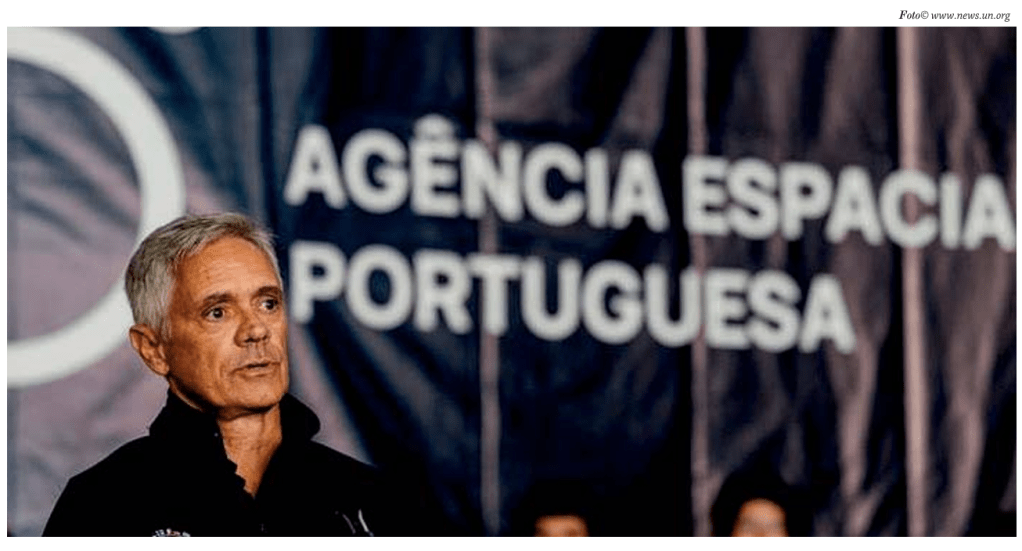
Construction of the Azores Space Hub on Santa Maria Island must begin by the end of June if the project is to meet the timetable agreed with the European Space Agency. The warning comes from Ricardo Conde, president of Portugal Space, in remarks to ECO/eRadar.
“We are in a race against time,” Conde said. “Right now we are preparing the construction tenders.” He stressed that work must start “by the end of the first half of the year” in order to keep pace with the schedule for the European Space Rider program.
The Space Hub Açores project represents a €15 million investment financed by the European Space Agency and is considered a key component of Europe’s emerging strategy for space sovereignty. The infrastructure is intended to serve as a return site for orbital missions and is expected to host the reusable Space Rider vehicle, whose inaugural flight is currently scheduled for 2028.
According to Conde, the future complex will consist of three essential components: a landing site for returning spacecraft, a technological center, and a ground station designed to manage operations and communications with orbital vehicles. For the ground station, the ESA has already awarded a contract to an international consortium that includes the aerospace companies Safran and Thales. The latter is also responsible for operating the existing Santa Maria Teleport.
“We are currently in the process of submitting the construction permit for the building where the antennas and the entire ground station system will be installed,” Conde explained. The plan, he said, is to build the technological center and the landing site simultaneously in order to remain synchronized with the Space Rider mission’s timeline.
Despite his optimism, Conde acknowledged the logistical challenges. “It’s a demanding project,” he said. “Not only because the construction will take place in the Azores, but also because the construction sector is under intense pressure everywhere. We need to focus all our energy on securing contracts and starting the work this year.”
Europe’s First Authorized Orbital Reentry
Conde also highlighted the symbolic importance of a recent license granted by Portugal’s communications regulator, ANACOM, to the Franco-German company Atmos Space Cargo. The authorization allows the controlled reentry of the Mission Phoenix 2.1 capsule off the coast of Santa Maria, expected in the second half of 2026.
“This has never been done in Europe before,” Conde noted. “It will be the first time a controlled reentry license is issued.” He described the event as a pioneering milestone that could help establish the Azores as a European hub for space missions. “Our goal is to build the path that will make the Space Hub in Santa Maria a return point for orbital missions.”
Coordination With the Air Force and New Space Projects
At the same time, the Portuguese Air Force plans to install a rocket launch facility—known as the Santa Maria Space Port—near its infrastructure by the island’s airport. The project, also budgeted at €15 million, will be financed through Portugal’s Recovery and Resilience Plan. The announcement was confirmed to ECO/eRadar by Colonel Pedro Costa, head of the Air Force’s Space Operations Center.
Asked about the coexistence of the two initiatives, Ricardo Conde emphasized the need for close coordination. “There must be coordination and synergies,” he said. “They are different dynamics, but complementary ones. On the ground there must be collaboration so that one project does not overlap the other.”
Despite the challenges, Conde remains confident about the future. “These are excellent developments,” he said. “For years we managed scarcity. Now our challenge is to manage abundance.”
Translated into English as a community outreach program by the Portuguese Beyond Borders Institute (PBBI) and the Modern and Classical Languages and Literatures Department (MCLL), in collaboration with Bruma Publication and ADMA (Azores-Diaspora Media Alliance) at California State University, Fresno. PBBI thanks Luso Financial for sponsoring NOVIDADES.

 Novidades - The Islands and the Diaspora