

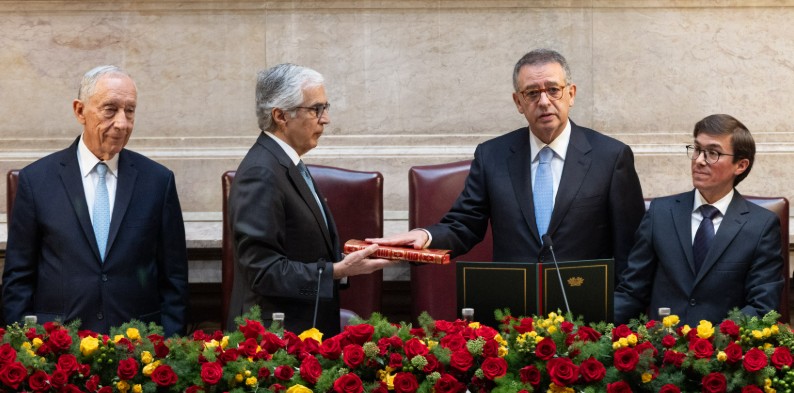
Portugal’s new President of the Republic took office yesterday. In his inaugural address, António José Seguro said many things—some ceremonial and expected, others more direct and clearly signaling the direction he intends to take. Among the more traditional elements of the speech were appeals for national unity, political dialogue, and international cooperation. It was an address that acknowledged both Portugal’s domestic challenges and the uncertainties of a rapidly shifting global landscape, while reaffirming a commitment to democracy and social justice. Seguro also positioned himself as a defender of an international order grounded in respect for state sovereignty, the rule of law, and the strength of multilateral institutions. He reminded the country that we live in an era of profound change and rupture, a moment when pillars of the international system are beginning to crumble and when the force of law is too often replaced by the law of the strongest.
Domestically, however, Seguro spoke with greater clarity about the role he intends to play. He pledged to serve as a guarantor of political stability and promised to confront what he described as the electoral “frenzy” that has characterized Portuguese politics in recent years. Portugal, he said, continues to face structural challenges that have lingered far too long: insufficient economic growth, an economy built on low wages, persistent inequality, entrenched poverty, demographic aging, slow-moving justice, burdensome bureaucracy, difficulties in accessing health care and housing, labor shortages, limited opportunities for younger generations, insecurity among the elderly, and growing distrust toward institutions and politics itself.
Though mentioned only briefly, the 50th anniversary of the Autonomous Regions appeared in his remarks, somewhat folded into a broader reflection on local governance. Seguro acknowledged that “Portugal continues to display significant regional imbalances, to the detriment of an interior that remains abandoned and forgotten. The path of decentralization and the strengthening of territories deserves reflection and future decisions,” he said.
That observation invites a reminder of the commitments he made to the Azorean people during his campaign visits to Terceira and São Miguel. At the time, Seguro openly recognized that Portugal has long been shaped by a deeply rooted centralist culture—one he promised to challenge. He presented himself as a figure capable of bringing together diverse political wills and expressed his readiness to work, within a country of regions, toward a contract of economic and social development policies that would allow the islands to move closer to the national average of prosperity.
Azorean voters responded decisively: 66.4 percent supported the new President, placing their confidence in him as a defender of autonomy and hoping that through the subtle but influential power of the presidency, he might help address the region’s enduring challenges. Many of these problems stem from a persistent financing deficit—one that continues to widen the gap between the islands’ economic and social realities and those of mainland Portugal.
To truly understand the Azores is to recognize that they are nine islands, each with its own resources, demographics, and levels of development. Governing such a region is no simple task. It requires more than administrative distance and institutional reports; it requires presence. One must walk the ground, listen to the people, and see the archipelago not from the offices of Belém or São Bento, but from the islands themselves.
Every president brings his own style of leadership. Yet considering that António José Seguro himself comes from Portugal’s interior—a region long acquainted with the experience of distance from the centers of power—perhaps he will carry with him a particular sensitivity. And perhaps, from time to time, he might choose to do something both symbolic and meaningful: to preside over Portugal from the Azores.
 Novidades - The Islands and the Diaspora