

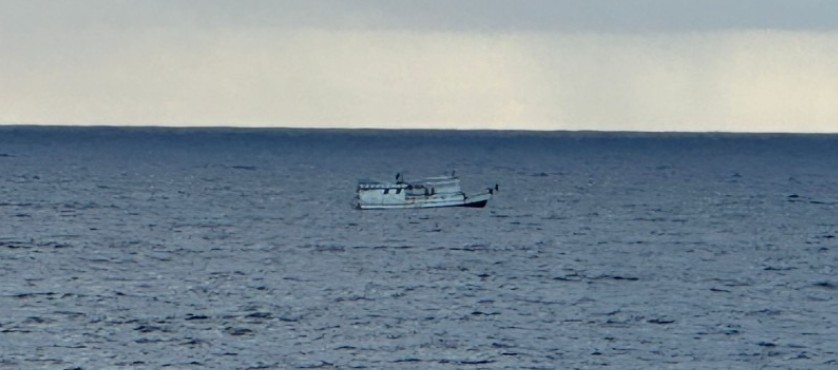
Portugal’s Judicial Police (Polícia Judiciária), through its National Unit for Combating Drug Trafficking, carried out a major law-enforcement operation in recent days in close coordination with the Portuguese Navy and Air Force, leading to the dismantling of a criminal group responsible for smuggling large quantities of drugs into mainland Europe using a fishing vessel. Authorities seized approximately 1,800 kilograms (about 4,000 pounds) of cocaine during the operation.
The vessel, which had departed from a Latin American country, was detected and intercepted about 450 nautical miles from the Azores under extremely difficult conditions at sea.
On board the boat, authorities found eight men—four Brazilian nationals, three from Suriname, and one Dutch citizen. Investigators also seized various items used in the navigation and transportation of the cocaine.
A Portuguese Navy ship escorted the fishing vessel, its eight crew members, and the seized drugs to the port of Ponta Delgada in the Azores, where it docked.
Based on the evidence gathered, investigators from the Azores Criminal Investigation Department (DIC) of the Judicial Police, working in coordination with the Public Prosecutor’s Office in Ponta Delgada (DIAP), carried out additional investigative actions aimed at collecting evidence and halting the suspects’ illicit activities, which authorities believe had been underway for several days.
The investigation, conducted within the framework of the Maritime Analysis and Operations Centre – Narcotics (MAOC-N), began earlier this month as part of an international law-enforcement cooperation effort. It involved close coordination with authorities from the United Kingdom’s National Crime Agency (NCA), the United States Drug Enforcement Administration (DEA), and the Joint Interagency Task Force South (JIATF-South).
The investigation remains ongoing.
In Correio dos Açores-Paulo Viveiros, director
Translated into English as a community outreach program by the Portuguese Beyond Borders Institute (PBBI) and the Modern and Classical Languages and Literatures Department (MCLL), in collaboration with Bruma Publication and ADMA (Azores-Diaspora Media Alliance) at California State University, Fresno. PBBI thanks Luso Financial for sponsoring NOVIDADES.

 Novidades - The Islands and the Diaspora