

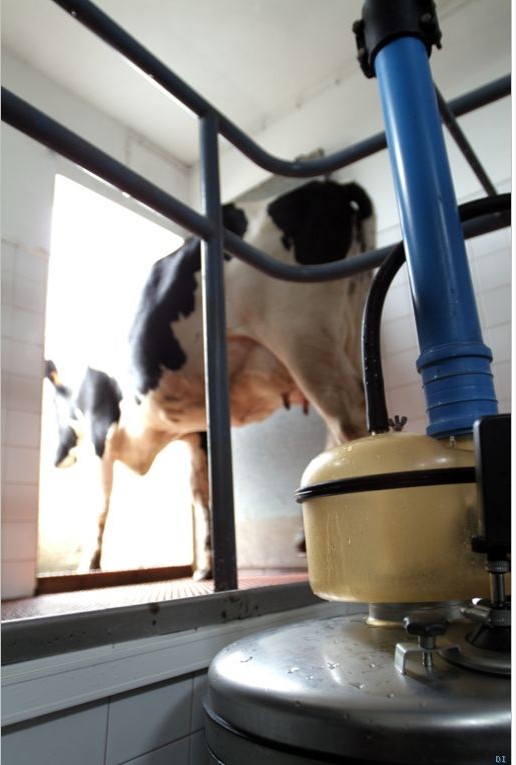
The Agricultural Federation of the Azores (FAA) is warning that dairy farmers across the archipelago are facing mounting difficulties as the price paid for milk continues to fall while the costs of production steadily rise.
In a statement, the federation described a troubling economic climate for producers—one made even more uncertain by the ongoing conflict in the Middle East and its ripple effects on global markets. The situation, the FAA argues, demands coordinated responses not only from regional authorities but also from the Portuguese government and the European Union.
The concerns were raised during the general assembly of the Azorean Center for Milk and Dairy Products (CALL), held Wednesday at the headquarters of the São Miguel Agricultural Association (AASM). The meeting brought together representatives from several key institutions in the dairy sector, including the Terceira Island Agricultural Association (AAIT), the Institute for Agricultural Food and Market Affairs (IAMA), and leaders from major dairy companies such as Lactaçores, Insulac, Prolacto, BEL, and PRONICOL.
Beyond the routine discussion of CALL’s financial matters, participants examined the current state of the dairy market and the evolution of both national and international demand. Agricultural associations used the meeting to outline the pressures felt by producers at a time when milk prices are declining while operating costs—from fuel and electricity to natural gas, fertilizers, raw materials, and maritime transport—continue to climb.
According to the federation, these rising costs are tied to a volatile global environment marked by new armed conflicts and economic uncertainty, conditions likely to fuel higher interest rates and inflation. For farmers already operating on narrow margins, the imbalance between declining revenues and expanding costs has become increasingly difficult to sustain.
The federation also noted that the sector faces additional pressures with the approach of a new European Union funding framework, which will require farms to undertake significant investments in modernization and compliance.
FAA leaders said the warning was directed in part to the dairy industry itself, urging reflection on the long-term sustainability of the sector. If current conditions persist, they cautioned, the combination of financial strain and chronic labor shortages could accelerate the demoralization and decapitalization of farmers. A continued decline in the number of producers—and in overall milk production—could ultimately jeopardize the stability of the entire dairy chain in the Azores.
For that reason, the federation is calling for a joint strategic discussion among the Regional Government of the Azores, the Portuguese national government, and European authorities to address what it describes as a critical moment for the region’s dairy economy.
Signs of unrest among farmers have already begun to emerge. In early February, dairy producers on the island of Terceira said they were considering reducing milk production, converting farms to beef operations, or even taking to the streets in protest after the price paid for milk dropped by three cents per liter.
“Producers are indignant and demoralized,” José António Azevedo, president of the Terceira Agricultural Association, told reporters at the time. “There has to be some solution to change this scenario. It ultimately lies in the hands of the producers and the delegates of Unicol. Too often producers simply accommodate the situation.”
The base price paid by the dairy cooperative Unicol had fallen to 35 cents per liter—currently the lowest milk price in the Azores.
Last month, the Azorean Regional Secretary for Agriculture, António Ventura, acknowledged that the drop in milk prices on Terceira and Graciosa could not be explained solely by market forces. He also signaled support for a proposal from the Agricultural Federation to open applications for programs allowing dairy farms to convert their operations to beef production.
Taken together, the developments reflect a growing unease within one of the Azores’ most important economic sectors—a landscape of green pastures and grazing cattle that has long defined the islands’ rural identity, but which now stands at a crossroads shaped by global markets, rising costs, and uncertain futures.
In Diário Insular – José Lourenço-director.
Translated into English as a community outreach program by the Portuguese Beyond Borders Institute (PBBI) and the Modern and Classical Languages and Literatures Department (MCLL), in collaboration with Bruma Publication and ADMA (Azores-Diaspora Media Alliance) at California State University, Fresno. PBBI thanks Luso Financial for sponsoring NOVIDADES.

 Novidades - The Islands and the Diaspora