

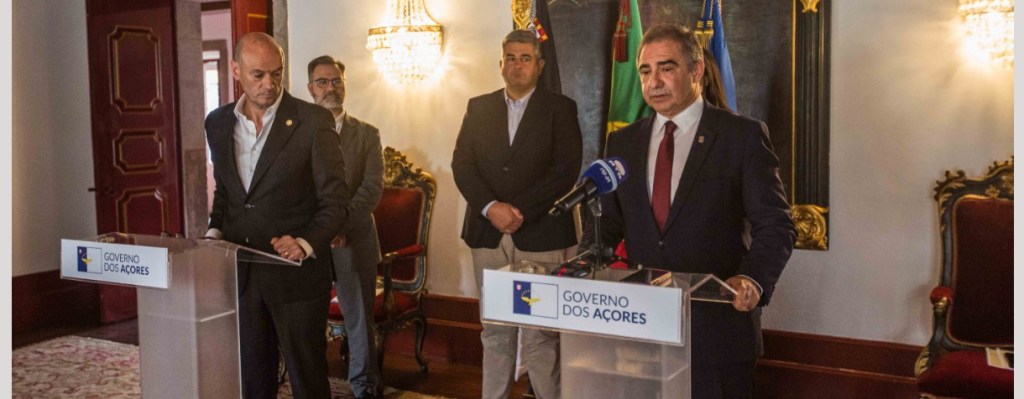
The president of the Azorean Regional Government, José Manuel Bolieiro, said he will not allow what he called “parochial narratives” to shape public policy, reaffirming that investment in the region’s health system will continue to strengthen the complementary roles of the archipelago’s three public hospitals.
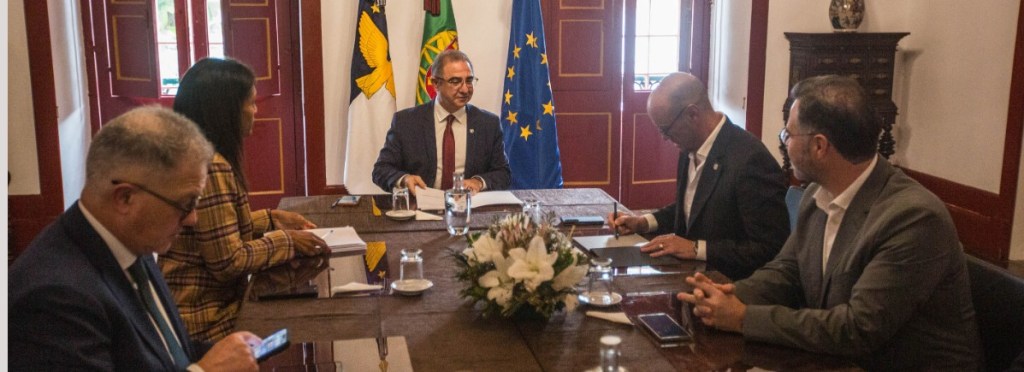
Speaking to reporters after a meeting with the executive board of Terceira Island’s Island Council, Bolieiro stressed that the government remains committed to a balanced and cooperative model of healthcare across the islands.
“I will not allow the governance of the Azores to be conditioned by false narratives rooted in local rivalries,” he said. “What I do welcome is dialogue—listening to the perspectives of each part of the Azores so that together we can value the entire archipelago.”
Bolieiro noted that the government’s program already establishes that the Regional Health Service is built upon three hospitals working in complementarity, and he insisted that the administration has not changed course. According to the regional leader, ongoing investments are designed to strengthen the capacity of each hospital while improving the system as a whole.
“All the investments we have been making aim to empower each hospital,” he said, referring both to their current capabilities and to their future expansion. “The goal is a Regional Health Service that becomes increasingly robust, not only within Portugal but also within the broader European context.”
The president also emphasized that development in one part of the archipelago should never come at the expense of another.
“We cannot halt the development of one hospital in the name of another, nor can we strengthen one without valuing the others in an equitable way,” he said.
Bolieiro reiterated his position following last year’s fire at Hospital do Divino Espírito Santo (HDES) in Ponta Delgada, explaining that the government is not planning to build an entirely separate new hospital. Instead, he said, the region is pursuing a solution that will effectively create a new facility capable of reinforcing the hospital’s capacity—while maintaining the three-hospital framework that structures healthcare in the Azores.
“There is nothing contradictory between what we are doing and what is set out in the Government Program,” he said. “Nor is there any attempt at centralization. No one will be prevented from growing or developing in the Azores.”
The meeting in Terceira also focused on strengthening cooperation and dialogue across the islands. Bolieiro argued that regional cohesion must prevail over narrow local interests.
“We do not govern in the name of island rivalries,” he said. “We govern in the name of the cohesion of the Azores and the value of each of our territories. Whenever parochialism prevails, we weaken. Whenever regional cohesion and convergence prevail, we grow stronger.”
At the meeting, Marcos Couto, president of Terceira’s Island Council, presented Bolieiro with a document outlining the council’s vision for the future of healthcare in the archipelago.
“We defend the importance of a Regional Health Service that operates in complementarity through its three hospitals,” Couto said after the meeting. “It must also have a strong strategy for attracting and retaining doctors and other healthcare professionals, and it must continue to grow so it can provide better care for the people of the Azores.”
Couto, who has previously expressed concern about the possible concentration of investment in the hospital in Ponta Delgada, said he was reassured by the guarantees offered by the regional government.
“We leave satisfied,” he said. “There are many points where the Island Council’s thinking and what the president and the regional secretary for health conveyed to us are in perfect alignment. This is a process that will continue to unfold over the coming months, but there is far more that brings us together than what separates us.”
In a region defined by geography as much as by politics, the future of the Azorean health system—spread across islands yet tied by a single public service—remains a question not only of infrastructure but of balance, cooperation, and the shared promise of care across the Atlantic archipelago.
In Diário Insular – José Lourenço-director
Translated into English as a community outreach program by the Portuguese Beyond Borders Institute (PBBI) and the Modern and Classical Languages and Literatures Department (MCLL), in collaboration with Bruma Publication and ADMA (Azores-Diaspora Media Alliance) at California State University, Fresno. PBBI thanks Luso Financial for sponsoring NOVIDADES.

 Novidades - The Islands and the Diaspora