

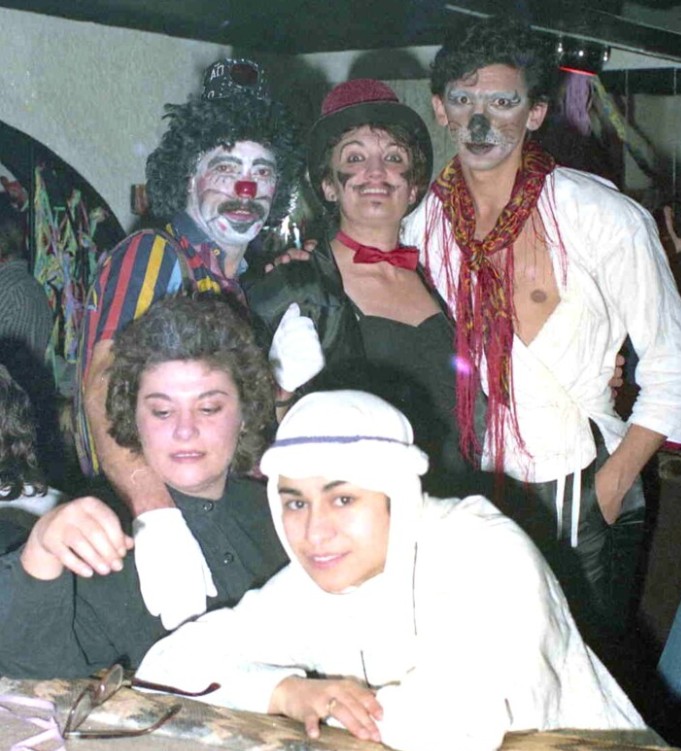
A few days ago, as I passed a café terrace in Angra do Heroísmo, I overheard three people leaning over a phone, debating the date of a photograph, the place where it had been taken, and—if I understood correctly—the identities of the people in it. I immediately knew what they were looking at. Like so many others in recent weeks, they were scrolling through the galleries of “Foto Gabriel.”
Gabriel Vieira—known to everyone simply as Foto Gabriel—is one of the most popular photographers on Terceira Island, perhaps even across the wider Azores. His work has traveled far beyond the islands, especially among the diaspora, thanks to his iconic photographs of the touradas à corda, the traditional rope bullfights that remain a hallmark of Terceira’s summer festivals. He also preserved many of those moments on video. Who among us has never noticed his small chair tied to a pole in the middle of a crowded arraial, his improvised studio perched above the chaos?
Now, as he celebrates half a century behind the camera—after even running a YouTube channel that once gathered hundreds of thousands of followers before anti-bullfighting activists succeeded in taking it down—Gabriel has opened his archives. And what has emerged are galleries that feel less like photo albums and more like a living history of the island.
Almost overnight, people began rediscovering events and faces, many from the 1990s—yes, already a different century. These images remind us of something we scarcely value today: the moment itself. In our time everything moves at a frantic pace—instantaneous, fleeting, volatile, consumed and forgotten almost as quickly as it appears. We take thousands of pictures, release them into the digital ether, and abandon them there.
Back then—though it was only yesterday, really—life moved more slowly. Events were fewer, anticipated, and savored. Was it better or worse? Simply different. Yet it carried one priceless advantage: those moments were lived alongside people who are no longer with us. And that, as we all know, cannot be measured or compared.
Scrolling through the Foto Gabriel galleries, I suddenly found myself again at the Students’ Bullfight of 1993, or at the prize ceremony of the 2nd Agência Teles Rally in 1988. So many people who have since departed appear there again, unexpectedly alive, as if speaking to us through the grain of a roll of film. In the crowd at a bullfight. At a Carnival party. At a sporting event. In a procession. At a military oath ceremony. In those frames, the entire island suddenly gathers—men thinner and dressed in white socks, women younger, curls bouncing in the island wind.
There is Mestre Gil, and Mr. Raul Pamplona, the unforgettable Almeida brothers—after all, Gabriel served as the resident photographer at the legendary Twins Pub. There are rally drivers and footballers, José Greta, political leaders, musicians, masked revelers, and countless anonymous faces. Each one, knowingly or not, helps to sketch the memory of a place.
Whether one agrees with every aspect of that past or not, the galleries offer something rare: the chance to revisit a shared time. And for that, Foto Gabriel, one can only say thank you.
Now the question lingering in everyone’s mind is simple: what memories will appear next from the depths of that archive?
Miguel Sousa Azevedo is a regular columnist for Diário Insular and a radio broadcaster at Rádio Clube de Angra, on terceira island, Azores.
NOVIDADES will feature occasional opinion pieces from leading thinkers and writers in the Azores, providing the diaspora and those interested in the current state of the Azores with a sense of the significant perspectives on some of the archipelago’s issues.
Translated to English as a community outreach program from the Portuguese Beyond Borders Institute (PBBI) and the Modern and Classical Languages and Literatures Department (MCLL).
 Novidades - The Islands and the Diaspora