

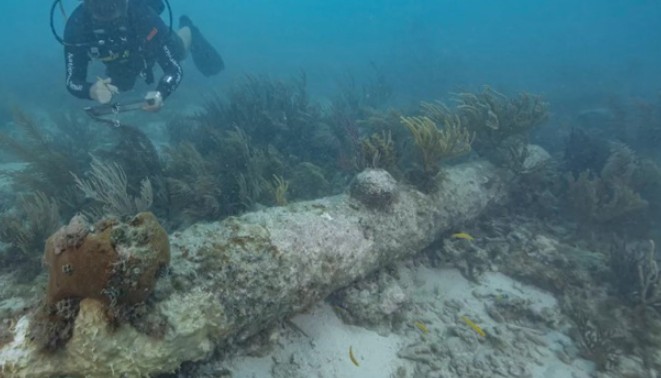
Beneath the deep waters that embrace the Azores lies one of the most extensive submerged historical archives in the world. For more than five centuries, this archipelago stood at the crossroads of the great maritime routes linking Europe to the Americas, Africa, and the East. Through these waters sailed ships laden with goods, soldiers, explorers, pilgrims, and emigrants. Many, however, never reached their destination. Sudden storms, navigational errors, naval confrontations, piracy, and the simple hazards of the sea left behind, on the ocean floor, a trail of sunken vessels that today constitute a remarkable archaeological heritage of immense historical and scientific value.
According to the Guide to the Underwater Cultural Heritage of the Azores, published by the Regional Directorate for Culture, it is estimated that nearly one thousand shipwrecks are historically documented in Azorean waters. This striking number reflects the archipelago’s central role in Atlantic navigation since the sixteenth century. Yet only a small portion of these vessels has actually been identified on the seabed through archaeological research. Between the written record and scientific discovery stretches a vast realm of silence where much of the maritime history of the Azores still lies undiscovered.
The explanation for this concentration of shipwrecks begins with geography. Situated roughly midway between Europe and the Americas, the Azores became, from the fifteenth century onward, an almost inevitable waypoint on transatlantic voyages. The prevailing currents and winds of the North Atlantic often guided ships returning from the Americas or the Eastern trade routes toward the archipelago before the final leg of their journey to European ports. For centuries, Azorean harbors served as staging points for resupply, repairs, and the reorganization of fleets, transforming the islands into a vital node of global navigation—and, inevitably, into a frequent stage for maritime tragedy.
The bay of Angra do Heroísmo, on Terceira Island, was during the sixteenth and seventeenth centuries one of the principal ports of the Atlantic world. Later, between the eighteenth and nineteenth centuries, the harbor of Horta on Faial Island emerged as a major stopover for British and American vessels. Between 1839 and 1862 alone, twenty-nine ship losses were recorded in the port of Horta, involving vessels of several nationalities—an eloquent testimony to the intense maritime activity of the era.
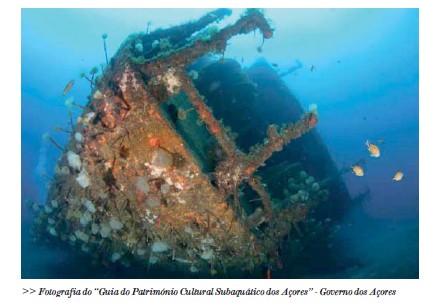
In recent decades, underwater archaeology has begun to shed light on some of these remnants of the past. The Guide to the Underwater Cultural Heritage of the Azores identifies thirty archaeological sites open to observation across the islands, forming some of the most significant underwater heritage locations in Portugal. Among the most well-known are the remains of the Dori off São Miguel, the Caroline near Pico, the Slavonia in the waters of Flores, and the Canarias off Santa Maria. These sites are part of a broader system of heritage protection that includes five underwater archaeological parks created in the region since 2005.
The first of these parks was established in the bay of Angra do Heroísmo, widely regarded as one of the areas with the greatest scientific potential for underwater archaeology in Portugal. Subsequently, other sites—including the Dori, Caroline, Slavonia, and Canarias—were granted similar protected status, forming a network of safeguarded areas dedicated to scientific research, heritage education, and carefully managed tourism. What was once merely the site of maritime loss has thus become a place of knowledge and discovery.
For archaeologists, every shipwreck functions as a time capsule. The remains preserved on the seabed—wooden structures, artillery pieces, anchors, ceramics, navigational instruments, and countless other artifacts—allow researchers to reconstruct episodes from the history of Atlantic navigation, global trade routes, and the shipbuilding technologies employed across centuries. Some of these wrecks are linked to events of far greater historical scale: naval battles between European powers, attacks by privateers on treasure-laden galleons returning from the Americas, or accidents during voyages along the famed India Route. The study of these vestiges illuminates not only maritime disasters but also the economic and political dynamics that shaped Europe’s maritime expansion.
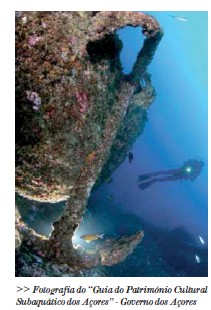
In the Azores, underwater archaeological research is conducted by scientific institutions and public entities dedicated to protecting and studying this unique heritage. The removal of artifacts or entry into submerged structures is strictly prohibited in order to preserve the integrity of these archaeological sites; only observation, photography, and scientific documentation are permitted. At the same time, the appreciation of this heritage has contributed to the emergence of a new dimension of regional tourism. Shipwreck diving has become one of the most sought-after experiences in the archipelago, combining adventure with history, science, and contemplation.
Despite these advances, much of the Azorean underwater heritage remains undiscovered. The depths of the surrounding ocean—exceeding one thousand meters in many areas—make the identification of wrecks extremely difficult, requiring advanced technology and complex research expeditions. Nevertheless, scholars believe that new discoveries are likely in the coming decades as ocean exploration technologies continue to evolve.
Should that occur, the sea surrounding the Azores may come to be recognized more fully as one of the great submerged archives of the Atlantic. There, in the dim silence of the depths, rests a memory composed of routes, losses, empires, hopes, and crossings. And perhaps that is the deepest fascination of this heritage: the reminder that beneath the vast blue surface of the ocean, the Atlantic still guards the long and unfinished story of its own making.
In Diário dos Açores-Paulo Viveiros-director
Photos from the Regional Government of the Azores.
Translated into English as a community outreach program by the Portuguese Beyond Borders Institute (PBBI) and the Modern and Classical Languages and Literatures Department (MCLL), in collaboration with Bruma Publication and ADMA (Azores-Diaspora Media Alliance) at California State University, Fresno. PBBI thanks Luso Financial for sponsoring NOVIDADES.
 Novidades - The Islands and the Diaspora