

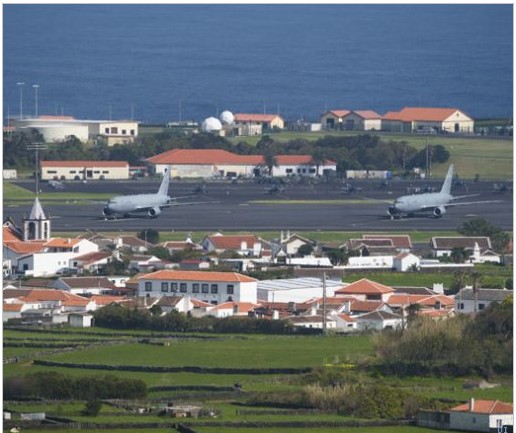
The March plenary session of the Azorean Legislative Assembly opens today under the weight of urgency and geopolitics, as lawmakers confront a question long suspended between diplomacy and neglect: what, exactly, has the region gained from hosting one of the Atlantic’s most strategic military outposts?
At the center of the debate stands the U.S. use of the Lajes Air Base on Terceira Island—once again thrust into global relevance amid renewed military activity linked to the recent American strike on Iran.
The right-wing party Chega, which requested the emergency session, is calling for a rigorous and transparent accounting of the base’s real impact. For its deputies, the issue is no longer abstract strategy but tangible return: economic, social, and structural benefits for the Azorean people.
They want answers. What compensation has flowed back to the islands in exchange for their strategic location? How actively have both the Azorean Regional Government and the Portuguese Republic defended local interests in negotiations with Washington? And perhaps most urgently: how can a base of such global importance coexist with local workers reportedly earning below Portugal’s national minimum wage?
The debate, as framed by Chega, is not merely about military cooperation—it is about accountability. Lawmakers are pressing for clarity on the current strategic framework governing Lajes, the obligations assumed under international agreements, and whether those commitments have been honored in practice. They are also demanding a forward-looking vision: what future, if any, does the base hold for the region beyond its role as a logistical node in times of war?
The timing is no coincidence. Increased U.S. military traffic through Lajes has reignited public scrutiny, once again exposing the uneasy balance between global power projection and local consequences.
For decades, the base has symbolized transatlantic alliance; today, it risks becoming a symbol of asymmetry—of strategic value extracted without proportional return.
Beyond the Lajes debate, the parliamentary agenda reflects a broader social and economic unease. Legislators will vote on proposed changes to the calculation of VAT revenues for autonomous regions, a move that could reshape the Azores’ fiscal landscape.
They will also consider labor protections, including a proposal to guarantee private-sector workers a daily meal subsidy equal to that of public employees. Housing access, environmental threats such as the chestnut gall wasp, and trail safety are likewise on the docket—issues that, taken together, sketch a portrait of a region negotiating both its vulnerabilities and its ambitions.
Two citizen petitions will also reach the floor: one calling for an increase in the regional supplement to the national minimum wage, backed by thousands of signatures, and another demanding urgent protection for a historic estate in Ponta Delgada. These voices, rising from the civic ground, echo the central question of the session itself: who benefits, and who is left waiting?
In the end, the debate over Lajes is not only about a base. It is about sovereignty in practice, about the lived meaning of autonomy fifty years after it was written into Portugal’s Constitution. It is about whether the Azores remain merely a waypoint in global strategy—or whether they can finally claim their place as a partner whose value is not only recognized, but returned.
In Diário Insular-José Lourenço-director.
Translated into English as a community outreach program by the Portuguese Beyond Borders Institute (PBBI) and the Modern and Classical Languages and Literatures Department (MCLL), in collaboration with Bruma Publication and ADMA (Azores-Diaspora Media Alliance) at California State University, Fresno. PBBI thanks Luso Financial for sponsoring NOVIDADES.

 Novidades - The Islands and the Diaspora