

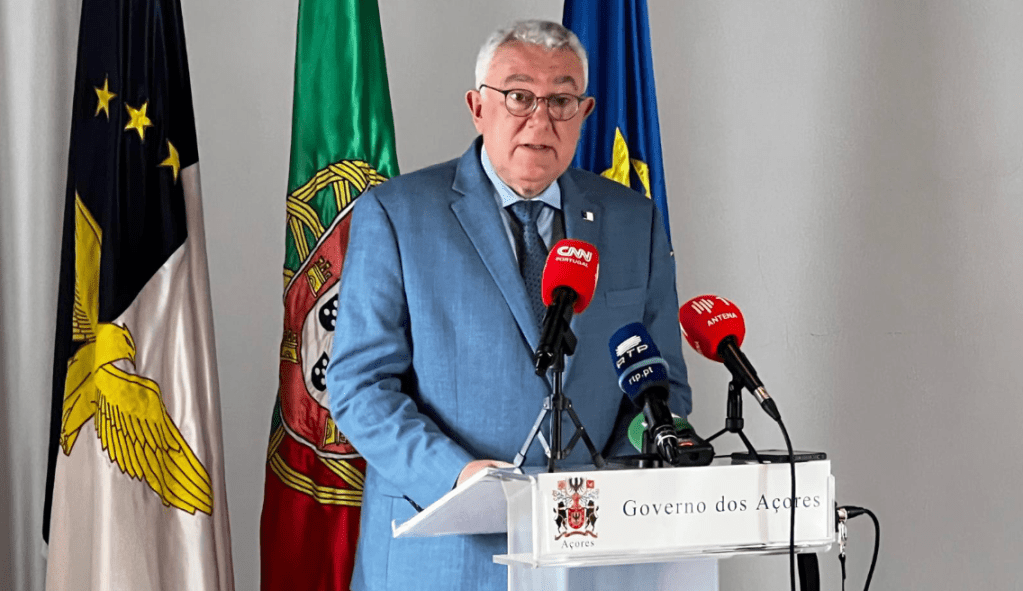
Vice-President of the Azorean Regional Government, Artur Lima, addressed the Regional Legislative Assembly yesterday during an urgent debate on the use of Lajes Air Base, emphasizing that “Lajes must continue to serve international security—but it must also serve the development of the Azores and the future of Portugal.”
For Lima, Lajes has long stood as “one of the fundamental pillars of the Euro-Atlantic security architecture and the preservation of peace in Europe and across the world.” The Azores’ location—at the crossroads of air and sea routes between Europe and North America—has made Lajes a vital logistical hub for military operations, maritime surveillance, communications, strategic transport, and NATO support.
He also underscored the deep, centuries-long relationship between the Azores and the United States—one shaped not only by diaspora ties, but by shared values and a common vision on major global issues. Within that framework, Lajes Air Base has played a decisive role in successive negotiations between Portugal and the U.S., leaving a lasting imprint on the history of the Azores, particularly Terceira Island.
Yet Lima argued that in each of those negotiations, “the Region has lost fair and rightful compensations—losses perhaps not felt by the Portuguese Republic,” adding that successive national governments have consistently failed to defend Azorean interests.
“The downsizing of the American presence did not mean a downsizing of its geostrategic importance,” he stressed.
Calling the timing of the debate misguided, Lima warned that revising the Cooperation and Defense Agreement under current international conditions would be “imprudent.” He also recalled that the Luso-American Development Foundation (FLAD), created under the 1983 bilateral agreement, exists because of the Azores and Lajes—a historical fact—and insisted it must meaningfully collaborate with the region’s research and innovation ecosystem.
“The Base of Lajes, on Azorean soil, must continue to serve international security,” he concluded, “but it must also serve the development of the Azores and the future of Portugal.” Autonomy, he added, “is not an abstract concept—it is exercised here, in the heart of the Atlantic.”
CDS: Azores Must Be Decision-Makers, Not Bystanders
CDS parliamentary leader Pedro Pinto argued that Lajes is “not merely a military installation,” but an integral part of Azorean identity and lived experience across generations.
He recalled that after World War II, the arrival of the U.S. military brought waves of Azoreans to Terceira in search of work, forging bonds that extend far beyond strategy. He also pointed to historical milestones such as the Azorean Refugee Act (1958–1960), which enabled many islanders—especially from Faial after the Capelinhos eruption—to emigrate to the United States.
That shared history, he argued, must guide future decisions, particularly within the Portugal–U.S. Bilateral Commission. Citing the Portuguese Constitution, Pinto maintained that it is both natural and constitutionally sound for the Autonomous Region of the Azores to play a stronger role in those negotiations.
“When the future of the Azores is discussed,” he concluded, “the Azores cannot simply be the object of decisions—they must be the protagonists.”
Chega: Strategic Value Must Be Converted into Real Gains
Chega’s parliamentary leader José Pacheco emphasized that Lajes holds the strategic importance his party has long recognized—central in the Atlantic and essential to regional leverage.
While acknowledging that the agreement with the U.S. has needed revision since 1995, he cautioned against immediate renegotiation, noting that the Azores currently lack political weight in decisions controlled from Lisbon.
Still, he argued for clear rules and stronger demands: “We have a house we rent out, but where nearly everything ends up in the tenant’s name.” For Pacheco, autonomy must mean an active voice in decisions affecting the region.
Liberal Initiative: “This Is the Moment” to Renegotiate
Nuno Barata of the Liberal Initiative argued that now—precisely when external powers recognize the Azores’ geostrategic importance—is the time to act.
“The agreement dates back to 1995, has gone unreviewed, and has been tacitly renewed since 2000,” he said. “It must be revised.”
Barata stressed that Lajes cannot be reduced to a transactional ledger between the U.S., Portugal, and the Azores. Instead, it must be understood as a cornerstone of regional development and forward defense. He noted that U.S. investment tied to the base injects roughly $100 million annually into the local economy.
Left Bloc: War Use of Lajes Risks Economic and Social Fallout
From a sharply different perspective, António Lima of the Left Bloc warned that supporting U.S. military operations—particularly in the context of escalating tensions with Iran—would deepen global instability and ultimately harm the Azores.
“Bombs dropped on Tehran do not bring democracy or human rights,” he said. “They bring death and destruction.”
The Bloc advocates an alternative path: reducing dependency on the United States, expanding civilian uses of Lajes, and aligning defense policy with international law, environmental protection, and peaceful cooperation.
Across the political spectrum, one point remains clear: Lajes Air Base is no longer just a military question. It is a question of autonomy, identity, and the right of the Azores to shape their own destiny at the center of the Atlantic world.
In Diário dos Açores-Paulo Viveiros, director
Translated into English as a community outreach program by the Portuguese Beyond Borders Institute (PBBI) and the Modern and Classical Languages and Literatures Department (MCLL), in collaboration with Bruma Publication and ADMA (Azores-Diaspora Media Alliance) at California State University, Fresno. PBBI thanks Luso Financial for sponsoring NOVIDADES.

 Novidades - The Islands and the Diaspora