

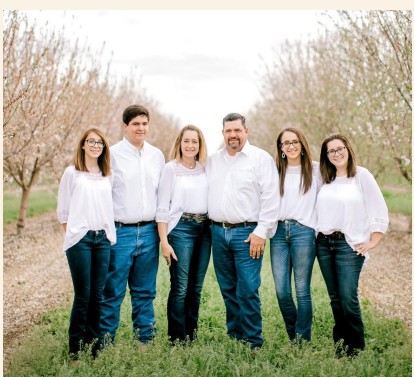
For my oral history project, I chose to sit with my mother, Anna De Borba Santos—a figure who has always stood at the quiet center of my life, steady as breath, constant as memory. What began as an interview became something deeper: an unfolding of stories shaped by migration, labor, love, and the enduring pulse of Portuguese heritage. In listening to her, I came to understand not only who she is, but how an entire world can be carried within one life.
Anna was born on June 29, 1971, in Tulare, California, a small town that would become, for many Azorean families, a new shoreline. She was the only daughter among three children, with her brothers Leon and John forming the early constellation of her life. But the story begins before her—across the Atlantic, in the volcanic landscapes of the Azores.
Her father, João De Borba, was born on October 23, 1930, on the island of Terceira, where the land demanded labor and gave back only what could be earned through persistence. He worked the fields, tending to the rhythms of agriculture that would later echo in California’s dairy country. Her mother, Arnalda De Borba, born on January 29, 1936, on the island of São Jorge, carried a different but equally essential labor. She nourished not only her family but entire crews of workers, preparing meals for milkers and farmers, sustaining the human side of an unforgiving routine. Together, they embodied a life rooted in endurance, dignity, and care.
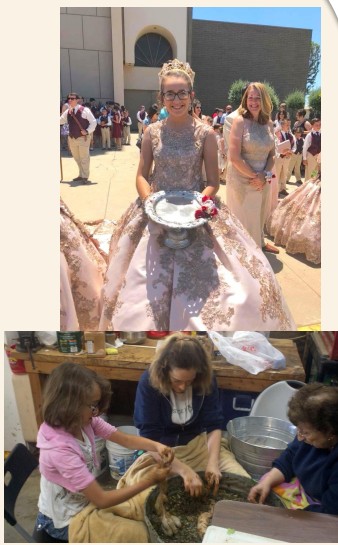
In the late 1960s, they made the crossing to California, drawn by the fragile promise of opportunity. What they found was not ease, but possibility—hard-won and repetitive. Anna remembers their days as a cycle of sacrifice: waking before dawn, working long hours, returning home only to rest briefly before beginning again. It was a life defined by discipline, and from it she inherited a work ethic that would shape her own path. Yet, in their relentless pursuit of stability, her parents remained somewhat distant from the organized expressions of Portuguese culture in their new homeland.
It was through extended family that Anna found her cultural grounding. Aunts and cousins became the keepers of tradition, inviting her into a world where identity was celebrated rather than simply remembered. She joined folklore groups, attended festas, and danced long into the night beside her cousins—moments that shimmer in her memory not only as joy, but as belonging. In these gatherings, culture was not something abstract; it was embodied—in music, in movement, in shared laughter.
These early experiences accompanied her through her years at Tulare Union High School, where another chapter of her life quietly began. It was there she met Tony Santos, her high school sweetheart, who would become her partner in both life and legacy. They graduated together, bound not only by affection but by a shared cultural inheritance. On August 12, 2000, they married, bringing together two families deeply connected to the Portuguese community of the Central Valley.
Tony’s family, already immersed in community life, helped deepen Anna’s engagement. He and his father—both named Tony—held leadership roles within Portuguese halls, shaping spaces where culture could thrive. Together, Anna and Tony did more than participate; they became stewards of tradition.
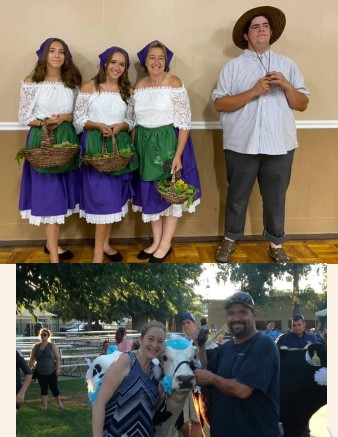
Their family grew to include four children—Adrianna, Manuel, Brianna, and Alexis—each raised within a world carefully cultivated by their parents. Across the Central Valley, from Tulare to Visalia, the family became a familiar presence at festas and community events. Adrianna, Brianna, and Alexis each served as queens for the Visalia PPAV Hall, embodying grace and cultural pride. Manuel, though less visible, played his own essential role—carrying flags, delivering water, ensuring the seamless flow of long, sunlit celebrations. Together, they formed a living tableau of continuity.
At the heart of this world stood Anna—not as a distant organizer, but as a tireless force of care and coordination. She packed cars before dawn, pressed dresses, and prepared her daughters to represent their heritage with dignity. Her commitment extended beyond her own family. She served on the PPAV Women’s Club Committee, took on the role of Queens’ Coordinator, and gave countless hours to the Portuguese bazaars, even helping to establish the booth in Visalia. Her life became a testament to the idea that culture survives not through grand declarations, but through sustained, often unseen labor.
She ensured that her children did not merely inherit their heritage—they lived it. They joined carnival groups, marched in festas, volunteered in community events, and learned the Portuguese language so they could speak with their grandparents, whose words carried the cadence of another land. In doing so, Anna built not only a cultural foundation, but a bridge between generations.
Within the home, tradition found its most intimate expression. Anna and Tony recreated the Azores in their own way, gathering family for matanças—rituals of food, labor, and memory that brought together young and old. These were not simply events, but acts of preservation, where knowledge was passed hand to hand. In the kitchen, Anna’s mother, Arnalda, became a quiet teacher, filling the space with the aromas of masa sovada, filhós, and fresh bread. There, recipes became stories, and stories became inheritance.
Through all of this, Anna has shaped a life where culture is not a distant origin, but a living presence. Even now, she remains active in marcha groups, continues to volunteer, and offers her time without hesitation. Her dedication is not performative—it is woven into the fabric of her being.
In telling her story, one begins to understand that heritage is not simply something we receive; it is something we choose to carry. Anna De Borba Santos has carried it with grace, with strength, and with a quiet, unwavering devotion. Through her, the past does not fade—it gathers, rises, and is offered forward, like bread shared at the table, warm and sustaining, across generations.
 Novidades - The Islands and the Diaspora