

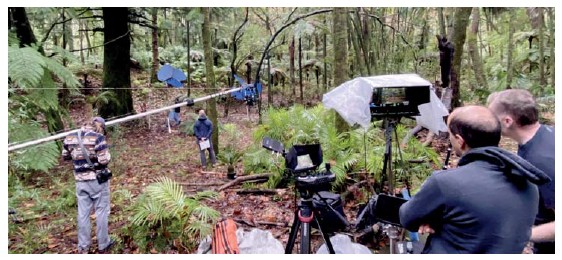
“The Goal Is That Anyone Who Comes to Film in the Azores Finds a Professional Experience—and Wants to Return”
João Dutra and Pedro Gaipo on building cinema from the middle of the Atlantic
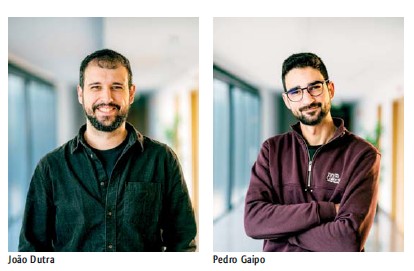
Since 2014, João Dutra and Pedro Gaipo have led Cão de Fila Produções, a video production company based in the Azores that has steadily evolved from a modest local initiative into a dynamic presence in both national and international audiovisual projects. What began as a way to support local musicians has grown into a broader vision: to position the Azores as a serious and competitive destination for film and media production.
Speaking to Atlântico Expresso, the two founders reflect on their journey, their challenges, and their ambitions.
Atlântico Expresso: How did the production company begin?
João Dutra & Pedro Gaipo:
Cão de Fila Produções was founded in 2014 with a very clear initial goal: to support local musicians by producing music videos and recording sound—services that, at the time, were largely inaccessible in the region. With the support of several institutions, we were able to set up a small studio at the Teatro Ribeiragrandense, equipped to record vocals and small instruments.
That’s where our first projects took shape, including the music video “Sensações” by Fred Cabral, featuring Romeu Bairros. From there, we began to realize that there was also room to expand into commercial work, producing aftermovies of events and promotional videos. The Ribeira Grande City Council became our first institutional partner, and from that point on, we steadily broadened both the scope and scale of our work.
What would you say is your core mission today?
Initially, it was about supporting Azorean artists—providing audiovisual products that would otherwise be too expensive for those not working in music full-time. Over time, that mission evolved.
Today, we aim to produce high-quality films for a range of regional clients while also creating the conditions necessary to attract outside productions—from mainland Portugal and abroad—by meeting international standards. The idea is simple: anyone who comes to film in the Azores should have a professional experience and want to come back.
In 2026, we’re entering a new phase with the release of our first original project: a 60-minute documentary. It marks the beginning of a deeper commitment to developing our own fiction and documentary work.
Did your academic or professional paths shape the creation of the company?
All of us have always been drawn to audiovisual work. About a decade ago, there weren’t many structured opportunities in the Azores to pursue that interest, so creating a production company became a natural way to follow that shared passion.
Our academic backgrounds didn’t necessarily lead to the company’s creation, but they did shape how we work. One of our team members studied at the Escola Superior de Teatro e Cinema, and that experience influenced our shift toward more structured, professional production methods—aligned with the standards used in mainland Portugal and internationally.
This meant building a more specialized and organized team, respecting the distinct roles of a film set—from director and cinematographer to camera assistants, gaffers, and beyond. That evolution has allowed us to collaborate with, and host, larger national and international productions with confidence.
You’ve worked on several major productions. Which stand out?
We’ve participated in a number of outside productions filmed in the Azores, including seasons two and three of the series Rabo de Peixe, directed by Augusto Fraga, and the film Honeyjoon by Lilian T. Mehrel. We’ve also collaborated on the BBC program Walking with Dinosaurs and campaigns for brands like Mango, Zara, Milhafre, and Siemens.
One recent highlight was coordinating the local production of the international workshop Werner Herzog – Azores Experience 2026, which brought 50 filmmakers from around the world to São Miguel. Over 11 days, they produced 28 short films—projects that will now circulate internationally, always carrying the Azores with them.
Those are the moments that feel closest to childhood dreams—standing on film sets like the ones we grew up watching.
What influences your work creatively?
We try to stay constantly engaged with both cinema and advertising. That means keeping up with storytelling techniques, visual language, and emerging aesthetic trends. But above all, we share a deep love of cinema. We go to the movies, we watch everything, and we let ourselves be immersed in the experience of storytelling on the big screen.
In advertising, we also follow global campaigns closely. We admire the creativity in many of today’s productions, and one of our goals is to bring that level of innovation to the Azores—so that regional companies can produce high-quality campaigns locally, without needing to outsource to mainland teams.
What are the biggest challenges you face? Does insularity play a role?
Absolutely. Insularity presents real logistical and financial challenges. Much of our equipment has to be sourced from outside the region, which increases costs. Repairs can also be complicated.
Then there’s geography: the Azores are made up of nine islands, and working across them requires flights, accommodations, vehicle rentals, and careful planning—especially with airline weight limits on equipment. These factors can make collaboration more difficult.
At the same time, the local market is relatively small and unpredictable. There’s a lot of talent here, but a limited client base. While private entities often distribute work among different companies, public sector processes aren’t always as transparent or quality-driven as they could be.
Why the name “Cão de Fila Produções”?
We wanted something strong, distinctive, and deeply tied to the Azores. Early on, we considered names connected to regional elements—cows, cheese, lagoons—but eventually landed on “Cão de Fila.”
It carries a sense of strength and identity, and over time, we’ve come to feel it was exactly the right choice.
What does the future look like for you?
Our future rests on two main pillars. The first is developing original productions—documentaries, series, short films, and feature films rooted in Azorean stories and realities.
The second is continuing to provide high-quality advertising content to both public and private clients in the region, ensuring that more projects can be produced locally with regional teams.
We’ve also been fortunate to discover and collaborate with an increasing number of local talents. These collaborations have not only strengthened our work but have also led to some of our most meaningful professional relationships.
What message would you like to leave to the community?
We want the audiovisual community in the Azores to know that we are always open to collaboration, especially on non-commercial projects—music videos, short films, and independent productions.
Each year, we try to support at least one locally produced short film by providing technical resources and equipment. We truly believe that great ideas are born from cooperation.
The Azores are too small for us to see each other merely as competitors. If we combine our efforts—producers, videographers, technicians—we become something much larger: a production ecosystem capable of competing on an international leve
Atlântico Expresso, a weekly newspaper directed by Natalino Viveiros.
Translated into English as a community outreach program by the Portuguese Beyond Borders Institute (PBBI) and the Modern and Classical Languages and Literatures Department (MCLL), in collaboration with Bruma Publication and ADMA (Azores-Diaspora Media Alliance) at California State University, Fresno. PBBI thanks Luso Financial for sponsoring NOVIDADES.
 Novidades - The Islands and the Diaspora