


Historian and former rector of the University of the Azores, Avelino Meneses, warned of “anemic economic growth and a structural financial deficit,” which, at present, stand as problematic legacies of Autonomy for the future.
“So how do we avoid disaster? By asking for money from those willing to give it—whether or not through a revision of the Regional Finance Law. Alternatively, by cutting spending or raising taxes,” he said.
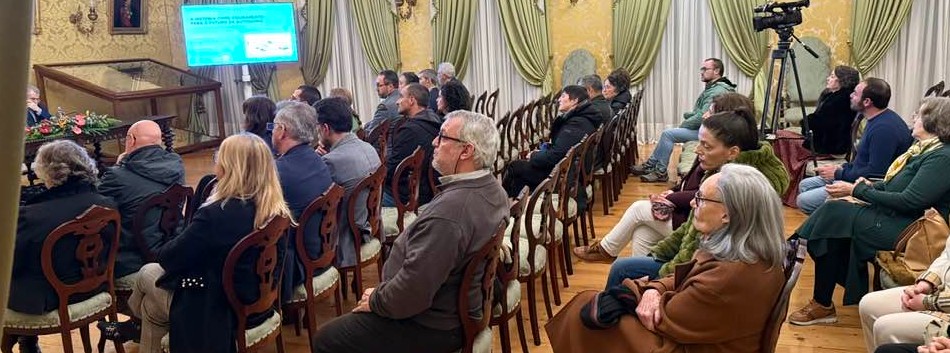
The former Regional Secretary of Education was speaking at a conference titled “History as a Lesson for the Future of Autonomy,” part of the series “Rethinking the Autonomy of the Future,” organized by the Historical Institute of Terceira Island as part of the 50th anniversary of the autonomous regime.
Meneses further argued that “after half a century, the Region’s record of the worst indicators in the country in terms of poverty and school failure, with no sustainable evidence of recovery, casts a deep shadow over the success of Autonomy.”
He also offered a partial critique of the narrative that Azoreans should retire earlier. “Equally striking is the revelation of the highest mortality rate (…) In such circumstances, the demand for early retirement for Azoreans, while demonstrating justice and humanity, also reveals a sense of intolerable inability to reverse this misfortune,” he lamented.
“And whose inability is it? First and foremost, that of the current government. Also, of past governments. And, worst of all, possibly of future governments,” he stressed.
Another speaker at the conference, held last Friday in the Noble Hall of Angra do Heroísmo City Hall, was Reis Leite, also a historian and former Regional Secretary of Education and Culture.
Reis Leite suggested that the Region may face the need to increase taxes, thereby reducing the fiscal differential with mainland Portugal.
At the same time, in the view of the former president of the Azorean Legislative Assembly, conditions are not favorable for revising the Regional Finance Law, which could even end up being revised downward.
“I don’t want to be cynical, but I think the Regional Finance Law has never been more than a utopia. Before that law existed, there were already discussions between regional governments and the national government to ensure compliance with the Constitution. I believe the governments of the Republic addressed the issue more effectively—first through the American agreement on Lajes Air Base and later through European integration,” he said.
For Reis Leite, the Regional Finance Law fails to fulfill its true purpose, “which was to provide certainty regarding the annual amount the regions would receive.”
“That never happened because successive finance ministers have always done their best to transfer as little as possible. It is a constitutional obligation, but I don’t see how the Constitution can specify that one ‘must receive x,’” he added.
“I won’t say I oppose the Regional Finance Law. But there were times when mechanisms existed that were more favorable to regional governments’ claims than the current situation,” he reinforced.
Yet the issue may run deeper, Reis Leite suggested, calling it “disappointing” that “after so much money has been invested in the Azores through Europe, America, and successive governments of the Republic, we still lack a sufficient tax base from citizens to at least cover administrative expenses.”
Avelino Meneses, for his part, expressed support for the existence of the Regional Finance Law as a factor of predictability. “It’s a double-edged sword. If regional politicians assert themselves before the central government, perhaps without a Regional Finance Law they might gain more—but the risk is that they could also end up receiving much less. I still agree with having such a law, clearly grounded in concrete assumptions, one that helps inject money into regional economies and makes administration more predictable,” he said.
However, he considered a revision of the law “advisable,” though the timing may not be right. “All of a sudden, national needs have grown—needs that did not previously exist. But one thing is certain: we will never find the perfect moment to revise the law. There is no ideal time, even if this moment is clearly not it,” he stressed.

One of the problems, the historian noted, is that “we want money to sustain our needs—and perhaps some fantasies—and the problem is that from the outside, only the fantasies are visible, not the needs.”
Still, Meneses rejected excessive pessimism. “The prime minister has already announced that it will be revised, and we hope that it will be.”
Taking a broader view of what has gone wrong in the autonomous journey, he pointed to shared responsibility. “The PSD governed, over 26 years, 20 alone and six with partners. The PS governed for 24. So, in fact, they are tied,” he noted.
This, however, is not the time to rely on arguments about inherited blame, he emphasized. “Everyone attributes their own failures to the past—to a historical legacy described as light or heavy, depending on preference. And now, in the era of the Azorean ‘geringonça,’ what is happening? The same thing,” he said.
“Very recently, I witnessed references to a so-called complex legacy—clearly a consequence of the long socialist tenure. Well, if after several years—a small eternity—that legacy is still complex, it is simply due to a lack of capacity to simplify it,” Meneses added.
Friday’s debate was moderated by former mayor of Angra do Heroísmo, Álamo Meneses, who warned of a moment of financial “asphyxiation” in the Region that could lead to a “decline” of the autonomous regime.
In Diário Insular-José Lourenço, director
Translated into English as a community outreach program by the Portuguese Beyond Borders Institute (PBBI) and the Modern and Classical Languages and Literatures Department (MCLL), in collaboration with Bruma Publication and ADMA (Azores-Diaspora Media Alliance) at California State University, Fresno. PBBI thanks Luso Financial for sponsoring NOVIDADES.

 Novidades - The Islands and the Diaspora