

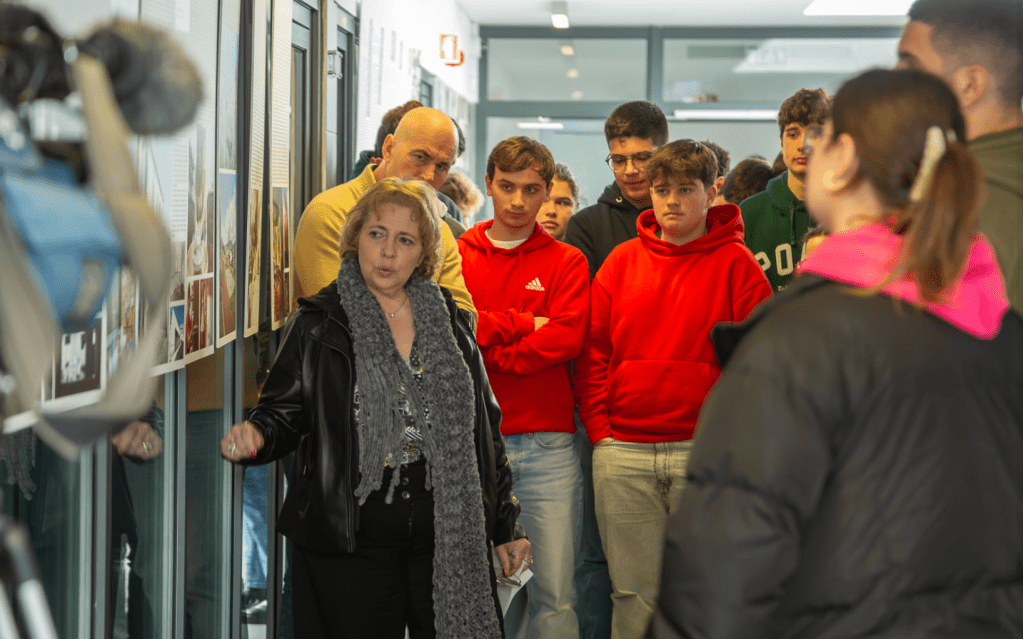
On Terceira Island, where landscape and livelihood have always been intertwined, the story of development is not written in abstractions, but in fields, classrooms, and the steady work of institutions that bind people to place. This week, that story found a new chapter as an exhibition marking the 30th anniversary of GRATER made its way into the schools of the island—carrying not only memory but also instruction.
At the center of this initiative was Fátima Amorim, Mayor of Angra do Heroísmo and Vice-President of GRATER, who visited both the Professional School of Praia da Vitória and the Secondary School Vitorino Nemésio to present the commemorative exhibition. Her presence was not merely ceremonial. It signaled a continuity between governance, education, and civic imagination—an acknowledgment that the future of the island is, quite literally, being formed in its classrooms.
Founded in 1995, GRATER has spent three decades cultivating what might be called the infrastructure of belonging. As a non-profit association, it has worked across the municipalities of Angra do Heroísmo, Praia da Vitória, and Santa Cruz da Graciosa, fostering collaboration between public and private actors and supporting projects that extend beyond economics into the region’s social and cultural fabric. Its mission—rooted in the valorization of both endogenous and exogenous resources—has translated into tangible improvements in quality of life, while preserving the integrity of local identity.
The exhibition now traveling through Terceira’s schools is, in essence, an invitation. It asks students and educators to see development not as a distant policy framework, but as a lived process—one that shapes their daily realities and future possibilities. By bringing GRATER’s work into educational spaces, the initiative bridges generations, offering younger audiences a practical understanding of how local action can yield lasting impact.
As Amorim noted, the exhibition underscores “the central role of GRATER in strengthening the municipality and mobilizing all local actors.” Her words carry a broader resonance. They speak to a model of development that is not imposed from without, but grown from within—sustainable, inclusive, and attentive to the rhythms of community life.
In an era when rural regions across the globe grapple with depopulation and economic uncertainty, the Azores offer a quieter, more deliberate counterpoint. Here, organizations like GRATER remind us that development is not only about growth, but about continuity—about ensuring that the knowledge, resources, and aspirations of a place are neither lost nor diminished, but renewed.
And so, in the classrooms of Terceira, amid the ordinary cadence of school days, a larger lesson unfolds: that the future of an island is inseparable from how it remembers, organizes, and invests in itself.
From Press Release
Translated into English as a community outreach program by the Portuguese Beyond Borders Institute (PBBI) and the Modern and Classical Languages and Literatures Department (MCLL), in collaboration with Bruma Publication and ADMA (Azores-Diaspora Media Alliance) at California State University, Fresno. PBBI thanks Luso Financial for sponsoring NOVIDADES.

 Novidades - The Islands and the Diaspora