

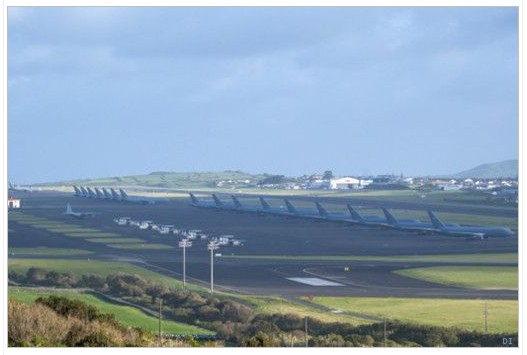
In recent days, the United States has significantly reinforced its presence at the Lajes Air Base, with a noticeable increase in aerial refueling aircraft and the deployment of advanced electronic warfare planes—moves that suggest heightened operational readiness amid escalating geopolitical tensions.
The fleet of Boeing KC-46 Pegasus tankers has grown by three additional units, bringing the total number stationed at Lajes to 18. In the weeks leading up to the first reported strikes on Iran, the number of tankers fluctuated between 11 and 15 aircraft. At times, as many as 24 refueling planes were observed on the ground. However, not all were American; some belonged to allied nations and were participating in pre-scheduled operations unrelated to the current conflict.
Pinpointing the exact number of aircraft operating exclusively from Terceira Island remains difficult. Daily fluctuations suggest a dynamic operational pattern, with some planes rotating through other bases after completing refueling missions before returning. Still, it is a reasonable estimate that between 11 and 15 KC-46 platforms are consistently flying missions from Lajes.
A Theater Beyond the Visible
Alongside the tanker buildup, the arrival last week of six Boeing EA-18G Growler jets marked a significant escalation in electronic warfare capability. These aircraft, often mistaken for standard F/A-18 fighters due to their shared design lineage, are equipped with sophisticated sensors and jamming systems designed to dominate the electromagnetic spectrum—an increasingly critical domain in modern warfare. The Growler replaced the aging EA-6B Prowler, a familiar presence at Lajes for decades before its retirement in 2019.
Also deployed were five Northrop Grumman E-2D Advanced Hawkeye aircraft, belonging to the United States Navy. These platforms serve as airborne command-and-control centers, capable of detecting and tracking targets over vast distances while coordinating complex operations—particularly in naval warfare environments.
By late last week, most of the Growlers had departed the base. As of yesterday afternoon, only one E-2D Advanced Hawkeye remained on site.
Waiting in the Wings
Both the EA-18G Growler and the E-2D Advanced Hawkeye are carrier-capable aircraft, typically operating from U.S. Navy aircraft carriers. Their temporary presence at Lajes may indicate a staging posture—awaiting orders to deploy aboard carrier strike groups entering operational range.
Such movements underscore the strategic importance of the Azores as a transatlantic hub, where geography and geopolitics intersect. In moments of uncertainty, the quiet runways of Terceira can quickly become a crossroads of global power projection—where aircraft arrive not only with fuel in their tanks, but with the weight of unfolding history in their wake.
In Diário Insular, José Lourenço-director
Translated into English as a community outreach program by the Portuguese Beyond Borders Institute (PBBI) and the Modern and Classical Languages and Literatures Department (MCLL), in collaboration with Bruma Publication and ADMA (Azores-Diaspora Media Alliance) at California State University, Fresno. PBBI thanks Luso Financial for sponsoring NOVIDADES.

 Novidades - The Islands and the Diaspora