

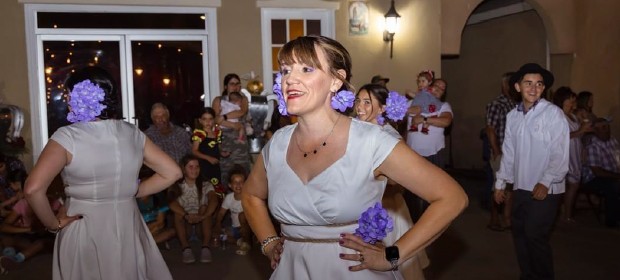
Stephanie Avila Mendes—born Stephanie Pereira Avila—begins not in rupture, but in continuity, one of those quiet continuities by which a people survives oceans, borders, and generations. Born on May 20, 1981, in Hanford, California, to parents from Terceira—her father from Biscoitos, her mother from Fontinhas—Stephanie came into the world already enveloped in the sounds, gestures, and emotional architecture of Portuguese life. Portuguese was not a language she later recovered as an emblem of ancestry; it was her first language, the intimate speech of home, affection, discipline, memory, and belonging. In that fact alone resides something deeply telling: for Stephanie, heritage was never a decorative attachment to identity, but its living root. From the beginning, she inhabited a world in which being Portuguese was not an occasional performance, but a daily way of understanding family, duty, celebration, and community.
That inheritance was strengthened by the social geography of her upbringing. Stephanie was raised in a world where Portuguese life was not abstractly remembered but actively lived—in halls, festas, rehearsals, classes, choirs, and gatherings where language and tradition moved naturally from one generation to the next. Her education at the Centro Português de Evangelização e Cultura in Tulare gave formal shape to what her home had already planted. There, she studied Portuguese and became one of the original members of the youth folklore group Doce Esperança at just ten years old. She also sang in the CPEC Youth Choir. These were not merely extracurricular activities; they were early acts of cultural stewardship. In dance and song, she learned that identity is preserved not only through memory, but through repetition, discipline, and joy. It is kept alive in the body as much as in the mind.
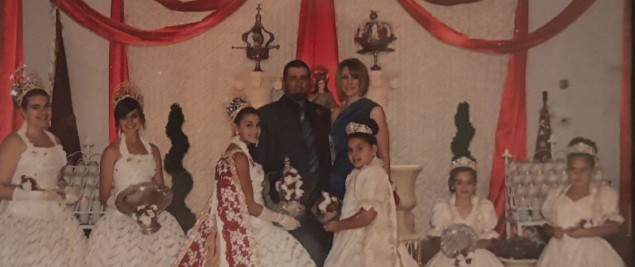
Over time, what began as participation matured into service. Stephanie did not remain simply a daughter of the community; she became one of its sustaining hands. Her work with the TDES Hall, including her service on its board between 2013 and 2015, and her earlier support of her husband John Mendes in his own roles within the organization, speaks to a life shaped by shared responsibility. Their marriage, celebrated on April 13, 2002, joined not only two people but two lives already deeply formed by Terceirense heritage. Together they built a family in which Portuguese identity would remain vivid and active, and together they assumed visible leadership in the Holy Spirit Festa in Tulare, serving as presidents in 2012 after Stephanie had earlier been honored as Big Queen in 1996. The festa, with its sacred and communal dimensions, remains one of the great vessels of Azorean memory in California, and Stephanie’s long devotion to it reveals the depth of her understanding that tradition survives only when people continue to carry it.
Yet her contribution extends beyond ceremonial roles. Stephanie’s life within the Portuguese community has been one of patient, multifaceted labor. She and her husband served as directors of the folklore group Saudade de Bravo, helping ensure that traditional dance would not become a relic but remain a living language among younger generations. Her clarinet playing with the Filarmónica Portuguesa de Tulare over nearly two decades gave music another lineage through which family and community could be woven together. In the Grupo Carnavalesco de Tulare, and through her long stewardship of the Marchas de São João for the past fourteen years, she has continued to animate the communal calendar with commitment, artistry, and care. Such work often escapes public grandeur because it belongs to the realm of continuity rather than spectacle. But communities endure less by isolated moments of brilliance than by the faithful labor of those who organize, rehearse, teach, encourage, and return, year after year, so that others may inherit what they themselves received.
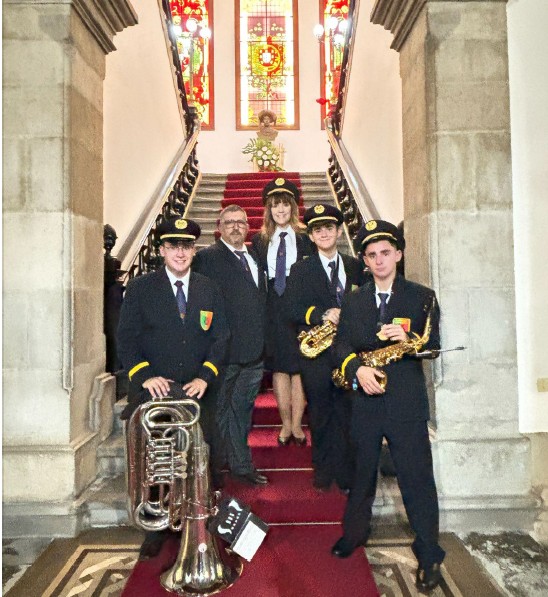
Perhaps most movingly, Stephanie has made of family itself a site of cultural transmission. Her three sons—Luke, Jonathon, and Ashton—have not merely observed Portuguese traditions from the margins; they have entered into them alongside their mother, performing in the FPDT and participating in danças, with her younger sons active in Luso-America. This intergenerational involvement reveals something essential: heritage does not survive through nostalgia alone. It survives because someone insists, lovingly and persistently, that the children come along, learn the songs, wear the clothes, understand the feast, enter the hall, and know the names of what came before them. Stephanie has understood that the future of a people is formed not only in grand declarations of pride, but in the everyday act of making sure the next generation belongs.
The dignity of that effort becomes even clearer when seen in light of her parents’ immigrant journey. Her mother arrived in the United States in 1968 at age twelve; her father came in 1972 at age sixteen. Their families, like so many Portuguese immigrant families in California, found their first footing in agriculture, laboring within the demanding but hopeful world of dairies and farm work. Their story is one of sacrifice, endurance, and adaptation. Stephanie grew up with a living awareness that the stability and opportunities she inherited had been hard won, often by parents and grandparents whose own educational and social paths had been constrained by language barriers, poverty, and the urgency of survival. In honoring her heritage, she also honors that sacrifice. Her devotion to community is therefore not sentimental; it is ethical. It arises from gratitude toward those who crossed the ocean with little certainty beyond the hope that their children might stand on firmer ground.
And Stephanie did stand on that ground with distinction. She excelled academically, graduating as salutatorian of Tulare Western High School in 1999, then earning both a bachelor’s degree in Liberal Studies and a master’s degree in Administrative Services from Fresno Pacific University. Since 2006, she has devoted her professional life to education in Earlimart, beginning as a seventh-grade English teacher and rising through positions of increasing responsibility—from Academic Coach to Vice Principal to Principal, a role she has held for the past nine years. Her recognition as Portuguese-American Teacher of the Year affirms not only professional excellence, but a broader symbolic truth: that the daughter of immigrants, formed by a culture sometimes overlooked in the American landscape, has become a leader entrusted with shaping young lives. In her, cultural rootedness and public service do not compete; they deepen one another.
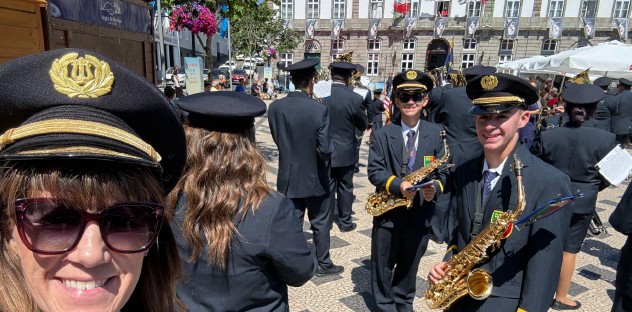
Stephanie Avila Mendes’s life offers more than a biographical sketch; it offers a lesson in what continuity looks like when it is lived with grace, discipline, and conviction. She stands as a figure of synthesis: at once educator and cultural bearer, community leader and mother, inheritor and transmitter. Her life reminds us that identity is not preserved by proclamation alone. It is preserved in fluency, in service, in music, in festas, in halls kept alive, in children brought into tradition, in memory made active through work. In a time when assimilation so often asks communities to soften their contours for the sake of convenience, her story speaks of another possibility—the possibility of entering American life fully without surrendering the ancestral music of one’s beginning. Her path shows that heritage, when loved and tended, does not confine a life. It enlarges it. And in that enlargement, a community finds not only its memory, but its future.
Oral History project submitted by Jonathan Mendes
Edited by Diniz Borges, Professor of Portuguese Language and Cultures and Director of PBBI-Fresno State.
 Novidades - The Islands and the Diaspora