

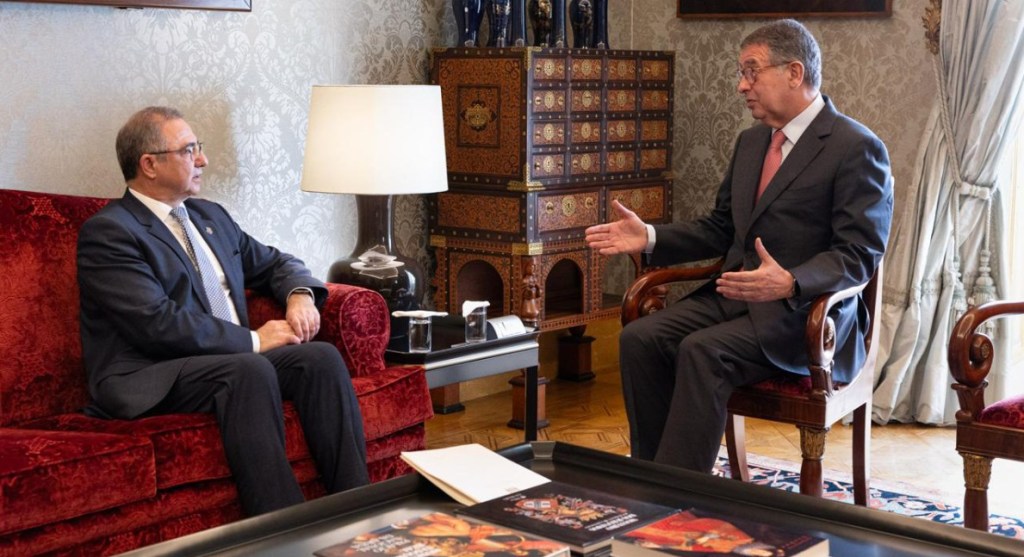
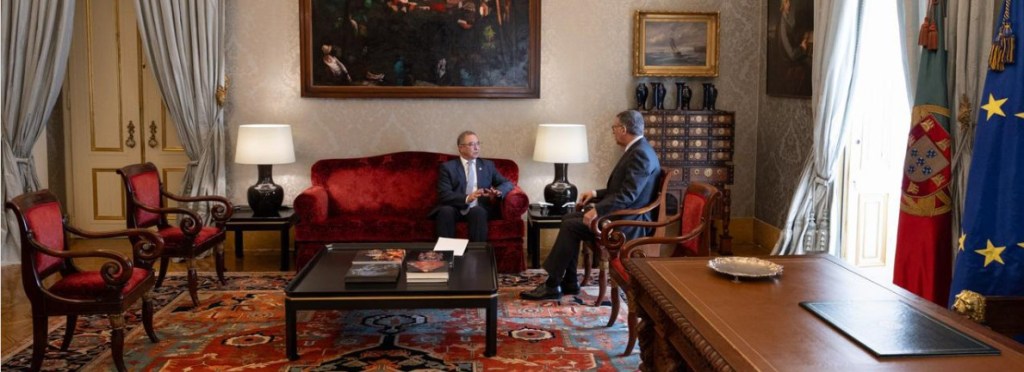
At the historic Palácio de Belém, the ceremonial seat of Portugal’s presidency, José Manuel Bolieiro met this week with António José Seguro in a first formal audience that underscored both continuity and ambition in the relationship between the Azores and the Portuguese state.
The meeting unfolded in what officials described as a climate of institutional closeness and openness to dialogue—an early signal, Bolieiro suggested, of a cooperative dynamic with the country’s new head of state. Offering formal greetings, the Azorean leader expressed confidence in the президентial mandate and reaffirmed the full availability of the archipelago’s autonomous institutions to work in tandem with Lisbon.
But beyond protocol, the encounter served as a platform for a broader assertion: that the Azores are no longer to be understood as a distant outpost, but as a strategic center in an increasingly interconnected Atlantic world.
A Strategic Vision, Delivered
Bolieiro presented the president with a document outlining the Azores’ principal strategic priorities—framed across national, European, and global dimensions. Among the key issues raised was the ongoing dialogue with Portugal’s sovereign institutions, particularly the national government, including the anticipated revision of the financing framework governing autonomous regions.
Europe, too, loomed large in the conversation. Bolieiro emphasized the importance of maintaining and strengthening the status of outermost regions within the European Union’s legal architecture—specifically under the European Union framework. He argued for continued recognition of the Azores’ unique geographic and economic conditions in the bloc’s next multiannual financial framework, while advocating a more direct relationship between the archipelago and European institutions, such as the European Commission.
The Atlantic as Destiny
If Europe provides structure, the Atlantic defines identity. Bolieiro underscored the Azores’ role as Portugal’s strategic projection into the oceanic space—a region whose importance is growing in matters ranging from maritime sustainability to global security.
He pointed to the archipelago’s contributions to international efforts, including ocean governance within the framework of the United Nations, as well as its enduring bilateral ties with the United States—particularly through infrastructure such as the Lajes Air Base.
The Azores, he argued, are also positioned at the forefront of global transitions: climate, energy, and digital. From renewable energy development and island-level energy autonomy to the strategic importance of connectivity projects like the CAM Ring (linking mainland Portugal, the Azores, and Madeira), the region is increasingly seen not only as a recipient of support, but as a laboratory of innovation.
Recognition and Symbolism
One of the most symbolically charged moments of the meeting came with the confirmation that Portugal’s national day—June 10, the Day of Portugal, Camões, and Portuguese Communities—will be celebrated this year on Terceira Island.
For Bolieiro, the decision carries profound meaning.
“This choice affirms Portugal in its full Atlantic dimension,” he said, “and recognizes the Azores as a strategic asset of the nation, with clear geopolitical and geostrategic value.”
It is, in effect, a symbolic re-centering of the nation—an acknowledgment that Portugal’s identity extends beyond continental borders, rooted as much in its islands and diaspora as in its mainland.
From Margin to Meaning
“The Azores are not a periphery,” Bolieiro declared. “They are centrality—an Atlantic centrality that gives Portugal scale, depth, and relevance.”
It is a message that resonates beyond rhetoric. In an era defined by shifting geopolitical currents, climate urgency, and digital transformation, the Azores are increasingly positioned as a nexus—where Europe meets the Atlantic, where local realities intersect with global stakes.
And in that intersection, Bolieiro is making a case not just for recognition, but for redefinition: of geography, of influence, and of Portugal’s place in the world.
In Diário dos Açores, Paulo Vivieiros, director
Translated into English as a community outreach program by the Portuguese Beyond Borders Institute (PBBI) and the Modern and Classical Languages and Literatures Department (MCLL), in collaboration with Bruma Publication and ADMA (Azores-Diaspora Media Alliance) at California State University, Fresno. PBBI thanks Luso Financial for sponsoring NOVIDADES.
 Novidades - The Islands and the Diaspora