

In the Ponta Delgada, where devotion has long been measured not only in prayer but in procession, the annual Festival of the Senhor Santo Cristo dos Milagres returns this May with renewed attention to the diaspora that has carried its meaning far beyond the islands.
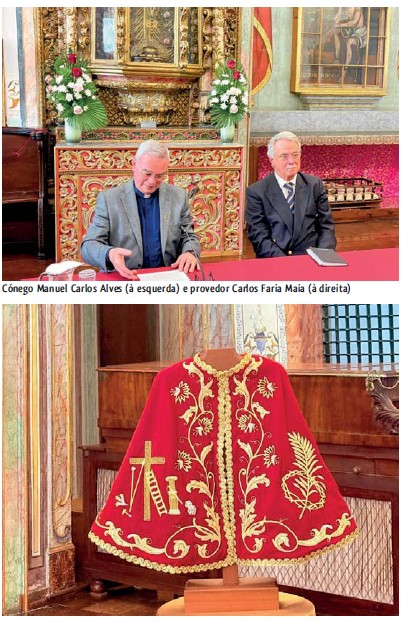
The celebrations, formally presented this week at the Church of Esperança, will take place from May 8 to May 14, with Cardinal António Marto presiding over the festivities—an honor that organizers describe as deeply significant for the Diocese of Angra and the broader Azorean community.
At the center of the week is a ritual that has defined the spiritual life of the archipelago for generations: the procession of the image of the Senhor Santo Cristo through the streets of Ponta Delgada, scheduled for the afternoon of May 10, following the morning Mass. It is a moment when faith becomes public, when the sacred moves through the city, and when thousands gather in a choreography of devotion that is at once solemn and communal.
Yet this year’s program gestures outward, toward the Atlantic world shaped by Azorean migration. Organizers have placed particular emphasis on initiatives aimed at emigrants—those who left but never fully departed. Meetings with visiting communities, guided access to parts of the sanctuary, and even an English-language Mass are designed to bridge distance and language, acknowledging that the festival belongs as much to those abroad as to those at home.
“The Church is for everyone,” organizers reiterated, echoing the pastoral vision often associated with Pope Francis. The statement, simple in phrasing, carries weight in a moment when religious gatherings increasingly serve as spaces of both spiritual and cultural reunion.
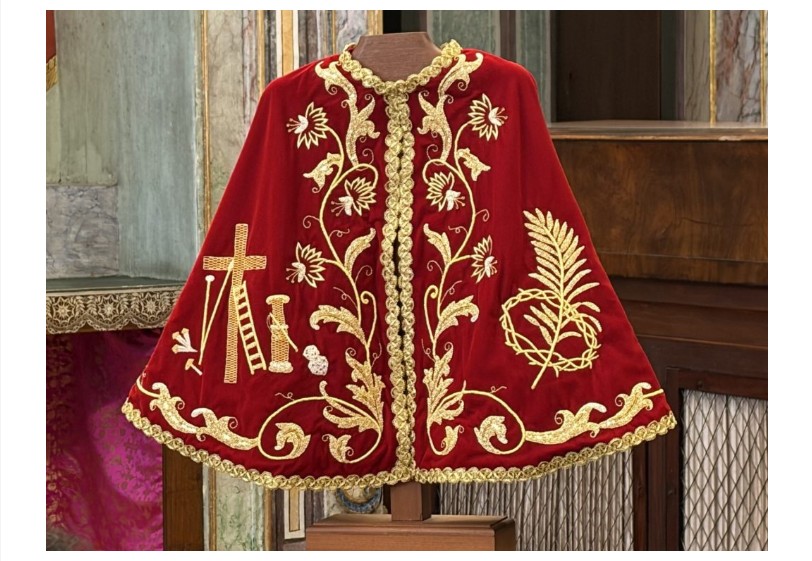
The material symbols of devotion also carry stories of migration. This year’s ceremonial cape, embroidered in gold thread on velvet and adorned with motifs of Christ’s Passion, was donated by a couple living in the United States—an offering shaped by gratitude and sustained by distance. Even the chalice used during the Mass bears its own history, having been presented by Pope John Paul II during his 1991 visit to the Azores.
Beyond ritual, organizers have issued a call that reflects both the scale and the fragility of such gatherings: respect, restraint and shared responsibility. Participants are asked to care for the city, to follow public safety guidance and, perhaps most notably, to pray for peace in a world increasingly marked by division and conflict.
In the Azores, faith is rarely confined to the interior of a church. It moves through streets, across oceans and between generations. And each May, in Ponta Delgada, it returns—reshaped by those who remain, and those who come back, if only for a moment, to walk again in its light.
In Correio dos Açores, from a story by journalist Diogo Simões Pires-Natalino Viveiros, director.
Translated into English as a community outreach program by the Portuguese Beyond Borders Institute (PBBI) and the Modern and Classical Languages and Literatures Department (MCLL), in collaboration with Bruma Publication and ADMA (Azores-Diaspora Media Alliance) at California State University, Fresno. PBBI thanks Luso Financial for sponsoring NOVIDADES.

 Novidades - The Islands and the Diaspora