

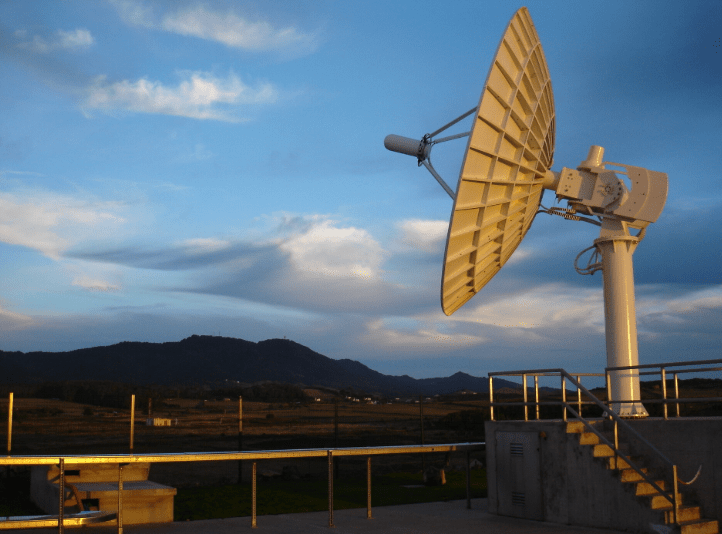
In an age when geography has reasserted itself as destiny, the Azores emerge not as periphery but as pivot—an Atlantic hinge upon which new economies, technologies, and imaginaries turn. The recent interview with André Craveiro, coordinator of the Estrutura de Missão dos Açores para o Espaço (EMA-Espaço), offers more than institutional clarity; it reveals a philosophical repositioning of the archipelago—from waypoint to engine, from passage to presence.
What unfolds in Craveiro’s discourse is not merely policy but narrative: a longue durée of insular centrality. From the Age of Discoveries to submarine cables, from wartime logistics to Cold War geopolitics, the Azores have persistently occupied that paradoxical space of being both remote and indispensable. Today, in what he names “the era of the space economy,” this historical continuity finds its most ambitious iteration. The Atlantic is no longer only crossed—it is now observed, measured, and launched from.

At the heart of this transformation lies Santa Maria, that modest island now recast as a node in a global orbital network. The ESA tracking station at Monte das Flores, once a technical installation, becomes in Craveiro’s telling the “genesis” of a broader terrestrial space capability. Around it has grown a teleporto, a lattice of data, signals, and ambition—quiet infrastructures that carry within them the promise of a new economic grammar.
Yet the sophistication of the project lies not only in infrastructure but in sequencing. Craveiro outlines a deliberate evolution: first, the anchoring of physical assets and companies; second, the emergence of downstream applications—Earth observation tools that migrate into civil protection, agriculture, fisheries, and environmental monitoring; and third, the cultivation of research, education, and cultural scientific literacy. It is a layered vision, one that resists the temptation of spectacle in favor of systemic depth.
Still, spectacle is not absent. The licensed launch center at Malbusca introduces a dramatic horizon: suborbital launches in the near term, orbital ambitions thereafter, and—perhaps most symbolically—the projected return of reusable spacecraft by 2028, with the European Space Agency’s Space Rider. Return, in this sense, becomes a poetic inversion of departure: the Azores not only sending objects into the void, but welcoming them back, closing the arc of motion that defines the space age.
Craveiro’s language is careful, almost restrained, when addressing metrics of success. He speaks of “impact”—economic, certainly, but also reputational. The ambition is to inscribe Santa Maria into the cartography of European space hubs, to ensure that the Azores are not merely referenced but required. Around ten companies already populate this emergent ecosystem, a modest number that nonetheless signals a threshold crossed: from aspiration to presence.
Yet the interview is equally attentive to fragility. The ecosystem, Craveiro acknowledges, remains contingent—dependent on the continued attraction of private investment, on regulatory clarity, on the delicate balance between innovation and environmental stewardship. The legal framework (DL 20/2024) is presented as both competitive and rigorous, a necessary architecture for managing risk in a domain where, as he notes with quiet candor, “there is no activity with zero risk.”
Particularly striking is the insistence on local integration. The rhetoric of space—so often abstract, global, detached—is here grounded in the social fabric of Santa Maria. Schools, municipalities, and local enterprises are not peripheral stakeholders but central actors in the project’s legitimacy. Transparency is not framed as compliance but as pedagogy: a process of demystifying rockets, of translating orbital mechanics into civic understanding. In this, the project gestures toward a rare alignment between technological ambition and communal belonging.
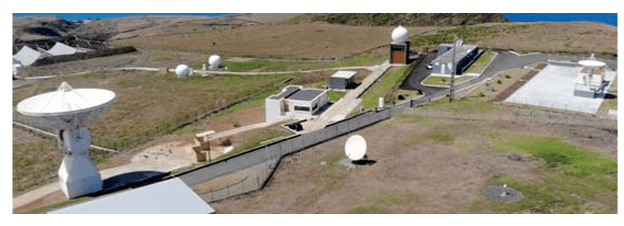
The economic horizon, meanwhile, is sharply defined. The focus on small satellites—representing over 80% of the market—reveals a strategic pragmatism. Rather than competing with established heavy-launch infrastructures, the Azores position themselves within a niche that is both expanding and accessible. The partnership with Innospace, and the anticipated cadence of 14 to 20 launches per year, suggest not a singular leap but a sustained rhythm—an industrial tempo calibrated to global demand.
And yet, beyond markets and metrics, there is a deeper undercurrent. The Azores’ entry into the space economy is not only an economic project but a rearticulation of identity. Insularity, long associated with marginality, is here reframed as advantage—a condition of vantage, of clarity, of unobstructed horizon. The islands, once defined by their distance from centers of power, now leverage that very distance as proximity to the infinite.
In the end, Craveiro’s vision is less about rockets than about continuity. The same Atlantic that carried caravels, cables, and aircraft now carries data, trajectories, and return vehicles. The medium changes; the logic endures. The Azores remain, as they have always been, a place where worlds meet—only now, the meeting point extends beyond the visible sky.
And perhaps that is the quiet revolution embedded in this interview: not the conquest of space, but the recognition that space, like history, is something the Azores have always already inhabited.
Adapted from an interview by Rui Leite Melo for Diário dos Açores, Paulo Viveiros, director.
Translated into English as a community outreach program by the Portuguese Beyond Borders Institute (PBBI) and the Modern and Classical Languages and Literatures Department (MCLL), in collaboration with Bruma Publication and ADMA (Azores-Diaspora Media Alliance) at California State University, Fresno. PBBI thanks Luso Financial for sponsoring NOVIDADES.

 Novidades - The Islands and the Diaspora