

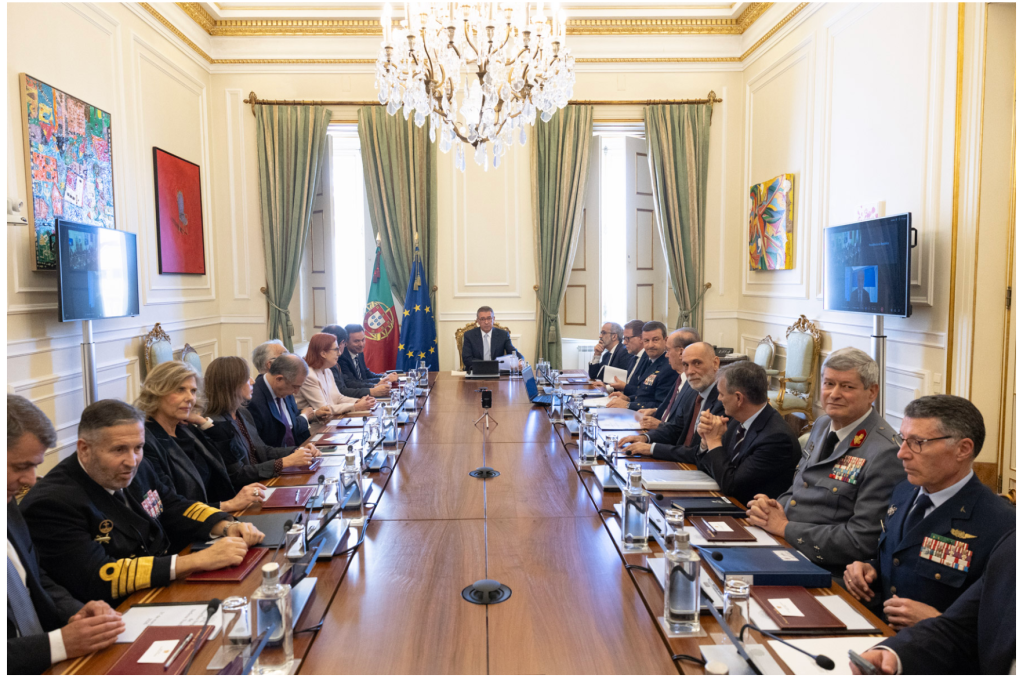
The President of the Azores’ Regional Government, José Manuel Bolieiro, took part this week in a meeting of Portugal’s National Defense Council at Palácio de Belém—the first session chaired by António José Seguro since assuming the presidency of the country.
Set against a backdrop of mounting global instability, the meeting focused on shifting security priorities shaped by the ongoing war in Ukraine and rising tensions in the Middle East. Bolieiro used the occasion to highlight what he described as the Azores’ growing strategic importance in the Euro-Atlantic space.
“We have definitively left behind the illusion of a stable and predictable security order,” Bolieiro said, arguing that current geopolitical dynamics are refocusing attention on the North Atlantic—and, with it, the Azores—as a key node in global strategy.
Once viewed as a remote periphery of the European Union, the archipelago is now, in Bolieiro’s words, “a true center of gravity between Europe, America, and Africa,” with increasing relevance across maritime routes, energy corridors, and communications networks.
But the regional leader warned that recognition alone is not enough. “It is not sufficient to proclaim the centrality of the Atlantic—it must be translated into capabilities, presence, and strengthened cooperation,” he said, calling for greater investment in surveillance, deterrence, and rapid-response infrastructure.
Bolieiro also emphasized the Azores’ potential as a point of convergence between NATO, the European Union, and the United States, while advocating for a stronger European role in defense matters.
At the same time, he cautioned against a purely military understanding of security. “Defending territory also means defending people—their quality of life and their expectations for the future,” he said, underscoring the importance of territorial cohesion and sustained development in island regions.
The meeting concluded with the unanimous approval of adjustments to Portugal’s deployed national forces for 2026, along with a formal commendation of the country’s armed forces—an acknowledgment of their role in an increasingly uncertain global landscape.
In DIário dos Açores-Paulo Viveiros, director
Translated into English as a community outreach program by the Portuguese Beyond Borders Institute (PBBI) and the Modern and Classical Languages and Literatures Department (MCLL), in collaboration with Bruma Publication and ADMA (Azores-Diaspora Media Alliance) at California State University, Fresno. PBBI thanks Luso Financial for sponsoring NOVIDADES.

 Novidades - The Islands and the Diaspora