

Along the northern coast of São Miguel, where the Atlantic presses its restless body against the land, the shoreline of Ribeira Grande has long lived between beauty and vulnerability. The winds carve their language into the cliffs, the waves insist, again and again, on their ancient claim. And in that fragile space—between permanence and erosion—promises have been made.
Now, those promises are being questioned.
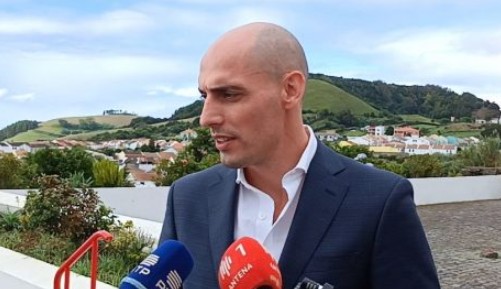
This week, Carlos Silva, Vice-President of the Parliamentary Group of the PS/Açores, publicly raised concerns over what he describes as a failure to comply with a €2.6 million contract intended to rehabilitate the coastal front near Monte Verde and reinforce the protection of Ribeira Grande’s shoreline. The project, framed as essential for safeguarding both people and property, remains stalled—its absence felt not only in bureaucratic terms, but in the lived anxiety of a coast exposed.
At the center of the controversy lies Contract ARAAL No. 8/2023, an agreement between the Regional Government and the Municipality of Ribeira Grande. On paper, it carries the weight of urgency: a multi-million-euro investment designed to address long-standing vulnerabilities in a region where the sea is both identity and threat. In practice, however, progress has lagged, and with it, confidence.
“We are speaking of an intervention long demanded,” Silva stated, “with direct impact on coastal protection and the safety of local populations, yet it remains unrealized.” His words do not simply echo political opposition; they resonate with a deeper unease—one that emerges when time, nature, and governance fall out of alignment.
In response, the Socialist parliamentary group has formally submitted a request to the Legislative Assembly of the Azores, seeking clarity. They ask not only for timelines and percentages of completion, but for something more fundamental: accountability. How much of the project has truly been executed? What funds have been transferred—and what remains in limbo? What mechanisms exist to ensure oversight in a project whose delays may carry tangible risks?
These are technical questions, yes. But beneath them lies a more human inquiry: how long can a coastline wait?
The Atlantic does not negotiate contracts. It does not recognize administrative delays. Each season, each storm, each incremental erosion redraws the edge of the island. In places like Monte Verde, where land meets sea with little margin for error, infrastructure is not merely development—it is defense.
The Socialist deputies have also pressed the government on whether corrective measures have been considered. Should funds already transferred be returned? Should the contract be restructured? These are the kinds of questions that surface when governance is forced to confront its own inertia.
For Silva, the issue is clear: “There can be no complacency with delays in projects that are decisive for safety and territorial protection.” His insistence on transparency is less a political posture than a demand shaped by geography itself. In the Azores, governance is always, in some way, environmental governance.
And so, the story of this delayed project is not just about numbers or contracts. It is about trust—between institutions and citizens, between promise and execution, between land and those who inhabit it.
In Ribeira Grande, the sea continues its work. It advances, retreats, reshapes. It does not wait for signatures or clarifications.
But the people do. For now.
Adapted from a story in Correio dos Açores-Natalino Viveiros, director
Translated into English as a community outreach program by the Portuguese Beyond Borders Institute (PBBI) and the Modern and Classical Languages and Literatures Department (MCLL), in collaboration with Bruma Publication and ADMA (Azores-Diaspora Media Alliance) at California State University, Fresno. PBBI thanks Luso Financial for sponsoring NOVIDADES.
 Novidades - The Islands and the Diaspora