

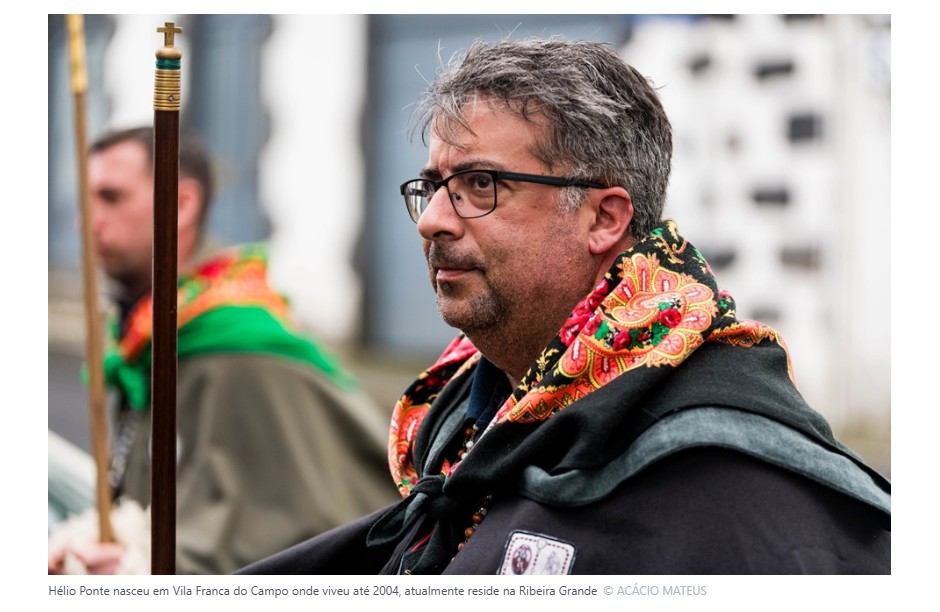
In the Azores, where faith often walks alongside the rhythms of daily life, the line between science and spirituality is not a boundary—but a conversation. Few embody that dialogue more fully than Hélio Ponte, a nurse and romeiro (pilgrim), whose life bridges the clinical precision of the hospital and the introspective devotion of the island’s Lenten pilgrimages.
In this wide-ranging interview, Ponte reflects on vocation, suffering, dignity, and the enduring question: where does medicine end—and where does faith begin?
You’ve spent your life as a nurse. When did you first decide to pursue this path?
It wasn’t a completely straight road. Like many young people, I had doubts, moments of uncertainty. I was never what you’d call an “exceptional student,” but I always gave my best. In 1997, I took my national exams and entered nursing school that same year. I completed my training in 2000 and then continued with an additional year, earning the equivalent of a full degree.
Looking back, it was an opportunity—one that gave me both purpose and stability. Within less than a year, I joined the staff at the Hospital do Divino Espírito Santo, where I’ve remained ever since.
Was nursing a calling, or more a practical decision?
A bit of both. I don’t particularly like the word “calling”—it’s too strong, too absolute. Nursing is, above all, about knowledge, about knowing how to act, how to be present, how to be human. At the time, it was also a profession with strong job prospects. But I can say this: I have no regrets. I do this work with rigor and dedication.
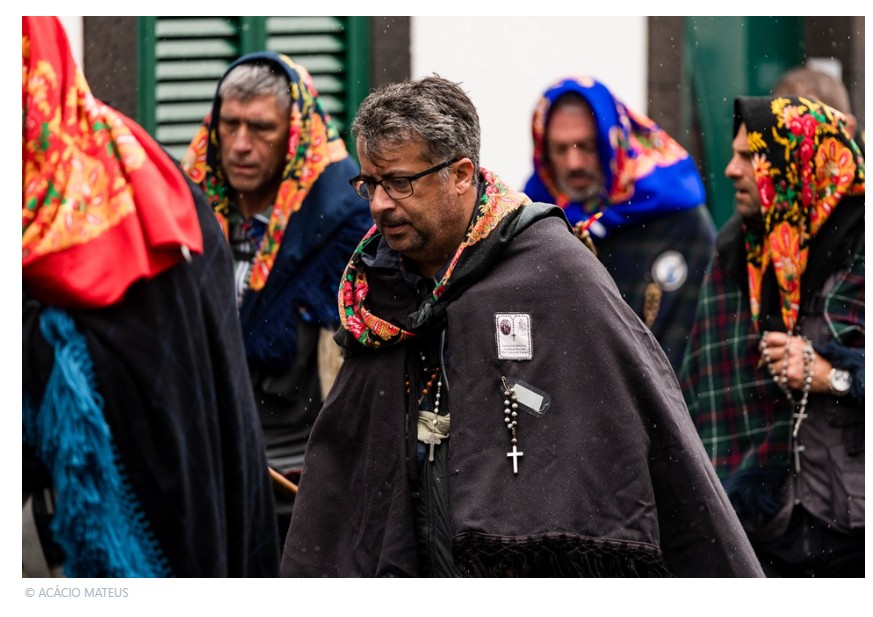
Alongside your work in medicine, you are also a romeiro. When did that journey begin?
That’s an important distinction: not when did I “go on pilgrimage,” but when did I become a pilgrim. Because this isn’t something that lasts eight days—it’s a way of life.
I made my first pilgrimage in 2006. I only regret not starting sooner. It’s not about being perfect or exemplary—we are not saints. We go because we feel a purpose, a calling. And once you enter that rhythm—of walking, of reflection, of discomfort—you begin to understand something deeper about yourself.
I remember my first night vividly. I barely slept. I was exhausted, physically unwell, questioning why I was even there. But the more experienced pilgrims encouraged me. By the next day, something shifted. Since then, I can’t imagine a year without that week of introspection.
You live at the intersection of medicine and faith. How do you reconcile the two?
I don’t see them as opposing forces. I see them as complementary—like the two wings of a bird. One is reason, science. The other is faith. A bird cannot fly safely without both.
Science explains how things happen. Faith asks why.
Think of someone like Albert Einstein, who saw in the order of the universe the trace of something greater. Or Georges Lemaître, a priest who developed the Big Bang theory. These are not contradictions—they are continuations of the same search for truth.
In my daily work, I rely on scientific evidence. That’s essential. But that doesn’t exclude faith. One does not cancel out the other.
Have you witnessed moments in your medical career that defy explanation?
Yes—many times.
There are patients whose conditions suggest they will not survive, and yet they recover. Each person’s body responds differently to trauma or illness. Even now, as we speak, I believe such a case is unfolding somewhere.
But these moments also raise difficult ethical questions. How far should we go in prolonging life artificially? At what point does treatment become suffering? There is a concept we must consider: dignity. Even in death, dignity must come first. A painless death, when possible, is part of that dignity.
Faith can influence these decisions—but it must be balanced. We must ask: are we preserving life, or prolonging suffering?
Do you believe faith can heal?
As a Catholic, I cannot dismiss that possibility. But I also remain grounded in scientific evidence in my professional life.
Faith, at its core, is belief without seeing. It is a gift, but it can also be intellectual—a philosophy, a way of understanding the world. It connects us to something larger than ourselves.
And yes, I have seen cases that make you pause.
There was a child, born with severe complications. Doctors were uncertain he would survive. His family entrusted a prayer intention to our pilgrimage group. We carried that intention with us. Today, that child is healthy.
Was it medicine? Faith? Both?
These are the questions that stay with you.
So, in the end—can faith save lives?
Perhaps not always in the way we expect. But it brings something essential: comfort, hope, meaning.
And sometimes, that can make all the difference.
As we once said during a pilgrimage: “Here, too, we seek what science cannot resolve.”
(From Diário da Lagoa)
Interview and photos from Acácio Mateus, Diário da Lagoa
Translated into English as a community outreach program by the Portuguese Beyond Borders Institute (PBBI) and the Modern and Classical Languages and Literatures Department (MCLL), in collaboration with Bruma Publication and ADMA (Azores-Diaspora Media Alliance) at California State University, Fresno. PBBI thanks Luso Financial for sponsoring NOVIDADES.

 Novidades - The Islands and the Diaspora