

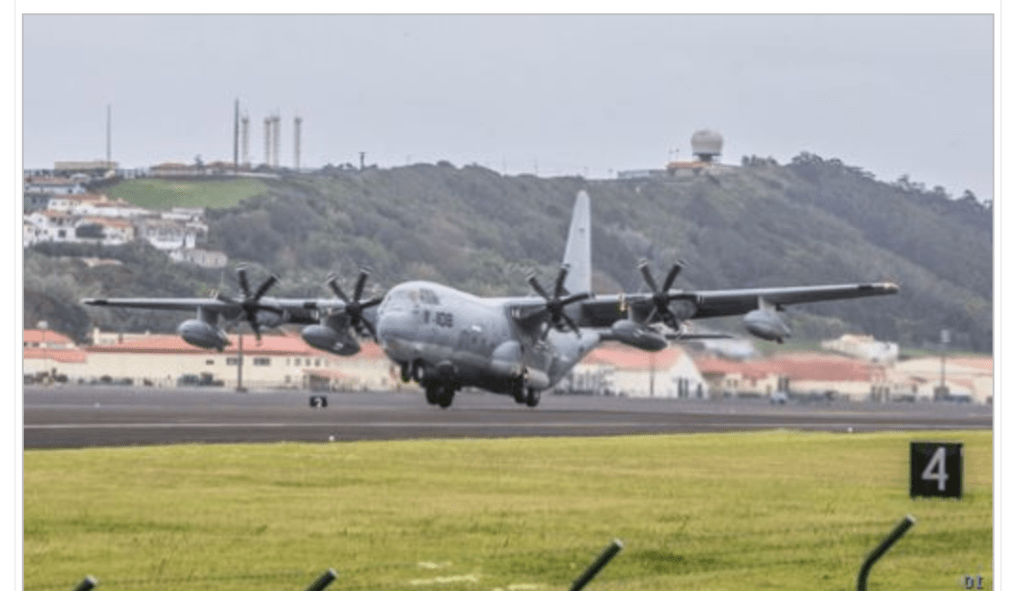
Portugal’s Left Bloc party filed a complaint Thursday with the Public Prosecutor’s Office, alleging that the use of the Lajes Air Base in recent U.S.-led military operations against Iran may constitute an illegal act under both international and Portuguese law.
Party leaders José Manuel Pureza, Fabian Figueiredo, and Catarina Martins are calling for a formal investigation into what they describe as Portugal’s “indirect participation in acts of force contrary to international law.”
In their filing, the lawmakers point to a large-scale military operation launched on February 28, 2026, by the United States and Israel — dubbed “Operation Epic Fury” — involving roughly 900 airstrikes over a 12-hour period targeting military, command, and leadership sites across the Iran. The complaint alleges that the strikes resulted in dozens of civilian casualties, including 170 deaths from a missile strike on a girls’ school in the city of Minab.
According to the Left Bloc, the operation was carried out without authorization from the United Nations Security Council and in the absence of any prior armed attack that could justify self-defense under Article 51 of the United Nations Charter. The party also emphasized that the strikes were not conducted under the framework of the North Atlantic Treaty Organization, noting there was no decision by NATO’s governing bodies nor any applicable collective defense mechanism.
The complaint further underscores that the U.S. president publicly framed the operation as an effort to bring about regime change in Tehran — a characterization, the party argues, that undermines any claim that the strikes were defensive in nature.
Left Bloc officials also highlighted a significant increase in U.S. military aircraft activity at Lajes Air Base in the weeks leading up to the strikes. They contend that these movements were tacitly authorized under Portugal’s Decree-Law No. 2/2017 without proper adherence to the legal framework governing foreign state aircraft operations. That law, they argue, requires prior diplomatic authorization and a case-by-case assessment of each mission’s purpose, legal basis, and operational context.
“In this case, effective oversight by the Portuguese state was required — and did not occur,” the complaint states.
While acknowledging that Lajes was not the launch point for the attacks, the Left Bloc asserts that the base functioned as a “critical logistical platform,” supporting aerial operations and the deployment of weapons systems. The presence of MQ-9 Reaper drones at the base, they argue, further reinforces its role within the broader military operation.
The complaint also challenges claims that U.S. military operations at Lajes do not require Portuguese authorization or even notification — an interpretation the party says directly contradicts both the Lajes Technical Agreement and national law. Under that agreement, exemptions from prior authorization apply only to operations conducted במסגרת NATO.
“This leaves only two possibilities,” Pureza told reporters. “Either the government agrees with a grave violation of international and Portuguese law — which would be extremely serious — or it does not agree and lacks the political backbone to do what must be done: denounce the illegality, distance itself from it, and refuse to be complicit.”
Translated into English as a community outreach program by the Portuguese Beyond Borders Institute (PBBI) and the Modern and Classical Languages and Literatures Department (MCLL), in collaboration with Bruma Publication and ADMA (Azores-Diaspora Media Alliance) at California State University, Fresno. PBBI thanks Luso Financial for sponsoring NOVIDADES.

 Novidades - The Islands and the Diaspora