

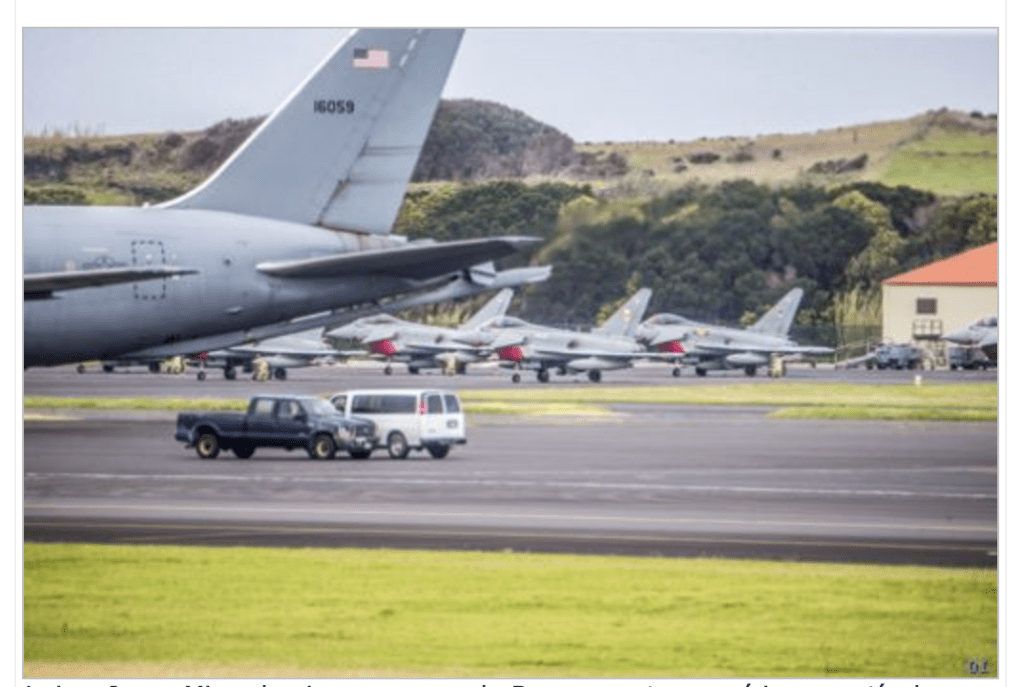
Speaking to Diário Insular, the emeritus professor of law at the University of Lisbon and the Portuguese Catholic University said that “the United States is waging a war outside the bounds of international law, to which Portugal is bound under Article 8 of its Constitution and under the general principles of international law.”
“Like several other European states have done, the Portuguese government should not have granted consent for that use,” he stressed.
Miranda emphasized that the base is located on the territory of the Portuguese state and the Autonomous Region of the Azores, and that “its use presupposes an agreement by the Portuguese state.”
“Because Portugal belongs to the Atlantic Alliance, its use within that framework requires an agreement by the Portuguese state. But that is not what is happening in the case of United States aircraft involved in the war in Iran,” he added.
Jorge Miranda is widely recognized as one of Portugal’s leading constitutional scholars.
To support his position, he points to Article 8 of the Constitution, which addresses international law, stating that “the rules and principles of general or common international law form an integral part of Portuguese law.”
It further establishes that “the provisions of international conventions duly ratified or approved shall apply in the domestic legal order once officially published and for as long as they are binding on the Portuguese state,” and that “rules issued by the competent bodies of international organizations to which Portugal belongs shall apply directly in the domestic legal order, provided this is established in the respective founding treaties.”

The constitutionalist’s position clashes with that of the Portuguese government. The Minister of Foreign Affairs, Paulo Rangel, stated during a hearing before the Committee on European Affairs on the 1st of this month that “what we did was precisely to impose the criteria of international law.”
Authorization for the use of Lajes remains “conditional.” According to Rangel, it may be used by the United States “in response to an attack suffered, in a necessary and proportional manner, and not targeting civilian objectives.”
Prime Minister Luís Montenegro has also maintained that the use of the Lajes Base by the U.S. occurred within the bilateral agreement, with prior notification and without any violation of international law.
In early March, during the biweekly debate in Parliament, Montenegro stressed that the operations “resulted in no violation of international law.”
The President of the Regional Government of the Azores, José Manuel Bolieiro, said in an interview with Público earlier this month that “the Government of the Azores has no role in this matter,” but that “it was clear from the public statements of the Minister of State and Foreign Affairs” that “the terms of the agreement with the United States were respected and the conditions for the use of the Lajes Base were defined.”
Meanwhile, the Bloco de Esquerda filed a complaint on Monday with the Office of the Attorney General, calling for an investigation into the Portuguese state’s indirect participation “in acts of force contrary to international law.”
In Diário Insular, José Lourenço-director.
Translated into English as a community outreach program by the Portuguese Beyond Borders Institute (PBBI) and the Modern and Classical Languages and Literatures Department (MCLL), in collaboration with Bruma Publication and ADMA (Azores-Diaspora Media Alliance) at California State University, Fresno. PBBI thanks Luso Financial for sponsoring NOVIDADES.

 Novidades - The Islands and the Diaspora