

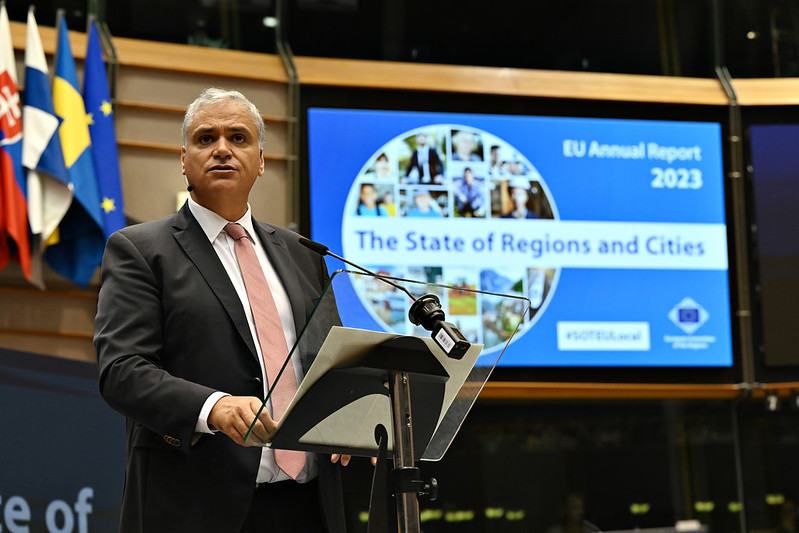
Eight months before the European elections, President Vasco Cordeiro says that more cohesion and a more substantial role for local and regional authorities are the necessary antidote to the growing discontent in Europe.
Today in Brussels, the President of the European Committee of the Regions, Vasco Alves Cordeiro, delivered his annual speech on the state of the regions and cities in the European Union, which coincides with the publication of the EU Annual Report 2023 on the state of the regions and cities, during the opening event of the European Week of Regions and Cities. The report includes an extensive survey, developed in cooperation with IPSOS, aimed at local and regional leaders in all 27 EU Member States.
The President of the European Committee of the Regions, Vasco Alves Cordeiro, began his speech by stressing that regions and cities have been managing more and more crises: “2023 is already a record year – for the worst reasons – with the hottest summer ever recorded. With the extreme heat came forest fires, heatwaves, extreme droughts, storms, and floods.” The climate crisis “takes lives, ruins our economy, and threatens our future,” he said, “but it also reinforces inequalities. And the consequences and impacts already being felt in the climate, economy, and infrastructure could also affect political and democratic institutions,” he explained. “Without the involvement and mobilization of regions and municipalities, it is not possible to translate global commitments into local actions,” stressed the Committee of the Regions President.
With regard to the reconstruction of Ukraine and the support of cities and regions, he added: “The European Committee of the Regions will play its part in ensuring that the local and regional dimension is taken into account and that key policies, such as cohesion policy, remain a central instrument for long-term investment in all territories. We must be prepared for this historic step in our common European project and we must be aware that, whatever the cost, it would be much more expensive to close Europe’s door to those who want to be part of this incredible political journey.”
As presented in the report, social inequalities are increasing across Europe: more than 32 million Europeans cannot afford a proper meal, and 40 million cannot keep their homes warm in 2022. For Vasco Cordeiro, “social cohesion in all our territories must remain a common goal. Local and regional authorities are the first to face the challenges and are the first to respond, despite the costs,” and called for “European solutions, but based on local responses, such as energy and food production or personalized support for people, especially the most vulnerable.”
To meet these challenges and achieve the green and digital transitions, while addressing demographic change, “public investment is the key,” he added, “to our goal of territorial, social and economic cohesion in Europe.” The President of the Committee of the Regions also said that it is clear that “adapting Cohesion Policy and preparing it for the future must be based on simple ideas: flexibility with predictability, partnership and accountability and we must work in partnership with all regions and cities. That’s why we need to strengthen the Code of Conduct on Partnerships”.
President Vasco Cordeiro stressed that underpinning all of this is the role that local and regional authorities play in their communities: “The success of ambitious policies needs a crucial ingredient: trust. […] The data shows that [citizens] have more trust [in local and regional representatives] than they do in their national governments. More trust than they have in the institutions of the European Union”. Looking ahead to the 2024 European elections, Cordeiro said that “even though our names are not on the ballot,” regions and municipalities “have a role to play. We are responsible for showing that democracy delivers results at all levels,” before adding that “giving a stronger role to the EU’s regions and cities is crucial before we move on to the big challenges we face, notably ahead of the enlargement of our Union. Only this can strengthen our common democratic fabric,” calling for “policies designed on the ground and a reinvigorated European democracy, with regions and cities at the center.”
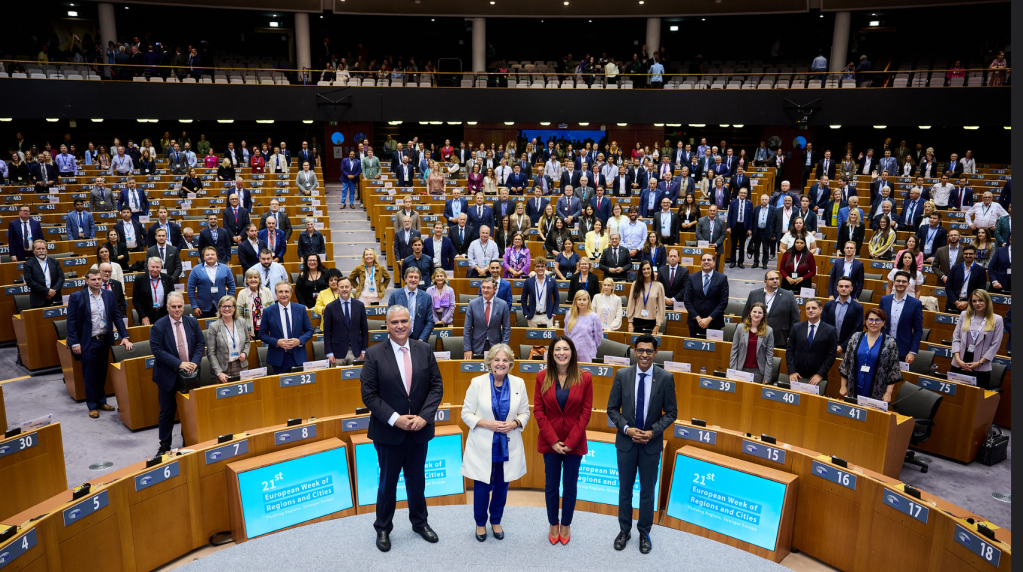
Some of the main conclusions of the EU’s annual report on the state of the regions and cities are as follows:
- EU regions and cities are key to the successful reception and integration of Ukrainian displaced persons. Half of EU regions and cities report receiving refugees from Ukraine. The German state of North Rhine-Westphalia is the EU region hosting the most Ukrainian refugees, followed by the Polish region of Mazowieckie, with just over 200,000. Most regions and municipalities (60%) see clear benefits – in terms of demographics, attitudes, and the economy – in welcoming refugees into their communities. Four out of five EU cities and regions (83) believe they can contribute somehow to the reconstruction of Ukraine. The Alliance of Cities and Regions for the Reconstruction of Ukraine, set up by the CoR and many partners in June 2022, is helping to bridge the gap in sub-national cooperation.
- Most regional and local politicians (75%) claim that there are no specific funding mechanisms to meet the challenges of adapting to climate change. Regions with a high level of employment in the agriculture or construction sectors are particularly affected, especially by more prolonged and more intense heat waves. Rising global temperatures are also significantly disrupting the local tourism industry.
- NextGenerationEU continues to be territorially “blind.” According to the new Regional and Local Barometer, more than 70% of local and regional authorities declared that they had not participated in implementing the Recovery and Resilience Facility, the cornerstone of the NextGenerationEU post-pandemic recovery plan.
- Regions and cities are mobilized to make the green transition work, but Europe must avoid an “ecological divide”. The CoR survey shows that regions and cities have taken action in particular to reduce energy consumption (62 %), promote nature conservation and the greening of cities (40 %), and reduce waste and its environmental impact (37 %). However, the regions of Czechia, Germany, Hungary, and Poland are among those witnessing job losses due to the closure of carbon-intensive industries. Accompanying these regions with investment and improved skills is therefore paramount to avoid creating a “green gap” in Europe. 45 % of regions and cities have set more ambitious climate neutrality targets than the EU level.
- It is estimated that 30 million people will “disappear” from Europe’s rural areas between 1993 and 2033. This is the size of the population of Romania, Bulgaria, and Lithuania combined. In addition, between 2015 and 2021, the percentage of people over 65 increased by 5% in rural areas, twice as much as in urban areas. Eight months before the European elections, this worrying situation threatens European democracy, as people who remain in rural areas quickly feel left behind by local, national, and European institutions.
- Trust in local and regional governments remains higher than at the national and EU levels. It continues to grow and remains higher than trust at the national and EU levels: since 2018, opinion polls have consistently shown that local and regional authorities are the only form of government trusted by more than 50% of EU respondents.
 Novidades - The Islands and the Diaspora