

For the past 18 years, João Costa, from Foto Íris, has been preparing what he rather amusingly calls the “Carnival journal,” the magazine that people keep throughout those days so that in the hall, they can mark the danças and bailinhos , and comédias (these are vaudeville type of presentations unique to the island of Terceira) they have already seen and the groups that are yet to arrive. The photographer says that this year, there will be 57 to see: Forty-two bailing, 6 danças with tambourine d, 3 danças with a sword (one from Toronto), five comédias, and one monologue.
This increased from last year when the tradition returned after the COVID-19 pandemic with 48 presentations.
“One thing you notice a lot about this Carnaval is that before we had three or four authors who wrote about a lot of subjects. This year it’s much more branched out. We have, for example, seven groups with their own subject,” he says.
Therefore, the total number of subject authors for this Carnaval is 32. He says the themes have a “tendency towards social criticism”, a hallmark of the island’s Carnaval.
“There are subjects that aren’t really geared towards that, but there’s always something, as is normal,” he explains.
Another figure: this Carnaval has 1,605 members, including musicians, dancers and actors.
The “Carnaval newspaper” began, he says, with a conversation between the photographer and two journalists, João Rocha and Francisco Faria, from the newspaper “A União,” which closed in 2012.

“We started with just a supplement inside the newspaper, and the following year, we started a magazine,” he recalls.
The print run for this year is 10,000 copies. The publication is supported by municipalities and advertising and is offered to the social halls and concert halls that fill up with people for the days of Carnaval.
The magazines are already something of a tradition. “I’m always getting phone calls asking, ‘Johnny, when is it ready?’ They’ve arrived and we’re going to start distributing them,” promises the photographer.
The island is awaiting the start of the festival, which Paulo Homem, actor and author of dances, recently called a “Bodo da Alegria” in an interview with DI (Diário Insular newspaper).
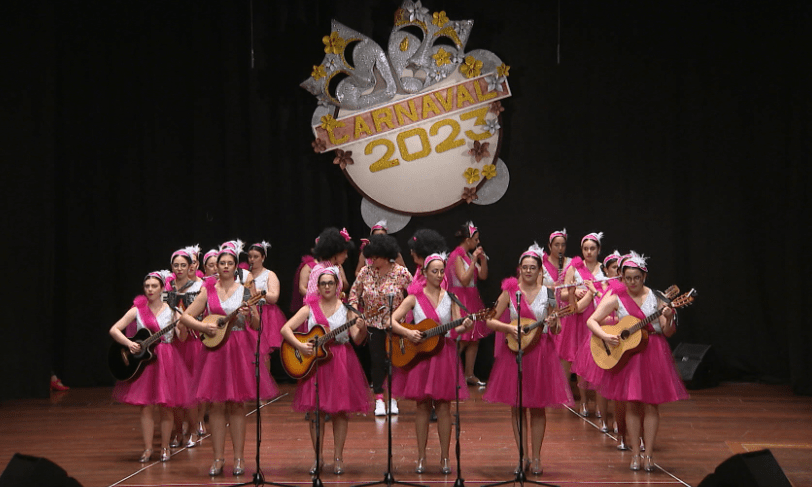
“Carnaval in Terceira is always the same. Last year, the nostalgia of the public and those participating in this tradition increased. There had already been another interruption when the earthquake hit in the 1980s. After the island was rebuilt, Carnival took to the stage with even more force. It won’t be because of setbacks that temporarily suspend it that Carnaval will change. It will change over time, as everything does, but it will always be the Carnaval of Terceira, as unique as the people who make it happen,” said Paulo Homem.
in Diário Insular-José Lourenço-director
Translated to English as a community outreach program from the Portuguese Beyond Borders Institute (PBBI) and the Modern and Classical Languages and Cultures Department (MCLL) as part of Bruma Publication and ADMA (Azores-Diaspora Media Alliance) at California State University, Fresno–PBBI thanks the sponsorship of the Luso-American Development Foundation from Lisbon, Portugal (FLAD)
 Novidades - The Islands and the Diaspora