


The regional political rentrée, following the Economy Committee’s work on the Multiannual Budgetary Framework (which the governments have reduced to nothing more than an uninteresting little framework), has brought a chorus of concerns about the state of the public finances in the Azores, with the President of CESA once again issuing several warnings about the path we are on, in which financial unsustainability could jeopardize the autonomous project.
Politicians seem to agree now that they are confronted with a kind of deep well that the ill-conceived revision of the Regional Finance Law at the time of the Troika has become, through the fault of the rulers and parties of the time, who allowed and even applauded an unbalanced and highly damaging document for the Autonomous Regions, as we now see with the impact of lower taxes, the consequent loss of revenue and the voluminous expenses in the Health and Education sectors.
All that remains is for us to lose around 20 million euros once the Azores’ GDP/capita returns to 90% of the national figure.
None of this is new, as many people, including this column, have been warning for several years that we are heading for a kind of financial rescue, which is what is now being called for with the urgent revision of the Regional Finance Law.
The whole model on which our development has been based in recent years has been an economic failure, as it has allowed us to create a monstrous and inadequate regional public administration, stifling the private sector and wealth creation, resulting in an economy that is highly dependent on public power, which, on top of that, is a bad payer and is plunged into a massive hole of debts to suppliers, not forgetting the financial debt of the administration and public companies, whose interest could be enough to build a new hospital every year.
An administration so Sovietized for decades that it even bagged sugar packets and filled tuna cans! The Azores have become a vast archipelago of public irresponsibility in recent decades. No one is responsible for anything, no one is called to account, no one is blamed, and everyone accuses each other without consequences. Party dynamics have taken precedence over the public interest. We have reached the point where regional revenues can only pay for a small fraction of expenses despite the growing revenue increase.
Our data on the impact of the IRS decrease is still incomplete, but it could ultimately result in less direct revenue for the state/region’s coffers. The good news is that this situation means more disposable income for families, providing more private spending and taxes paid in other ways.
It’s fair to conclude that we have no problem with tax revenue, which is increasing across the board, even with or because of the tax cuts. Even the Government of the Republic is already forecasting increases in tax revenue of around 4.1% for 2025. We’ll be dragged down, too!
Our problem is on the expenditure side, which has not stopped growing for reasons we all know, plus the severe cases of SATA, the Health sector (now more with HDES), Education, a multitude of social programs that keep growing, and the integration into the public administration of everything and everyone that passes through problematic sectors under the care of the government.
It’s effortless to integrate; even the workers of a municipal company are covered. This is how the regional public galaxy is growing, stunting our region’s development. The issue of revising the Regional Finance Law in a kind of autonomous salvation is not new. The problem is that politicians don’t understand each other on this issue. Can these people put aside party bickering and tactics and agree on something? I very much doubt it, not least because we are again entering a period of electoral tension, with the local elections looming, not to mention the unpredictability of the following regional budget and a fragile coalition.
A cold analysis of the figures, which is what matters, shows that nothing has changed in recent years regarding budget execution, considering the COVID-19 and SATA pandemics. The explanation is simple: no government, no matter how good, can perform the miracle of multiplying loaves of bread when there is no flour.
Without resources, revenue, wealth, and population, without knowing how to retain talent and without knowing how to get the economy to produce more, we can only ask for help from the State and the European Union, which is what is saving us, even though the Portuguese State is unreliable in everything (a State that allows dangerous prisoners to escape from a high-security prison is an international humiliation, as it does with the scandalous situation of the Ponta Delgada prison and with the rest of the State services in this region), including delaying the revision of a clearly outdated law.
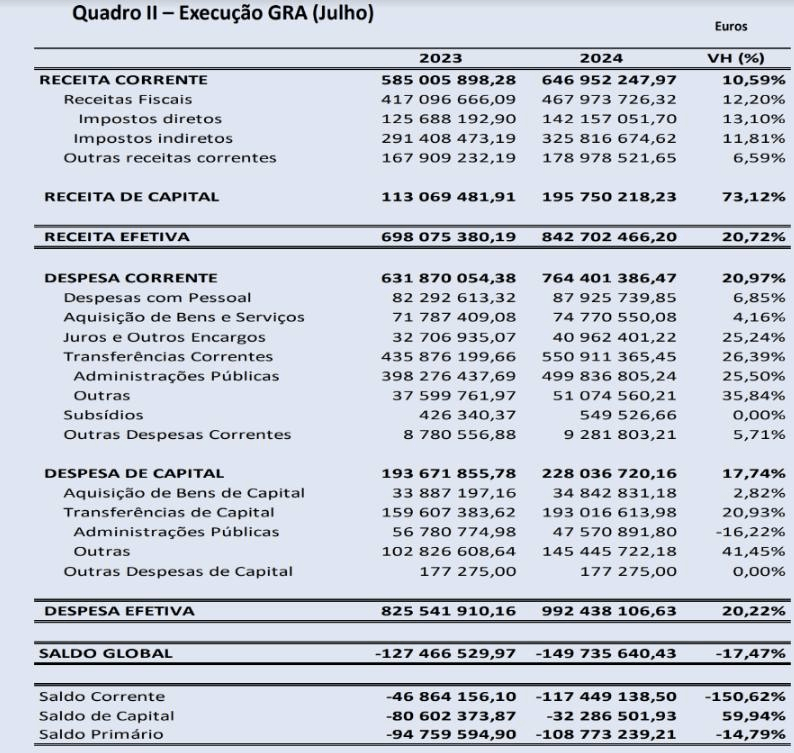
So, let’s look at the numbers according to the table we’ve published here.
In this year’s budget execution, current revenue is up 10.59%, and capital revenue is up 73.1%, for a total of +20.72%.
The problem is that current expenditures increased by 20.97%, double the increase in current revenue, and capital expenditures increased by 17.7% (a small fraction of capital revenue) for an actual expenditure of 20.22%.
Conclusion: we’re just as unbalanced as last year (the year of zero debt, which turned out to be more than 100 million).
In terms of the different taxes (tax revenues), the personal income tax is up 2% (almost 20% in 2023), the corporate income tax is up 47.68%, and indirect taxes are up 11%, with VAT increasing by 10.93%
Non-tax revenues also increased by 33%, mainly due to transfers from abroad.
In other words, current expenditures of 764,401,386.47 euros compare with tax revenue of 467,973,726.32 euros (61% of current spending). It’s an old structure, not new, but it’s not getting any better. It will not improve in the foreseeable future because there are no miracles, and, as a friend of mine says, “We’ve been had, and we’ve been had.”
The average Azorean has no idea of the hole we’re in.
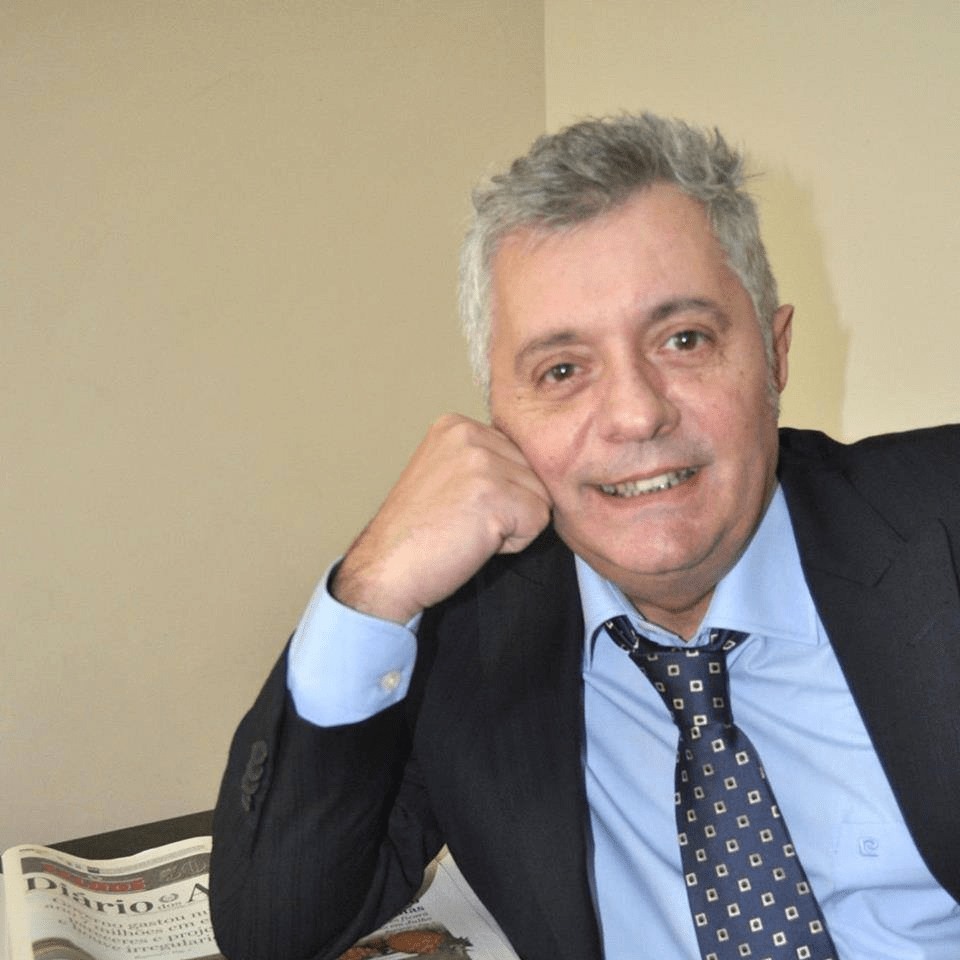
Osvaldo Cabral is the director of the newspaper Diário dos Açores.
NOVIDADES will feature occasional opinion pieces from various leading thinkers and writers from the Azores to give the diaspora and those interested in the current Azores a sense of the significant opinions on some of the archipelago’s issues.
Translated to English as a community outreach program from the Portuguese Beyond Borders Institute (PBBI) and the Modern and Classical Languages and Literatures Department (MCLL).
Below is the Chart that journalist Osvaldo Cabral referred to in his OpEd.
 Novidades - The Islands and the Diaspora