


José Manuel Bolieiro assured yesterday that his government is working on solutions to fill teacher vacancies, especially on peripheral islands such as Flores.
“Over the years, until today, this has always been the case. We have to find solutions to compensate for the absence of properly qualified teachers. These are the possible situations, it’s not ideal but we are working and making progress in this area,” said the President of the Government.
He said that there has been “recurrent difficulty in attracting and retaining teachers on the island of Flores. And we often face unexpected absenteeism: despite being posted, they often don’t show up.”
In his opinion, “our small islands will always have more difficulty and therefore deserve better attention so that we can, through increases and incentives, look at these specific needs that are necessary for educational success.”
He pointed out that the previous PSD government had an incentive plan within the framework of the proposal that his government presented in 2023 for the 2024 budget to provide for these incentives. “It wasn’t possible. We are preparing for the 2025 budget to ensure that the next school year starts with these incentives duly budgeted for.”
He pointed out that “whenever there is a transformation in our education system, new needs will arise and, at the start of the school year, everything will never be ready and perfect.”
And, in the face of the criticism that has arisen, he replied: “Anyone who criticizes what we’re doing, which is much more than what they’ve done over the last few years, immediately loses their morals. In any case, I’m not guided by what people say or by the desire to curse. I’m guided by objective reality. Yes, we often have difficulties, due to a lack of teachers or motivation for some territories and some islands. We are working to create motivation and also, specifically with some support we are giving to the University of the Azores, to boost the training of more teachers. Despite everything, we have more and more teachers and fewer students, and smaller classes. We need to find the teachers we need for the
subjects that are short of teachers. We are working on this,” added Bolieiro.
Sofia Ribeiro explains the reasons for the shortage of teachers.
Sofia Ribeiro, Secretary of Education, complementing the words of the President of the Government, tried to explain the lack of teachers in some subjects in schools in the Azores practically. Of all the competitions, 88 vacancies remained, and 460 were available. The Public Employment Exchange for Teachers was launched. And three vacancies remained unfilled “in a situation that is now being monitored by us with the schools, either for reallocation of the teaching services of the teachers who are there, redistribution, possibly also to see, given the movements that there are in other schools, if there is still an opportunity or interest on the part of the education system to relaunch these vacancies.”
Now, he explained, “What always happens throughout the school year and which requires our management is a series of no-shows and absences, which then require us to redeploy. And this is a very demanding process” (…).
“The policies we’ve been developing obviously don’t have an immediate impact. It takes five years to train a teacher and the process is not automatic. We will continue to monitor this process, which concerns us and demands a lot from our administration,” she said.
Asked if the shortage of teachers will be resolved in the coming months, she replied that this shortage “will be resolved as the result of the redeployment of teachers under the competition system is reported, as well as the result of the redeployment and redistribution of teaching services.”
And Sofia Ribeiro tried to be more explicit: “There are always needs, which require a differentiated response. Especially when it comes to education. As the year goes on, there are always new needs. Both in terms of human resources and material resources, which are reported to us and to which the government and the administration have to respond.”
The Secretary of Education then spoke of the changes made “to the career and remuneration conditions of teachers in our region, which are unprecedented in other classes, and which are aimed, of course, at greater dignity and better working conditions so that we can retain teachers.”

“We don’t want to radicalize the bet on digital,” says the President of the Government
Meanwhile, when asked what had failed to allow classes to start without digital textbooks, the President of the Government replied that the failure was down to “supply and delivery.” However, he left a warning: “We don’t want to radicalize the bet on digital. We want to mitigate the supply of physical textbooks by also registering digital textbooks. There will always be this mitigation,” he added.
The Secretary of Education, Sofia Ribeiro, added to José Manuel Bolieiro’s words that the government had increased the financial allocation to purchase digital textbooks compared to previous years. “Now, this school year, by giving digital textbooks again to the 5th and 8th grades, we now have all the students in the region, from the 5th to the 10th grade, with digital textbooks.”
Despite the pressure caused by a delay of around two months in the start of the acquisition of textbooks, Sofia Ribeiro said that she has information that “it will be possible, during this week, for some equipment to start arriving at our schools.” She added, “Especially on the more distant islands, the situation is more complex, but we are doing everything we can to resolve this situation by the end of this month. “
However, “…the digital textbooks are a great tool, but they are just another tool. They are a didactic tool that teachers and students use to achieve greater educational success, but there are many other tools that teachers naturally put at their disposal.”
There is a shortage of 200 assistants – but there could be more…
The Secretary of Education also revealed that, at the start of the school year, schools in the Azores were short of 200 operational assistants despite the “solid” investment being made in their placement. He pointed out that of the operational assistants in schools, “30% have found a permanent position due to competitions and incentives to regularize their working conditions. It’s a situation that then, in the face of retirements, requires our constant attention.”
Initially, the need for operational assistants was solved by placing them in occupational programs, which “is the quickest way we have of solving the problems.”
However, “because the government favors and aims to combat precariousness with solutions for job stability and also in our schools,” legislation has been created, which is currently under public consultation, to create a recruitment pool for operational assistants in schools who compete for placement on a staff or fixed-term placement.
Domo said, “priority orders are set up that allow us, in subsequent phases, whenever there is a need to reinforce the number of staff, we don’t have to wait for a new competition to place these professionals.”
“In this way, we have a system that is faster, that provides a more immediate response to our schools and is based on contractual stability, with labor and social stability for the workers themselves and for the schools.”
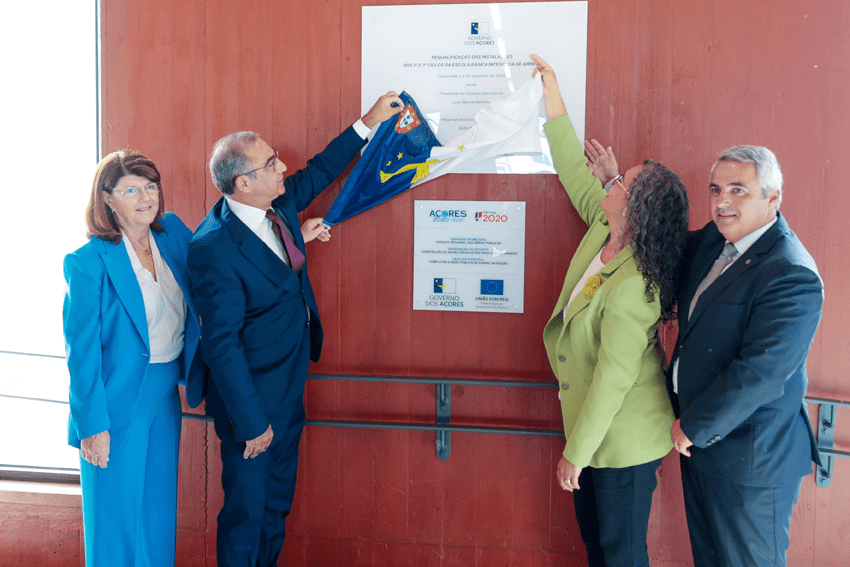
Bolieiro’s good news
In his statements, the President of the Government began by highlighting the “good news” to journalists. The first “is that in the great goal of educational success, we have already surpassed the national average here in the Azores in 10 subjects, including Portuguese and Mathematics A. This is a historic advantage,” he said. This is a historic advantage,” he said.
In addition, in terms of early school leaving, “we’ve gone from the old 27 points to 21, so this is the essential and motivational part. We have more teachers on staff, fewer students and better teaching conditions.”
New EBI (elementary and Junior High, here in the US) in Arrifes with shortcomings in the sports area
The President of the Executive Board of the new Arrifes Integrated Primary School, Isolina Medeiros, couldn’t hide her delight at starting the new school year in the new facilities and, at the time, explained some of the reasons why.
She pointed out that the last three years of teaching at the old school “were years of great sacrifice on our part and often of discouragement on the part not only of the students but also of the teaching and non-teaching staff.”
Isolina Medeiros also considered the present and the future. She recalled “the urgent need to upgrade the gymnasium, which not only serves our students but also the youth community of Arrifes.”
Despite this request, the President of the Executive Council—who gave an interview to Correio dos Açores, which we published in our edition last Friday—stressed that “civic values and discipline, as well as improving the quality of the student’s learning, will be our intervention priorities from today (yesterday).” He also took the opportunity to highlight the “Here I am happy!” project, which starts on the first day of school.
Isolina Medeiros raised the issue of inadequate sports facilities at the Arrifes EBI, which led journalists to ask José Manuel Bolieiro about the timing of the works. The President of the Government was not very optimistic.
When asked if he was inaugurating a finished building, he replied that the school “is complete for teaching” and that “we always want to add value to the dynamics that are taking place here, namely the sports facilities around it.”
When asked if the refurbishment of the school’s sports pavilion was on the horizon, his answer was, “we’ll see,” and he added: “naturally, within the framework of the needs we have throughout the Azores, all the parishes and islands, it won’t be a priority, it will be in progress. In the educational and school charter that we have of the assets under the responsibility of the Region, we are going to make a journey with more groundbreaking and inaugurations,” he concluded.
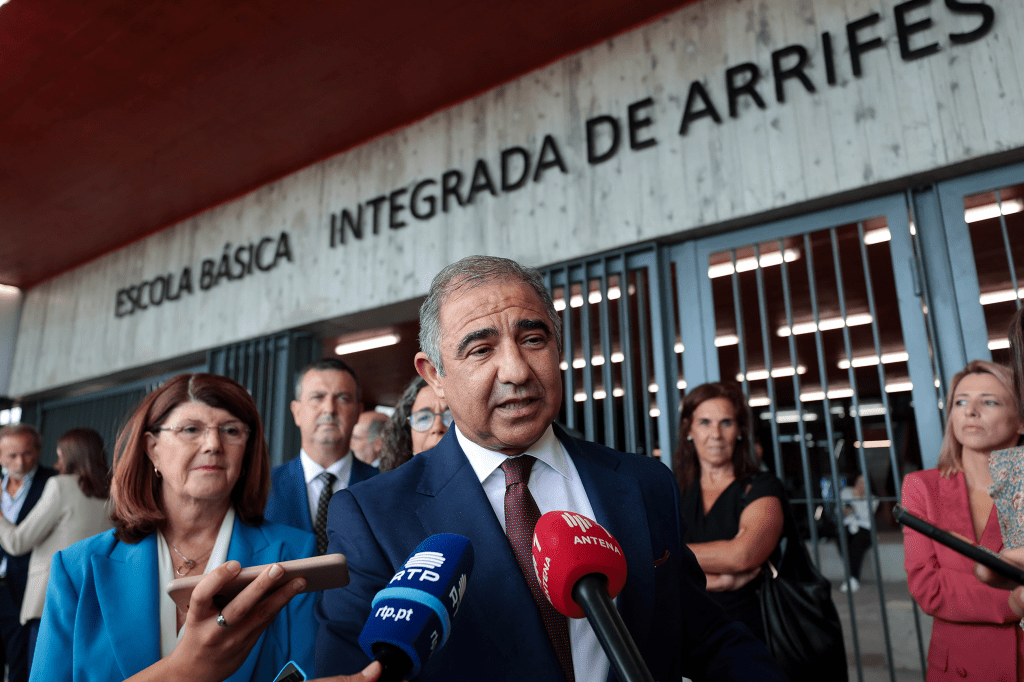
A school worth 19 million Euros
The new integrated elementary school in Arrifes represents an investment of 19 million euros. It’s a new building with an area of around 3,500 square meters and three floors, where all the school’s functions are concentrated.
The sports area, which needs refurbishment, corresponds to more than 10,000 square meters of gross construction area.
The complex consists of 26 classrooms, 12 group classrooms; two multifunctional EVT classrooms with a workshop and storage room; two multifunctional Technology Education classrooms with a workshop and storage room; a Physics/Chemistry laboratory, two Nature Science laboratories, two Music classrooms, and four IT classrooms, among other work offices and sports and leisure spaces.
The new school building can accommodate 750 students, spread across the 2nd and 3rd cycles of the elementary educational system in Portugal and Special Education.
Frederico Figueiredo is a journalist for the newspaper Correio dos Açores-Natalino Vivieros, director.
Translated to English as a community outreach program from the Portuguese Beyond Borders Institute (PBBI) and the Modern and Classical Languages and Literatures Department (MCLL) as part of Bruma Publication and ADMA (Azores-Diaspora Media Alliance) at California State University, Fresno, PBBI thanks Luso Financial for sponsoring NOVIDADES.


 Novidades - The Islands and the Diaspora