

People in our region still believe in miracles, especially among the political class.
When I’ve been writing here for a few years that we’re going down the wrong path, that we’re building an administrative galaxy every day that’s holding the region back, that we won’t have enough people in the next few decades to impose a good pace of development and that tourism is what’s going to save us, the usual “miracle workers” come along and say the opposite.
This isn’t being pessimistic; it’s reading reality and knowing what’s coming based on data that the average citizen doesn’t have easy access to because, in this region, everything is difficult to access officially.
The data scattered throughout the Plan and Budget for 2025 prove that we are not doing well and that our path to success is one of mediocre results.
Anyone who takes the time to analyze what is there will quickly conclude that the evolution of the region’s productive profile over the last 10 years shows a clear path of specialization in tourism activities, a sector responsible for 14% of total regional GVA, having almost tripled its value in the last decade (+174% between 2011 and 2022).
The government acknowledges that tourism has already overtaken the weight of the primary sector, which is traditionally the richest in the region.
Commerce is surprisingly leading the way, with 24% of total GVA in 2022, but tourism assumes an even more significant preponderance since it will account for 15.4% of the staff employed in establishments in 2022 (6 p.p. more than in 2011).
The primary sector has already become the third largest employer in the region (12.0%), and we should also highlight the sharp fall in the construction sector, which in 2022 would account for 10.1% of employment, along with the weight of manufacturing and administrative and support services (9.2% and 10.2% respectively).
With a weak industry, an oversized service sector, an aging population, and low levels of qualification, it becomes more challenging to leverage the economy and the development of the Azores.

The government itself acknowledges, in the Plan and Budget for 2025, that “the region’s structural difficulties with regard to the internationalization of its productive fabric persist, which can be seen in its low export intensity compared to other Portuguese regions (only comparable to the Algarve) and the strong resistance to the rise of this indicator over the last decade.”
An archipelago that doesn’t create wealth imports almost everything, and exports nearly nothing is doomed to failure.
It’s true that we have room to grow, but to turn things around, we need to create robust public policies and structural reforms.
Allied to this, as is also recognized, “the low qualification levels of the active population help, on the one hand, to explain the persistent difficulties in generating wealth in the Region, since the percentage of the active population with completed higher education is the lowest among Portuguese regions (19.5% in 2023)”.
To help the party, we have an international and national situation that dramatically influences our economy.
According to the Government of the Azores, “there has been a slowdown in the pace of recovery of the European economy, with some member states facing a recession. In Portugal, there is a risk of a contraction in private consumption which could put negative pressure on the region’s economic development”.
Against this backdrop, there is only one more opportunity left, and that is “the implementation of the 18 investments of the Recovery and Resilience Plan to be carried out in the Autonomous Region of the Azores, to which a financial envelope of more than 725 million euros is associated”.
If the RRP fails and the implementation of the 2030 Operational Plan goes wrong, you’ll give up believing in miracles.
It will be easier to see a pig riding a bicycle than to see the Azores developing vigorously in the coming years.
BAGACINA AOS MOLHOS – In any civilized country, the situation in Ponta Delgada jail would be a scandal. In ours, it’s a normal situation.
Even if people are escaping from the country’s prisons with a ladder, it’s not surprising that Portugal’s security and justice policy is good.
After António Costa’s previous government entertained us with that shameful story about the bagacina (pumice, a type of concentrated lava) on the land for the new prison, the current government is saying that construction won’t start until, believe it or not, 2027!
In other words, it will take two more years and a few more steps just to start the work. Imagine its completion…
Do you still believe in miracles?
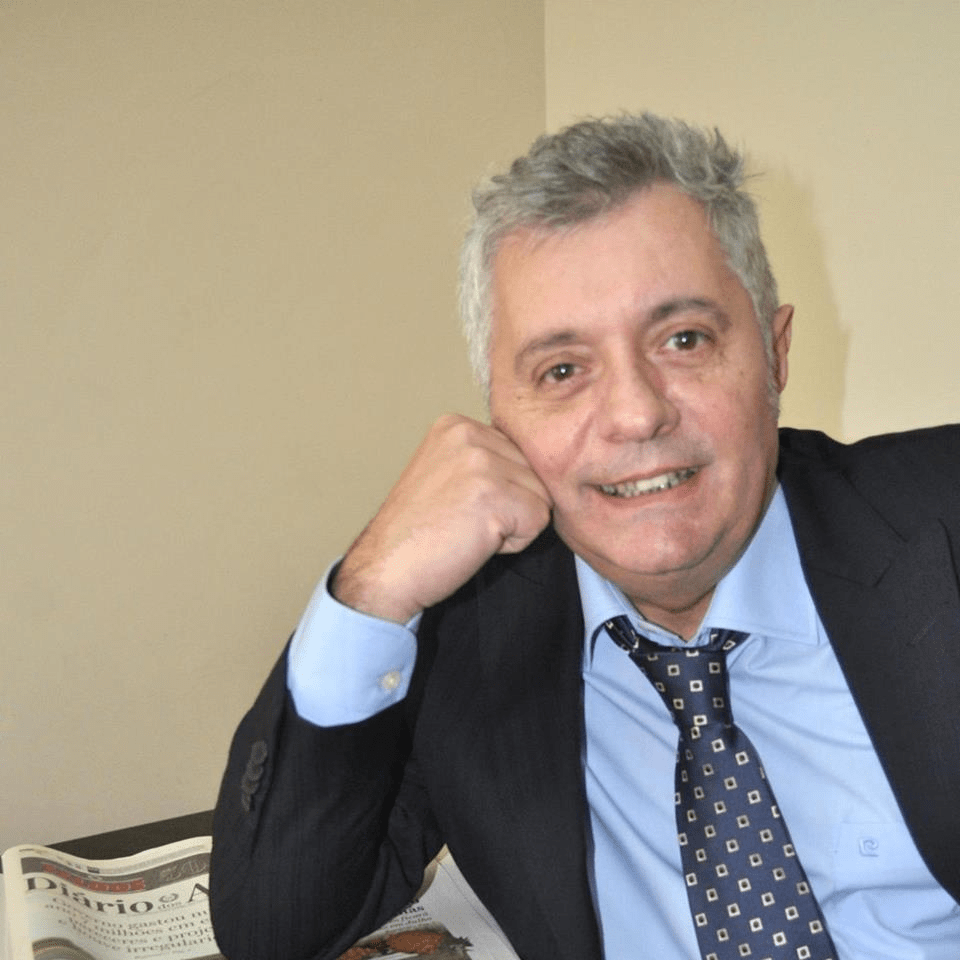
Osvaldo Cabral, Director of the newspaper Diário dos Açores, October 2024
NOVIDADES will feature occasional opinion pieces from various leading thinkers and writers from the Azores to give the diaspora and those interested in the current Azores a sense of the significant opinions on some of the archipelago’s issues.
Translated to English as a community outreach program from the Portuguese Beyond Borders Institute (PBBI) and the Modern and Classical Languages and Literatures Department (MCLL)
 Novidades - The Islands and the Diaspora