

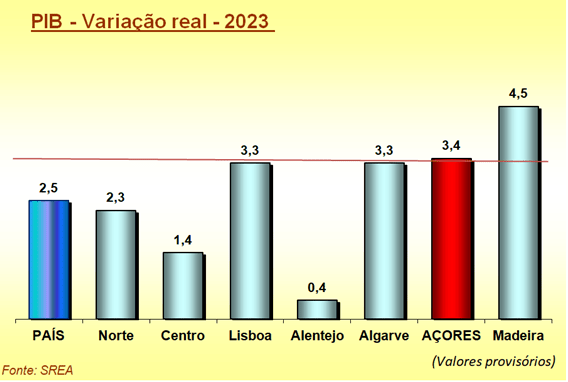
The latest GDP figures for 2023 show that the archipelago recorded a growth of 3.4%, higher than all regions except Madeira. Without knowing all the Gross Value Added data, which allows us to confirm which sectors contributed to the increase or decrease in GDP, we can deduce that tourism was one of the main growth drivers. The only reason it wasn’t more pronounced was the fall in agricultural gains and the real estate sector.
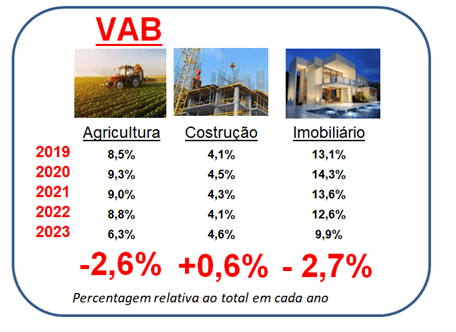
According to the preliminary results of the Regional Accounts, in 2023, the RAA’s GDP (Gross Domestic Product) recorded a real increase of 3.4% compared to the previous year, which was 2.5%. This increase brought it slightly closer to the national average – rising from 87% to 88% of the country’s total and, above all, in the last two years as a whole, a significant rise closer to the European average.
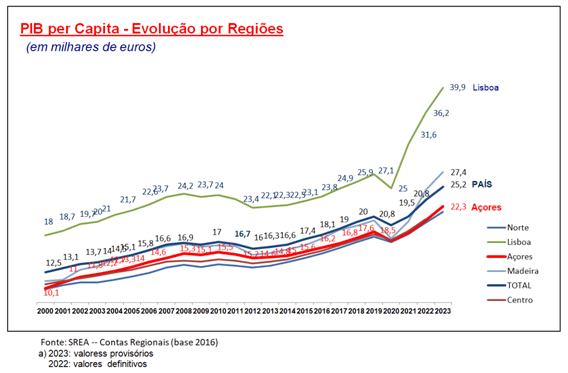
The data also shows that the per capita value has grown to 22.3 million euros, which is still below the country’s average. However, it is closer, but further away from Madeira, which has a value of 27.4 million euros per person and is well below the Lisbon Region, which has always had the highest value in the country.
Agriculture falls
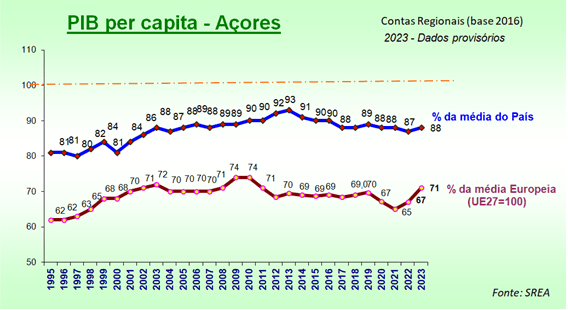
The Gross Value Added figures for all sectors are not yet known. However, from the statistics already known, it can be seen that agriculture saw a significant drop, falling from 8.8$ to 6.3% of the total, 2.6 percentage points less than in 2022, when it had already fallen from 9% to 8.8%. The real estate sector also fell by 2.7 percentage points.
The GVA for tourism has not yet been released, but everything suggests that it was the sector that contributed most to the positive GDP results. In August, INE published a report on the country in 2023, which showed that the Gross Value Added generated by Tourism (GVAGT) registered a nominal increase of 16.0%, revealing a greater dynamism than the national economy. The figures do not specify the data for the Azores, but it is assumed that a similar dynamic was recorded in the archipelago.
The latest GVA figures for tourism in the Azores are from 2022, at which time it was 6%, but before swine flu, in 2018 and 2019, it was as high as 8%. Private sources admit that it has already exceeded double digits.
Rafael Cota is a veteran and distinguished journalist living in the Azores. This story will also appear in Portuguese in the newspaper Diário dos Açores.

Translated to English as a community outreach program from the Portuguese Beyond Borders Institute (PBBI) and the Modern and Classical Languages and Literatures Department (MCLL) as part of Bruma Publication and ADMA (Azores-Diaspora Media Alliance) at California State University, Fresno, PBBI thanks Luso Financial for sponsoring NOVIDADES.

 Novidades - The Islands and the Diaspora