

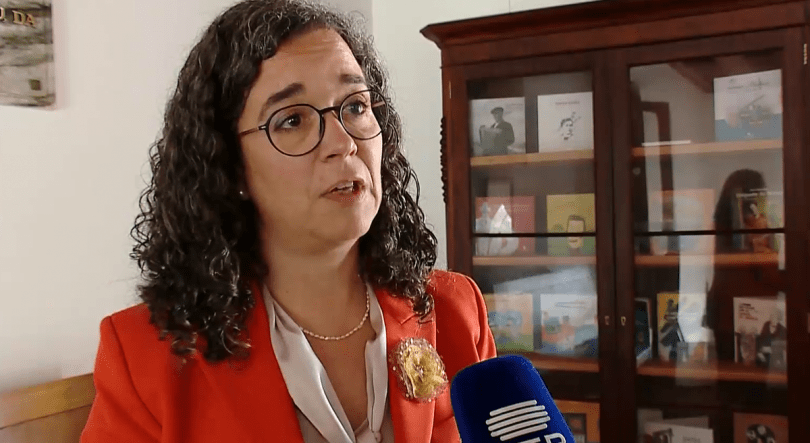
Today in Horta, Sofia Ribeiro, the Regional Secretary for Education, Culture and Sport, presented the Teaching Prioritization Plan, which includes incentives for teachers to settle on six islands, changes to the staff competition, and the management of surplus teachers.
“It’s true that we’re seeing a demographic reduction, but unlike in the past, when not investing in the placement of new teachers was justified by the reduction in the birth rate, this government has always recognized that the reduction in the number of students does not justify any restraint with the placement of teachers,” she stressed at a press conference.
After listing the various measures already taken in the sector, the Regional Secretary presented the three axes of the Teaching Prioritization Plan: incentives for teachers to settle, changes to the teaching staff competition regulations, and the management of surplus teachers.
In the first case, aimed at the islands of Santa Maria, Graciosa, São Jorge, Pico, Flores, and Corvo, which have seen the highest rates of annual fixed-term contracts over the last three years, financial incentives will be defined for the teaching groups and schools where, in August last year, it was necessary to use the competitions on the Azores Public Employment Exchange (BEPA) because there were no candidates in the centralized competition.
“On the condition that these vacancies correspond to the need for integration into staff posts, support of 300 euros per month will be processed, plus an annual return ticket under the Azores Tariff or the Social Mobility Allowance. Teachers who are placed in the vacancies identified will benefit from this support, regardless of their contractual relationship and as long as they commit to remaining there for a minimum period of three years, with monthly attendance of no less than 75%,” says Sofia Ribeiro.

As for changing the regulations for the teaching staff competition, the Regional Secretariat for Education, Culture, and Sport is going to start the negotiation process for revising the rules for the teaching staff competition, having presented the unions with the respective preliminary legislative proposal and a timetable that begins on March 7. Creating a first priority for placements in the internal, external, and recruitment competitions will be proposed for teachers who, having benefited from the incentives for settlement explained above, wish to settle on the same island and recruitment group. After obtaining a permanent post (being tenured), the teachers who enjoy this first priority must remain in that post for no less than five years.
In addition, it is proposed to create a rule requiring a minimum of one year’s teaching service in the school and subject group in which a permanent post is obtained.
As far as the management of surplus teachers is concerned, the Azorean government will transfer teachers to organic units where there is a shortage.
“In other words, if a situation is identified where, in a school where there are more teachers than the number of posts defined by law, and in another school, in the same municipality, there is a shortage of teachers, the educational administration will transfer the teacher with the lowest professional grade. This mechanism is also possible between schools in different municipalities, as long as the distance between the two schools in the two different municipalities is less than the distance between the schools in the same municipality,” she said.
Sofia Ribeiro said that the Regional Secretariat has already started preparing a second phase of this Teaching Prioritization Plan, “to be implemented when organizing the next school year, is now in the process of defining the distribution of work, taking into account the students and the existing courses.”
She added, “At the last Coordinating Council for the Regional Education System, we raised this analysis, and we plan to present a set of guidelines to the organic units so that they can begin the next school year with this new policy.”
in Correio dos Açores-Natalino Viveiros, director
Translated to English as a community outreach program from the Portuguese Beyond Borders Institute (PBBI) and the Modern and Classical Languages and Literatures Department (MCLL) as part of Bruma Publication and ADMA (Azores-Diaspora Media Alliance) at California State University, Fresno, PBBI thanks Luso Financial for sponsoring NOVIDADES.

 Novidades - The Islands and the Diaspora