


I do not believe that the country’s historical political landscape—fifty years of democracy under the PS and PSD—has been altered by the May 18 elections to the Assembly of the Republic. There has indeed been a change, but it can only be confirmed at this point in time and in this political context. There is no guarantee that the legislature will even reach the end of its term, even with presidential elections coming up that will ensure the government remains in office for longer, specifically for one year, from now until six months after the new president takes office, as the president cannot dissolve parliament. And the local elections, despite the political distance, will be a good barometer to test this idea: at the outset, given the single-person and unprepared political format of Chega (single-person, no staff, no program or with disparate variations, hateful and stupefying discourse, no democratic leadership), it is predictable that the government will continue in its historical vein. If not, then it will be possible to conclude that, in some way, the historical record is breaking down. This is unlikely, in my view, because the PS is deeply rooted in Portuguese society. However, in political theory, hypotheses are always correct until reality proves them wrong.
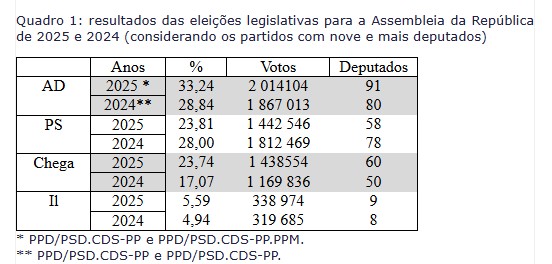
With the final election results (in the cases reviewed here, all with more votes than the provisional results), as shown in Table 1, there are winners and losers: the big loser is the PS, or more correctly, the PS of its now former leader, Pedro Nuno Santos. Throughout the electoral process, and even after abruptly losing the elections, he continued to talk about extremist issues, fixated on Montenegro, when he is also being pursued by the Attorney General’s Office, as if stubbornly saying that he had ethics as party leader and as future Prime Minister, whereas the other did not. Instead of fighting for a civilized discourse of progress and better living conditions for the Portuguese people, the PS focused exhaustively on itself, as if it were talking only to itself. This is unique in the country. I believe that he was the real driving force behind the loss: if he had adopted a realistic and loyal discourse and aimed to govern the country, the PS would not have sunk so low.
AD is the big winner because it wins back the government and significantly increases the number of votes and seats. It has a weak PS due to the shock of coming third in the Assembly of the Republic, but it has the motivation of more votes than Chega. The PS has a lot to do to get back on its feet because António Costa’s (Carlos César’s) PS punished the system, first by creating the geringonça, and second, because it was the party that contributed most to the rise of Chega. That is on the one hand; on the other, because the local elections are much more important than the internal life of the PS: if the result is identical to that of the legislative elections, the future of democracy will be unpredictable, perhaps. All in all, therefore, the government’s AD will benefit from the PS not saying no to everything that comes from the radical extreme; and it will benefit from Chega, which, if it maintains its tiresome discourse on corruption and immigrants, is likely to lose its aura of illusion.
However, there is another serious loser, as shown in Table 2: the PSD-Azores AD, which decreased from 42,343 votes in 2024 to 36,879, representing a drop of more than 5,000 votes, despite winning three seats when it had held two in 2024. In other words, the balance of power in terms of the number of seats does not match the decline in votes, and this is not due to an increase in the number of votes, which it actually lost, but to a numerical adjustment in the distribution by Chega (and perhaps by others as well). In any case, on the one hand, this may not be repeated; on the other hand, it certainly loses votes. This indicates strong discontent with the government in the Azores, as it continues to increase debt and address trivial matters. This is the result of a lack of political and governmental oversight, as we have often emphasized.
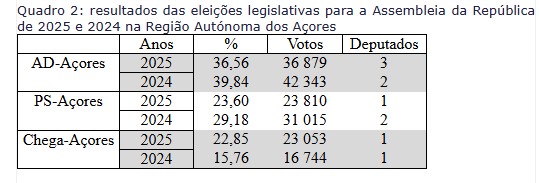
However, there is a problem in the Azores that AD is and will continue to exploit: the PS’s failure to come up with any valid alternatives. With a leader who is more concerned with Lisbon than with the archipelago, things could go badly for the PS, helping AD to remain in its political limbo of moving forward without actually going anywhere.
In Diário Insular
Arnaldo Ourique is a specialist in the Portuguese Constitution and the Azorean Autonomy.
NOVIDADES will feature occasional opinion pieces from various leading thinkers and writers in the Azores, providing the diaspora and those interested in the current state of the Azores with insight into the diverse opinions on some of the archipelago’s key issues.
Translated to English as a community outreach program from the Portuguese Beyond Borders Institute (PBBI) and the Modern and Classical Languages and Literatures Department (MCLL).
 Novidades - The Islands and the Diaspora