

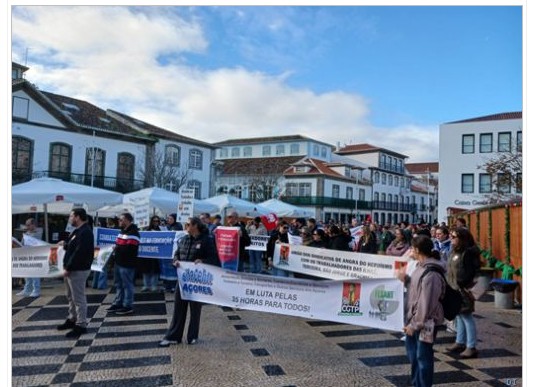
The general strike had “very significant participation” in the Azores, according to the CGTP coordinator in the region.
“The data we have indicates widespread participation in the strike in practically all sectors and on all islands. Although there were some differences between sectors, all sectors were affected,” said Rui Teixeira, in statements to DI.
Among the sectors affected, the union leader highlighted health, noting “over 70%” participation in hospitals, where only minimal services were operating. There was also a “very significant impact” on education, according to Rui Teixeira. Only “a residual number of schools” opened and operated normally, due to the participation of teachers and non-teaching staff. The impact on education also extended to the private sector, claimed the CGTP coordinator in the Azores. “The Colégio de Santo António, in Horta, which does not usually close, closed completely. Most nurseries were closed or restricted,” he revealed.
In transportation, despite minimum service requirements being decreed, most flights did not operate. “Minimum services were not provided because the meteorological services did not transmit the information needed to know whether they could take off or not,” explained the union leader.
On the island of Flores, no buses ran due to 71% participation in the strike.
In most of the slaughterhouses in the Azores, “there were no slaughters,” with participation “around 80%.” There was also “high participation” in local authorities, according to Rui Teixeira. In the municipality of São Roque, participation exceeded 50%; in Madalena, it was around 34%,as in Horta, and in Lajes do Pico it reached 20%. “Participation is significant in both the private and public sectors. It may be slightly more significant in the public sector, precisely because of the nature of the workplaces,” said the union leader.
“For example, Cofaco, in São Miguel, had a strike participation rate of over 50%, which is very significant when we consider the wages of those workers,” he added. According to Rui Teixeira, in their contacts with workers, union leaders detected “enormous concern” about the labor package in all sectors of activity.”
“Many workers decided to join the strike for this reason, while many others, calculating the cost of the day’s work they would lose, may have decided not to join because of the financial loss. The overwhelming majority of workers realized that this was the time to fight and protest. Let’s see if it will be necessary to continue the fight or not,” he stressed.
Asked about the fact that the Minister of the Presidency, Leitão Amaro, said that participation was between 0 and 10%, Rui Teixeira said it was “astonishing” that the minister managed to “express that opinion without laughing.”
“This is a huge disrespect for the striking workers and will have to be answered. We will see if this ends here or if we need to continue the fight,“ he said. The union leader said that the CGTP cannot negotiate ”what workers are willing to lose“ when there is ”a proposal on the table that further upsets the balance of labor relations.“
”We are willing to negotiate, yes, but to rebalance labor relations and to better protect workers,” he stressed. DI also tried to reach the leader of UGT/Azores, Manuel Pavão, but had not succeeded by the time of going to press. Speaking to Antena 1/Azores, the union leader said he expected the strike to have a major impact on the public sector, but regretted that it had not had a greater impact on the private sector.
“In the sectors where I would have liked to see a greater impact on private activity, such as large-scale distribution, hotels, restaurants, sectors where this labor package most harms these workers, there was not much participation. The banking sector, for example, activated the strike fund, I expected it to be closed, and only one or two went on strike,” he said. Yesterday’s general strike, the first called by CGTP and UGT since 2013, was in protest against the Government of the Republic’s proposed changes to the labor law.
In Diário Insular-José Lourenço, director.
Translated into English as a community outreach program by the Portuguese Beyond Borders Institute (PBBI) and the Modern and Classical Languages and Literatures Department (MCLL), in collaboration with Bruma Publication and ADMA (Azores-Diaspora Media Alliance) at California State University, Fresno. PBBI thanks Luso Financial for sponsoring NOVIDADES.

 Novidades - The Islands and the Diaspora