

“An island is a way of inhabiting the world.”
— Vitorino Nemésio
There are years that do not simply pass through time but teach us how to inhabit it. For Novidades: The Islands and the Diaspora, by Bruma Publications from PBBI at Fresno State, 2025 was such a year—not a sequence of headlines, but a sustained act of presence. Day after day, word after word, the Azores and Madeira were not remembered from afar but spoken into the present, carried across water and distance as living realities. What unfolded was not merely growth in scale, but a deepening of attention: journalism as dwelling, language as bridge, the island not as nostalgia or origin, but as a way of being fully in the world—for to write through translation the islands daily is to inhabit them together, across water and time.
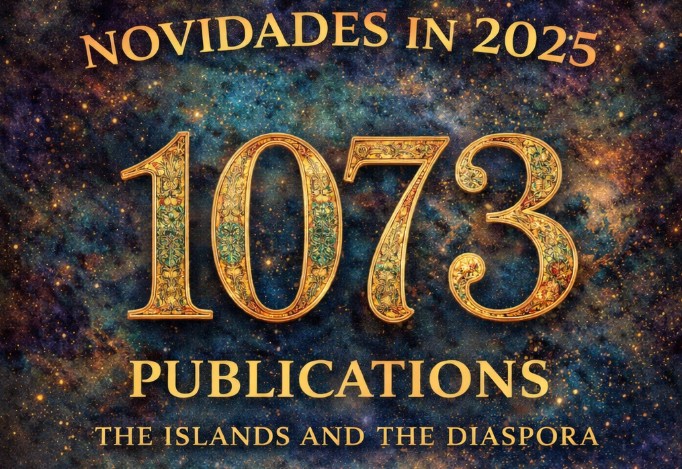
That presence took form in daily labor. In 2025, Novidades published 1,073 stories, interviews, and opinion pieces—not as accumulation, but as continuity. Each piece extended a conversation across the Atlantic, insisting that the islands are not an afterthought of migration but a living center of inquiry. What began in July 2023, with a few hundred articles and cautious ambition, matured into a sustained practice: to speak the Azores and Madeira every day, in real time, with clarity and care. Growth followed not because we chased scale, but because we honored rhythm—the slow, exacting rhythm by which attention becomes belonging.
That rhythm can also be measured. From roughly 150,000 words published in 2023, Novidades grew to nearly 775,000 words in 2025—a testament not only to volume, but to endurance. These words formed a living archive of the present: politics and culture, education and housing, migration and return, language and loss, opportunity and inequality. The translated journalism here did not freeze the islands in memory; it kept them in motion.
Numbers, however, are only thresholds. Once crossed, they become geography. The more than one thousand pieces (1,073) published in 2025 did not remain on the page; they traveled, dispersing into a diasporic map that stretched from the Azores and Madeira to California and Ontario, from Lisbon to Toronto, from New England to the Pacific coast, and onward into Europe, Africa, and the Southern Hemisphere. Readers arrived from many shores, carrying different histories and accents, yet bound by a shared present—because to write the islands daily is to inhabit them together, across water and time.
Our strongest currents flowed through the United States, Canada, and Portugal, with intensity in California, Ontario, the Autonomous Region of the Azores, Lisbon, Massachusetts, New York, Texas, Hawaii, Florida, and Idaho. Cities such as Tulare, Los Angeles, Toronto, Ponta Delgada, Fresno, New York City, San Francisco, Lisbon, Boston, San Diego, Palm Coast, Angra do Heroísmo, Montreal, Vancouver, Turlock, San Jose, Honolulu, and Hanford emerged as points of convergence. Beyond them, readers connected from the United Kingdom, Germany, France, Ireland, the Netherlands, Sweden, Spain, and from places as distant as Finland, Norway, Romania, Argentina, Mexico, Japan, South Korea, Kenya, and Australia. What this revealed was not dispersion, but relation: an archipelago of attention where distance no longer implied detachment.
What distinguishes Novidades is not reach alone, but intention. This is translated and original journalism that refuses nostalgia as a destination. We do not traffic in postcard memory or folkloric comfort. Instead, we insist on presence: the Azores and Madeira as they are—complex, creative, challenged, contested, and alive. By writing the islands daily, we humbly help shape a diaspora that is informed rather than ornamental, engaged rather than distant—one that knows the islands not only through inheritance, but through knowledge.
This work, however, has never been solitary. It is sustained by trust, generosity, and shared commitment. A million thanks are due to the Azorean press, whose openness has allowed us to translate and circulate their reporting across borders; to the public institutions and private entities that regularly entrust us with their press releases; and to the many Azorean opinion writers who believe in Novidades as a bridge—confident that their words will reach the diaspora with fidelity and context. We are equally grateful to the community organizations that open their doors, share their histories, and keep local life legible across distance. And we owe a profound debt to the families who, through our Portuguese Oral History Project at Fresno State, offered their memories—voices, gestures, silences—so that the stories composing who we are as Americans of Portuguese ancestry may live not as anecdote, but as archive, in a multicultural world that needs such testimonies. A huge thanks to the Luso-American Development Foundation (FLAD) for their supportin creating and sustaining Novidades and Luso-American Financial for being a community supporter through their advertising. We are open to other partenerships.
This commitment has also been pedagogical. Novidades has become an instrument of learning—for students at California State University, Fresno, where it feeds classrooms, research, and discussion, and for students and educators in any institution seeking to understand the Azores and Madeira in real time. It functions as a living syllabus, renewed daily, where journalism becomes cultural literacy and the Atlantic ceases to be a void, becoming instead a shared intellectual space.
Underlying this work is the broader mission of Bruma Publications: to publish the Azores and Madeira in the United States, to normalize their presence in North American discourse, and to affirm that island societies belong not on the margins but at the center of global conversations. From a few hundred stories to more than a thousand, from tentative beginnings to sustained attention, the project has grown without losing its ethical compass—because, as Fernando Pessoa reminds us, “Tudo vale a pena quando a alma não é pequena” (“Everything is worthwhile when the soul is not small.”). What we have built was made possible by refusing to think small about culture, language, and responsibility.
And yet none of this would endure without fidelity to language itself. “Sem a palavra, o mundo fica incompleto,” warned Natália Correia (“Without the word, the world remains incomplete.”). Novidades has taken that warning seriously. Each article, interview, and essay has been an act of completion—a way of ensuring that the Azores and Madeira do not drift into abstraction or silence, but remain fully spoken, argued, questioned, and imagined in the present tense. And so, 2026 begins—not as a break, but as a continuation of breath. If, as Nemésio teaches us, an island is a way of inhabiting the world, then this work remains an exercise in that inhabitation: attentive, rigorous, shared. As long as there is sea between us, we will continue to translate and publish, as well as write original pieces—not to close the distance, but to inhabit it, turning separation into relation, and time itself into a shared, unfolding now.
Abraços and many thanks
Diniz Borges
 Novidades - The Islands and the Diaspora