

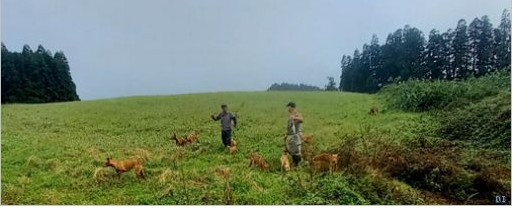
Although rock pigeon hunting on the island of São Miguel will remain open until February 26, 2026, and wild rabbit hunting will also remain open in São Miguel this coming January 2026, using the Corricão method, that is, only with hunting dogs and without weapons, I believe that we can already anticipate an assessment of the 2025-2026 hunting season in São Miguel and even in the Azores.
Hunting only makes sense if it is accompanied by a strong social component, whether experienced through a healthy relationship with animals, which involves respect for hunting dogs and game species, cooperation with the agricultural sector in controlling the population dynamics of game species, that hunting is effectively used in gastronomy, and finally that the practice of hunting does not jeopardize the sustainability of the species in question. Naturally, with diseases and viruses increasingly affecting animals, research and science should occupy, or do occupy, a central place in monitoring hunting and setting hunting calendars. This requirement is a priority in monitoring hunting in the Azores and globally to safeguard its sustainability.
But returning to the assessment of the 2025-2026 hunting season, by species, and starting with the wild rabbit, which is the game species that attracts the most hunters in the Azores, it can be concluded that in the case of the island of São Miguel, it took place with reasonable to good catches, because in some areas of the island this species has recovered well from hemorrhagic disease and developed reasonable colonies of wild rabbits, unlike islands such as Santa Maria, Terceira, and Pico, to name a few, where recovery from hemorrhagic outbreaks has been very slow and therefore very difficult. In summary, we had a good hunting season for wild rabbits on the island of São Miguel. Regarding this species, cooperation with the agricultural sector during this closed season must be genuine and involve careful, informed intervention by the Official Hunting Services. The worst outcome for wild rabbits is new outbreaks of hemorrhagic fever.

As for the rock pigeon, the most abundant species on the hunting calendar in the eight islands where hunting is permitted in the Azores, it continues to have high densities and is clearly not a game species that attracts many hunters across the islands. One explanation for this situation is, I believe, linked to a lack of awareness of the high gastronomic potential of the rock pigeon.
As for the wild quail, its numbers on most islands are low, especially when compared to those during the wheat economic cycle. The hunting season and the number of specimens of this species that can be hunted are very limited in the Azores, except on the islands of Graciosa and Terceira. This is justified to avoid jeopardizing the sustainability of this game species. However, it would be advisable in the case of São Miguel to increase the four Sundays currently allowed to six and reduce the current five quails to four or even three quails, the number allowed to be shot per hunting day, since I believe that nowadays no one hunts quail to make numbers, but because other values arise, such as dog breeding and the relationship with nature. There are fewer and fewer hunters on São Miguel who have pointing dogs to hunt only four Sundays a year. In summary, hunt this species, yes, but first and foremost, prioritize the sustainability of our wild quail, Coturnix coturnix conturbans, which currently faces its greatest dangers and challenges in the changes in agriculture and the technologies used, and not in hunters.
The other noble species that can be hunted on some islands in the Azores is our woodcock, Scolopaxrusticola. In my case, I currently only hunt it on Pico Mountain, and it is my informed opinion that this year, this species has reduced its stock. There are several reasons for this, and it is up to the official hunting services and the hunters themselves to find the best solutions to preserve this authentic treasure of hunting and the Azores, with the aggravating factor that this species is overwhelmingly resident in the Azores, that is, it does not benefit from migration, which increases our responsibility in its management.
Finally, regarding the migratory birds that visit us every year, namely ducks and coots, I believe this was a poor year, increasingly constrained by the species that are permitted to be hunted, the reduced hunting season, and the number of hunters involved. This situation warrants further study.
In Diário Insular, José Lourenço-director
Translated into English as a community outreach program by the Portuguese Beyond Borders Institute (PBBI) and the Modern and Classical Languages and Literatures Department (MCLL), in collaboration with Bruma Publication and ADMA (Azores-Diaspora Media Alliance) at California State University, Fresno. PBBI thanks Luso Financial for sponsoring NOVIDADES.

 Novidades - The Islands and the Diaspora