

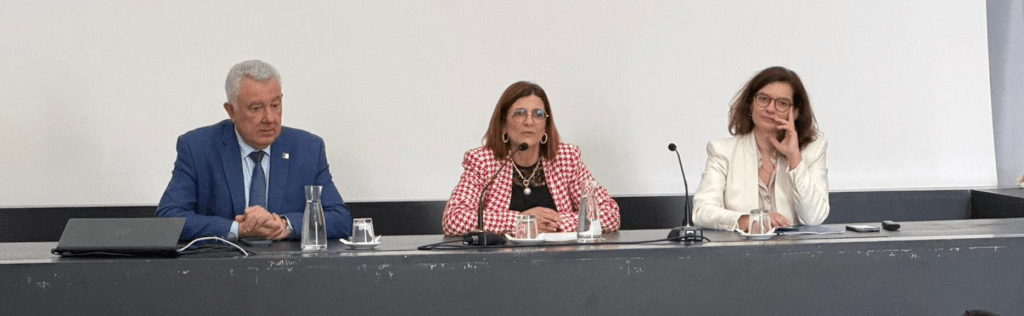
In the shifting geometry of Europe’s geopolitical landscape, the Atlantic once again asserts its quiet centrality. Speaking on Monday, Artur Lima, Vice-President of the Regional Government of the Azores, underscored the enduring strategic importance of the archipelago—not only for mainland Portugal, but for Europe and the wider world.
His remarks came during a visit to the region by Inês Domingos, Portugal’s Secretary of State for European Affairs, who delivered an open lecture at the University of the Azores titled “The Challenges of Territories in the Current European Context.” Addressing students and faculty, Lima situated the Azores within a broader historical arc—one that stretches from the Cold War to today’s emerging geopolitical realities.
“The Azores were absolutely pivotal, through their actions and their geostrategic position, in maintaining peace during the Cold War,” he said. “The region and the Lajes Base were fundamental in preserving that delicate balance between East and West.” The reference to Lajes Air Base—long a cornerstone of transatlantic defense infrastructure—served as a reminder of the islands’ role at the crossroads of military, political, and diplomatic history.
Lima went further, linking the archipelago’s geographic reality to Portugal’s place on the global stage. “It is also thanks to the Azores that mainland Portugal holds the importance it does in Europe and the world. Portugal is a founding member of NATO because of the Azores. That fills us with pride and elevates us,” he said, framing geography as both inheritance and agency.
Yet his vision was not confined to the past. The Vice-President pointed to emerging sectors where the Azores could again occupy a central role—particularly in global security, digital infrastructure, and space. Submarine cable systems such as NUVEM and SOL, expected to pass through or near the archipelago, were cited as examples of the region’s growing relevance in the architecture of global connectivity. The expanding space sector, too, signals a new frontier where the islands’ location may once again translate into strategic advantage.
“In the past, we were central and strategic to the discovery of the New World,” Lima observed. “The Azores are—and will always be—strategic. Europe must value us more.” It was both a statement of fact and a quiet appeal, directed as much to policymakers as to the next generation.
Turning to the students in attendance, Lima emphasized the importance of civic and political engagement at the European level. “We must make ourselves heard in Europe, and it is essential that young people also make themselves heard,” he said. “We have a future in Europe—and you have a future in Europe.” He highlighted opportunities for academic and professional development within the European space, noting that the Azores’ office in Brussels regularly hosts interns, offering a pathway into European institutions.
Lima closed by returning to a familiar intellectual touchstone, invoking Vitorino Nemésio. “Geography, for us, is worth as much as history,” he quoted. In that convergence of place and memory lies the enduring narrative of the Azores—an archipelago whose position on the map continues to shape its role in the world.
Translated and adpted from Diário dos Açores-Paulo Viveiros, director

 Novidades - The Islands and the Diaspora