

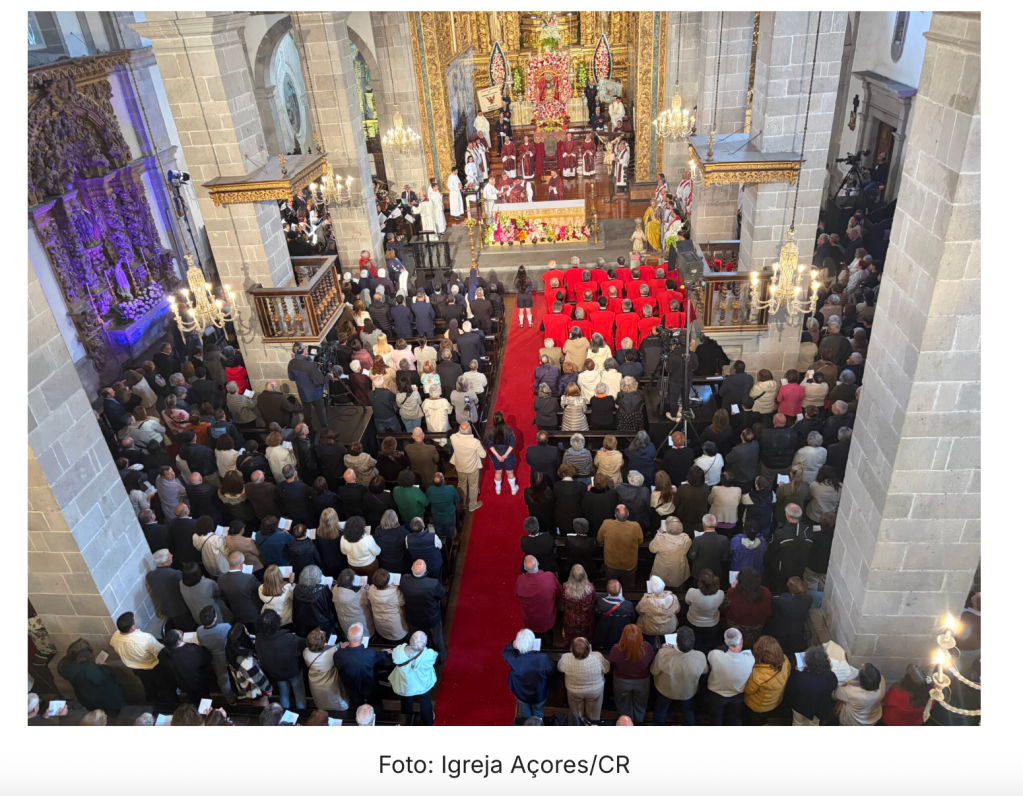
At the heart of the Festas do Senhor Santo Cristo dos Milagres in Ponta Delgada, Cardinal António Marto delivered a deeply reflective homily this morning warning that contemporary society is experiencing a profound crisis of “spiritual, emotional, and social orphanhood” — a condition he argued can only be healed through the rediscovery of God as Father and humanity as a family bound together in fraternity.
“The wars of the world, both small and great, always contain the dimension of orphanhood,” said the Bishop Emeritus of Leiria-Fátima during the Solemn Mass of Senhor Santo Cristo dos Milagres. “The Father is absent when peace disappears. And the greatest remedy for healing this social orphanhood is the rediscovery of God as Father and the rediscovery of ourselves as His children — and therefore all brothers and sisters.”
The celebration took place inside the Church of São José after adverse weather conditions prevented the traditional outdoor mass at Campo de São Francisco. Even so, thousands of pilgrims and faithful continued to participate through screens placed outside the church, many having spent the night in vigil beside the revered image of the Lord Holy Christ of the Miracles Sanctuary.
Throughout the homily, Cardinal Marto described modern society as increasingly marked by loneliness, indifference, aggression, and spiritual disorientation.
“Today, our world carries a profound sense of orphanhood,” he said. “Emotional orphanhood, spiritual orphanhood, social orphanhood. Many people today are orphans — or feel like orphans — even while their parents are still alive.”
According to the Portuguese cardinal, the consequences of this condition reveal themselves daily through indifference toward God and toward others, interior emptiness, selfishness, the erosion of human dignity, and growing social hostility.
“The consequences of this emotional, spiritual, and social orphanhood are what we experience every day: indifference, inner emptiness, selfishness, lack of respect for the dignity of others, aggressiveness that sometimes escalates into insult and violence,” he warned.
Marto prayed that modern civilization — wounded by fragmentation and isolation — might once again recover a sense of spiritual belonging and shared humanity.
“May this civilization, which suffers from such a deep sense of orphanhood, receive the grace to rediscover the Father — God — who gives meaning to life and makes humanity one family: brothers and sisters, close to one another, tender, compassionate, supportive, sowers of the future, builders of a more fraternal and more beautiful world.”
The cardinal also spoke of what he described as a growing “eclipse of God” in contemporary culture.
“My brothers and sisters, we are living through a certain religious indifference today — a kind of eclipse of God, a forgetting of God and His presence in our lives,” he said.
In a pluralistic world, he added, Christianity can no longer survive merely as inherited custom or cultural habit.
“In today’s plural and pluralistic world, we can no longer be Christians simply by tradition — whether family tradition, cultural tradition, or social tradition. It must come from a free and responsible adhesion of heart and mind to the Lord.”
Rejecting the reduction of Jesus Christ to a distant historical figure, Marto insisted that Christian faith is rooted not in memory alone but in the living presence of Christ.
“At the center of our faith is a living person: Jesus Christ risen, God with us, carrying the mystery of His infinite love — the love through which He surrendered Himself on the Cross for us and offers Himself concretely to us today in the Eucharist.”
The cardinal also urged believers to cultivate greater respect, proximity, and civility in public life and debate, particularly at a time when polarization and rhetorical aggression increasingly dominate contemporary discourse.
The mass was concelebrated by D. Armando Esteves Domingues, Bishop of Angra, and the Apostolic Nuncio to Portugal, D. Andrés Carrascosa Coso, alongside dozens of priests.
At the beginning of the celebration, Monsignor Manuel Carlos Alves, rector of the sanctuary, welcomed participants and those following through the media, calling for “the construction of a world without wars.”
Members of the armed forces and security services also participated prominently in the liturgy, including during the Prayer of the Faithful.
The Sunday Eucharist — celebrated on the Sixth Sunday of Easter in the Catholic liturgical calendar — remains one of the emotional high points of the Senhor Santo Cristo festivities, whose centuries-old procession is expected to move through the streets of Ponta Delgada later this afternoon along routes lined with carpets of flowers and passing historic convents and parish churches.
At the center of the procession stands the iconic Ecce Homo image of Senhor Santo Cristo dos Milagres, traditionally believed to have been offered by Pope Paul III to the first community of Clarissan nuns seeking to establish a convent on São Miguel after traveling to Rome during the 16th century.
This year, the image debuts its forty-fourth ceremonial cape, which arrived at the Convent of Nossa Senhora da Esperança on March 17, 2026, donated by Emanuel and Kathy Correia, an Azorean emigrant couple living in the United States.
For thousands gathered in Ponta Delgada — and for countless Azorean emigrants following from abroad — the message delivered this morning extended far beyond theology. In a fractured age marked by uncertainty, loneliness, and exhaustion, Cardinal Marto’s words transformed the ancient devotion of Senhor Santo Cristo into something profoundly contemporary: a call for reconciliation, tenderness, and the rediscovery of human fraternity itself.
Translated and Adapted from a story by Igreja Açores.

 Novidades - The Islands and the Diaspora