

Normality has largely returned to São Jorge Island following the 4.6 magnitude earthquake that shook the island on Sunday, briefly reviving memories of the seismic uncertainty that marked the island’s 2022 sismo-volcanic crisis.
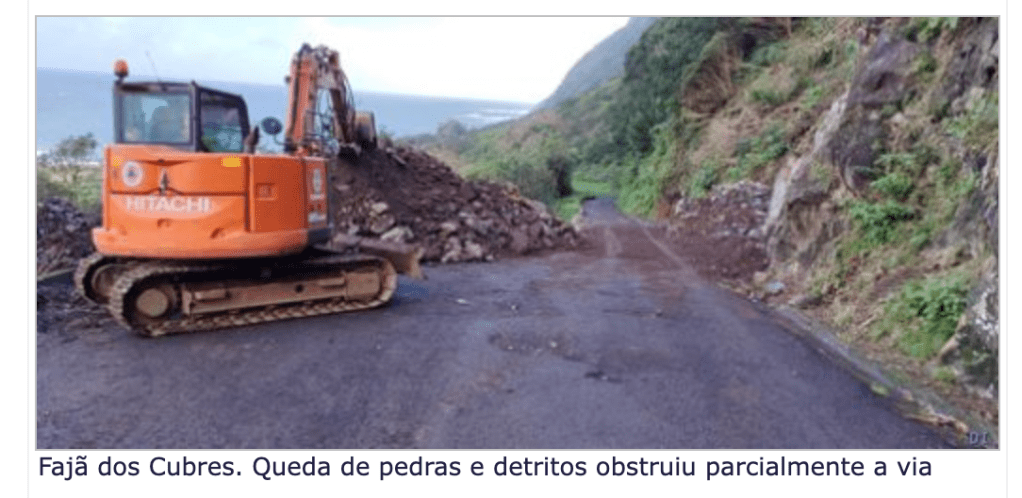
According to the Serviço Regional de Proteção Civil e Bombeiros dos Açores (SRPCBA), the most significant immediate incident was a rockfall along the access road to Fajã dos Cubres in the municipality of Calheta. The collapse partially blocked the roadway, temporarily interrupting circulation in the area.
However, Mayor António Viegas stated that the situation was resolved within hours and emphasized that the landslide was relatively minor.
“There were stones and some wood debris obstructing the road, but it was not a major collapse,” the mayor explained. “Within two or three hours, the road had been cleared and access restored.”
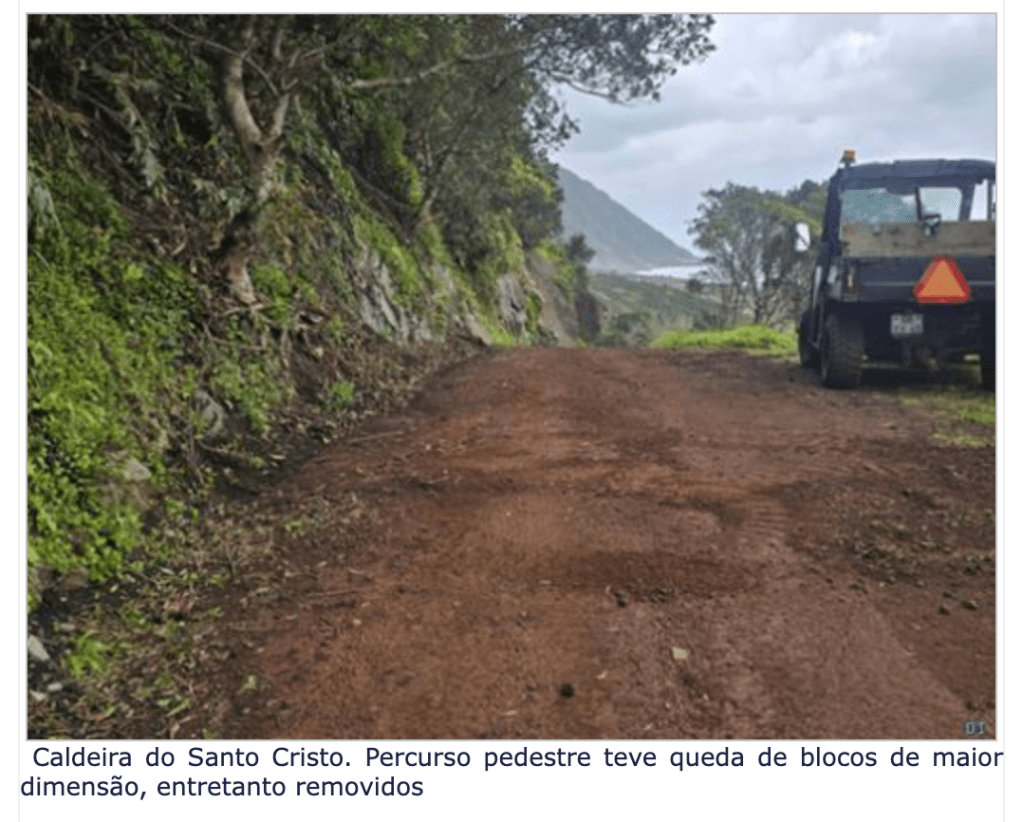
The more substantial debris, according to Viegas, occurred along the hiking trail connecting Fajã dos Cubres to Caldeira de Santo Cristo, where several larger rocks fell onto the path. Cleanup operations carried out by the regional environmental authorities reportedly restored accessibility there as well by Monday morning.
Despite the initial scare, local authorities say the population remains calm — a reaction shaped in part by the island’s recent experience with seismic instability during 2022.
“The people were more frightened in the areas of Topo and Santo Antão,” Viegas noted, explaining that many residents were gathered for Festas do Espírito Santo celebrations and community meals when the earthquake struck. “People came into the streets, naturally alarmed, but the aftershocks were weaker, and at this point the population is calm and not overly concerned.”
The earthquake, recorded at 12:21 p.m., had its epicenter near Santo Antão, according to the Instituto Português do Mar e da Atmosfera (IPMA). No injuries or significant material damage were reported. On the Richter scale, an event measuring between 4.0 and 4.9 is classified as a light earthquake.
In comments to Antena 1 Açores, seismologist Gabriela Queiroz of CIVISA moved to reassure the public, stating that the event does not appear connected to volcanic activity.
“The sismo-volcanic crisis that began in São Jorge in 2022 resulted from a very particular framework involving deep magmatic ascent,” she explained. “This earthquake behaves differently.”
According to Queiroz, Sunday’s tremor was tectonic in nature, resulting from the geological dynamics associated with the separation of tectonic plates in the North Atlantic region.
For many on São Jorge Island, the event served as a reminder of the archipelago’s restless geological reality — islands born of fire and fracture, where daily life continues in quiet coexistence with the immense forces moving beneath the Atlantic floor.
Translated and adapted from a story in Diário Insular-José Lourenço, director

 Novidades - The Islands and the Diaspora